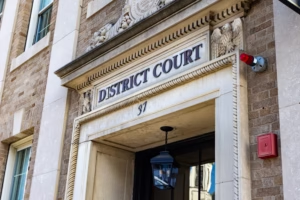


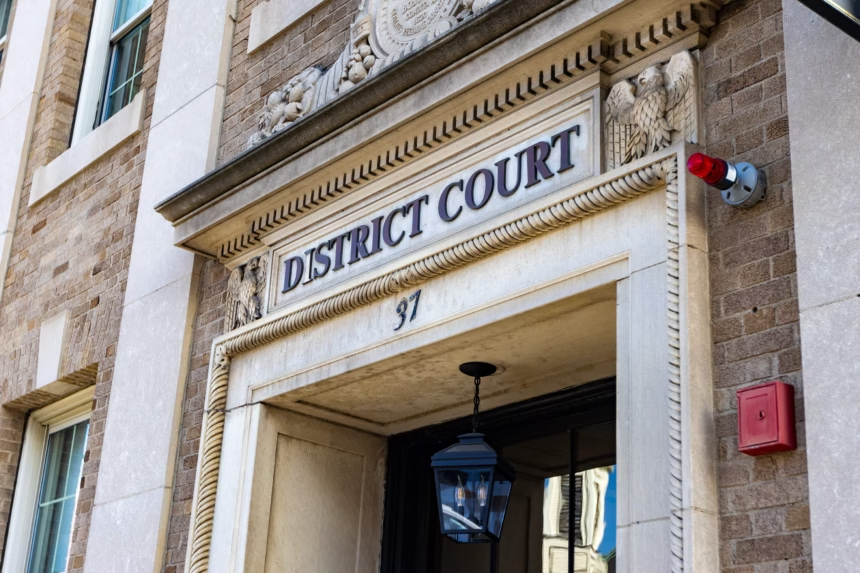
The increased presence of immigration agents in Massachusetts courthouses raises significant concerns about access to justice and the safety of individuals seeking it.
This year, Immigration and Customs Enforcement (ICE) agents have maintained a near-constant presence in Massachusetts courthouses. According to WBUR, they wait outside in unmarked vehicles, interact with clerks, and monitor hearings to identify individuals for apprehension.
Lawyers acknowledge that ICE has previously made courthouse arrests, but the scale has increased significantly under the second Trump administration.
“Before, you didn’t constantly feel immigration’s presence in the building. Today, it’s the first thing you think about,” testified Antonio Vincenty, a public defender working in East Boston, Chelsea, and downtown Boston.
ICE data compiled by the Deportation Data Project at the University of California, Berkeley, and reported by WBUR, show that arrests at Massachusetts courthouses nearly tripled during the first nine months of Trump’s presidency. Between January and mid-October, there were 386 arrests at 46 courthouses statewide, including 147 at Boston’s federal courthouse. In comparison, 131 arrests occurred during the same period the previous year under the Biden administration.
These figures likely underestimate the actual number of arrests.
For example, in East Boston, ICE reports only six courthouse arrests, while lawyers and immigrant rights advocates report witnessing many more.
Judicial Proceedings Undermined
Kevin Hayden, Suffolk County District Attorney, states that the increase in arrests has already affected hundreds of cases handled by his office.
He cites cases where defendants were detained during judicial proceedings and instances where victims and witnesses refused to cooperate due to fear of ICE agents.
“The major concern is the chilling effect this has on our ability to ensure public safety, particularly for victims and witnesses of crimes,” Kevin Hayden stated.
While acknowledging that ICE has legal authority to operate in courthouses, the district attorney added, “Do I wish they would stay out of our courthouses? Absolutely.”
In response, the Massachusetts Trial Court issued a directive in May outlining procedures for interactions with ICE. Court staff may provide public information upon request but must not initiate contact with immigration agents under any circumstances.
The policy allows federal agents to enter courthouse detention areas to make arrests but explicitly prohibits court staff from assisting or interfering with these operations.
This rule was tested on November 21 in East Boston after the arraignment of Alejandro Orrego Agudelo.
A video shared with WBUR shows the 27-year-old man lying on the ground, shirtless, barefoot, and shackled, calling for help as two agents in black hoodies and jeans attempt to restrain him.
As a crowd gathered, a court officer in a white shirt and court badge assisted ICE agents in subduing Orrego and helped push him into the back of a black SUV.
A woman in the crowd called out to the agents: “Where are you taking him? He was released by the court.”
“He has to go before immigration court,” one of the agents responded.
According to Trial Court spokesperson Jennifer Donahue, this incident violates state judicial policy. “Measures are underway to address this violation,” she stated in a release.
Disturbing Testimony in Courtrooms
In another incident in late November at East Boston District Court, an 18-year-old high school student appeared for a hearing. WBUR refers to him by his middle name, Josué, due to concerns about ICE retaliation.
According to his testimony, the judge first called cases involving non-Latinos before addressing those involving Latin Americans, all of whom were Spanish-speaking and required an interpreter. ICE agents allegedly appeared at that time.
Advocates outside the courthouse report that at least two people were arrested during hearings that day. Josué recalls hearing commotion and realizing individuals were being apprehended as they left.
“Of course,” he responded in Spanish when asked if he was afraid. “But thank God, no.”
Josué, who is undocumented and arrived in the United States at age 15, explains that he was able to leave the courthouse while agents were occupied with another arrest.
Calls to Strengthen Restrictions
In Waltham, west of Boston, signs posted on lampposts outside the courthouse state: “ICE arrested our neighbor here.”
“Unfortunately, our courthouse has become an ICE trap,” says Jonathan Paz, founder of the Fuerza Community Defense Network, a group that monitors the federal agency’s activities in the city.
Along with other activists, he is urging the state to impose stricter limits on ICE operations in courthouses. “Why are Massachusetts taxpayer dollars being used to facilitate these arrests in our courthouses?” he asks.
State Senator Lydia Edwards, an East Boston representative and co-chair of the state legislature’s judiciary committee, says she is closely monitoring the situation. She is considering proposing rules requiring ICE agents to present a warrant signed by a judge, similar to measures recently adopted in Illinois and Connecticut.
“Even though we already require a civil detention order, it’s essential to begin a debate on requiring a judicial warrant,” she says.
She also suggests expanding the use of remote hearings. “Not having to physically go to court prevents ICE from making arrests there,” she notes.
“I want our courthouses to be safe and welcoming places for justice, regardless of people’s immigration status,” Lydia Edwards concludes. “That’s my goal.”