



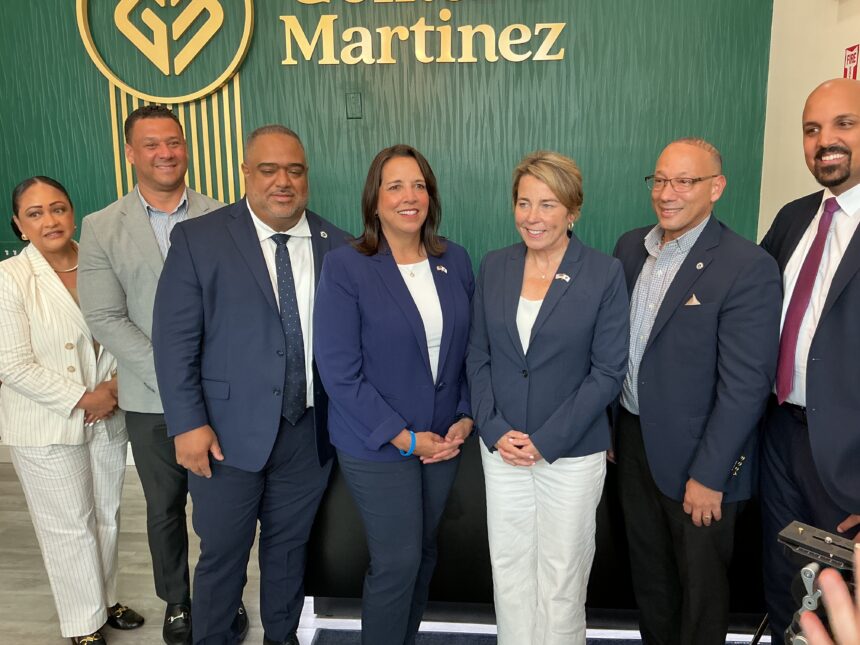
Massachusetts Governor Maura Healey signed the PROTECT Act last week and defended the state’s immigrant protection efforts at a roundtable meeting in Lawrence with lawmakers and community leaders, even as the TPS crisis leaves tens of thousands of residents facing both job loss and sudden loss of health insurance.
The meeting, which took place after Healey met with state legislators and representatives of immigrant organizations, reflected the growing rift between Massachusetts and the Trump administration over who should bear responsibility for the consequences of the Supreme Court’s decision to end Temporary Protected Status for Haitians and the federal government’s broader push for expedited deportations.
Governor Healey spoke directly about the scale of the Massachusetts crisis. “We have 45,000 TPS holders in Massachusetts who are affected by this,” she said, “and a lot of them, you know, they’re working in construction. They’re also working in health care themselves, taking care of people in their homes and in our nursing homes and hospitals. And so, it just makes no sense that Trump is taking these people away and taking their jobs away and taking their livelihoods away.”
But beneath the governor’s commitment to defend TPS holders lies a harder question the state has not yet answered: what happens to health insurance when work authorization ends?
Immigrant workers in Massachusetts, particularly those who held TPS and were employed, often received health insurance through their employers. When work authorization ends, so does employment. When employment ends, so does employer-sponsored coverage. State officials have not announced a plan to bridge this gap, even as the TPS termination accelerates.

The timing of the health insurance loss compounds existing problems. Many TPS holders worked in construction, health care, and service industries—sectors that offer minimal employer-sponsored insurance to begin with. Others were self-employed or worked part-time. Now, without work authorization, they cannot legally obtain employment-based coverage, and many fear that seeking public health insurance programs will flag them for immigration enforcement.
CTN’s Emmanuel Paul raised the question directly. One community representative asked: “Governor, with the TPS ending right now, a lot of people lost their health insurance and because of their status, is there any consideration to help people get health insurance even if they don’t have any legal status?”
Governor Healey did not directly address the health insurance gap. Instead, she reframed the issue as a moral problem for the nation. “The TPS situation that’s happened is so sad. It’s heartbreaking, and you know it’s terrible for these individuals, these people who lose their TPS status. It’s terrible for their families, you know, and it’s also terrible for our economy.”
She then called on the federal government to act, saying: “We’re going to continue to call on the United States Senate to take action to pass a law that will actually extend and restore TPS rights.”
What the governor did not offer was state-level action on health insurance access—a gap that immigrant advocacy organizations have identified as an immediate need.

The PROTECT Act as State-Level Defense
The PROTECT Act, which Healey signed last week, represents the state’s primary legislative response to the acceleration of federal enforcement. The law limits cooperation between state and local law enforcement and immigration agents, restricts ICE access to certain locations, and creates legal protections for immigrants regardless of status.
Healey framed the PROTECT Act not as a protection for undocumented immigrants alone, but as a defense of all Massachusetts residents. “The PROTECT Act was about making sure that our little kids can go to school and get an education, that people can go to the doctors and go to the, you know, healthcare clinic and go get the care that they need. Um, I want people to be able to go to church and worship and feel safe.”
The law passed with support from newly elected Brazilian lawmakers in the Massachusetts legislature—representatives from a community that has itself faced increased deportation pressure in recent months.
For Brazilian workers, construction workers, home health aides, and other TPS-holding populations, the PROTECT Act offers a shield against certain enforcement tactics. It prevents schools, hospitals, and clinics from being treated as enforcement locations and restricts state police cooperation with federal immigration agents. But it does not restore work authorization, extend TPS, or solve the health insurance problem.
Governor Healey emphasized the economic harm of losing TPS protections.
She described an economy dependent on immigrant labor and framed the TPS termination as self-destructive federal policy.
“It’s terrible for these individuals, these people who lose their TPS status. It’s terrible for their families, you know, and it’s also terrible for our economy,” she said.
The statistics support her claim. Massachusetts construction, agriculture, hospitality, and health care sectors all rely on workers, many of whom held TPS. When those workers lose authorization and leave the labor force—either by being deported or by withdrawing to avoid detection—businesses face labor shortages, and consumers face higher prices.
Yet the governor did not detail the economic impact of sudden uninsurance on the state’s health care system, nor did she address what happens when undocumented immigrants forgo preventive care due to fear of detection during a hospital visit.
Healey positioned Massachusetts as locked in an escalating conflict with the Trump administration, not only over TPS, but over the fundamental question of whether state resources should be used for immigration enforcement.
“The Trump administration has been about tearing communities apart. You know, going into neighborhoods, tearing families apart, tearing communities apart,” the governor said. “Um, he’s wrecking the economy.”
She pointed to specific federal actions: Trump’s proposed cuts to health care, education funding, and other federal programs that support low-income residents. She also directly criticized Immigration and Customs Enforcement (ICE) operations.
“ICE, we know ICE has been, and I say this as somebody who was formerly law enforcement, what ICE is doing is so wrong. It’s so wrong. And it’s it’s hurting so many,” Healey said.
This framing, a former law enforcement official criticizing ICE, was notable. Healey used her background as a prosecutor to argue that both sound criminal justice policy and sound immigration policy require protecting communities rather than maximizing deportations.
Who Runs Massachusetts After November?
The governor cast the November election as a choice about the direction of state government on immigration. She outlined a contrast between a governor who will “stand for people here in the state and protecting our residents, protecting our communities” and a governor who would be “a rubber stamp for Donald Trump, who’s pro ICE, who’s pro tariff.”
In 2024, some Massachusetts cities with large immigrant populations—including Lawrence—shifted toward Trump or reduced Democratic margins. Healey acknowledged that trend but dismissed concerns.
“There was a lot of talk in 2024 about Trump making gains among Latino voters. Cities like Lawrence shifting to the right. How concerned are you about that dynamic as you uh look to the fall?” a reporter asked.
“I think the people of Lawrence should best speak to that. We’re not very concerned about it. I think it was just a one-time deal. People have realized that what the Trump administration is doing is not looking out for the best interests of our community,” Healey responded.
The governor highlighted the state’s Latino Empowerment Council as evidence of sustained engagement with immigrant and Latino communities. She noted the council’s role in shaping state policies on education, housing, and economic development.
“Um, we had a Latino Empowerment Council. I don’t know if our co-chair, Joanna Martinez, is still here, but you know, we asked what we need to do. They came forward with recommendations. We’ve implemented a number of those recommendations. Um, we continue to stay on top of this and, you know, we’ll look to find ways to support education, housing, um, economic development, to support our Latino community, which, uh, is very important to the growth and the success of Massachusetts.”
She also referenced housing as a state priority, noting that Housing and Livable Communities Secretary Wana Matias was leading efforts to increase supply and reduce costs—a goal Healey said was essential for immigrant families.
Throughout the discussion, state officials emphasized solidarity as a core state value. Healey said: “In Massachusetts, we look out for each other. We take care of each other. We want to see everybody and every family feel safe in their community and have opportunity and success.”
This language reflects the state’s self-image as distinct from Trump-era federal immigration policy. But it also masks the practical limits of what Massachusetts can do: the state cannot restore TPS, cannot override federal immigration enforcement priorities, and has not yet announced solutions to the health insurance gap.
When asked whether the state would guarantee that the PROTECT Act would be enforced, Healey left no room for ambiguity.
“The law is passed thanks to the legislature. I signed it yesterday. The law is the law, and absolutely it will be enforced. And if Donald Trump tries to challenge the law, he’s going to lose,” she said.
That statement reflects the governor’s confidence that Massachusetts’ legal authority to restrict state cooperation with federal immigration enforcement will hold up in court. It also signals that she expects future litigation over the PROTECT Act.
As the meeting ended, the central question about health insurance for workers losing TPS remained unanswered. The state has defended its TPS-holding residents through the PROTECT Act and federal advocacy, but it has not announced a parallel plan for the immediate health care consequences of a sudden loss of work authorization.
Community advocates, lawmakers, and the governor herself acknowledged the crisis. But between acknowledgment and solution lies a policy gap—one that will grow deeper as more TPS holders lose authorization and slip out of the health care system, either voluntarily out of fear or through employer termination when work authorization ends.
https://ctninfo.com/?p=44128&preview=true
https://www.facebook.com/CaribbeanNewsMedia