



Massachusetts voters went to the polls Tuesday for a primary that reshaped the state’s November ballot, headlined by a hard-fought Democratic Senate contest that returned one of Congress’s most vocal advocates for Haitian immigrants to the general election. Senator Ed Markey defeated Rep. Seth Moulton, and Republican businessman Mike Minogue won his party’s nomination for governor, according to results reported by The New York Times and race calls by The Associated Press.
Below is a comprehensive account of the outcomes, beginning with the Senate race.
The most closely watched race of the night was the Democratic primary for U.S. Senate, and it ended decisively. Markey, 80, defeated Moulton, 47, drawing 453,399 votes to Moulton’s 248,357, roughly 65 percent to 35 percent, with about 78 percent of the vote counted, according to figures reported by The New York Times.
The Associated Press called the race for Markey. Because the Cook Political Report rates the seat as solidly Democratic, Markey is heavily favored to win a third full term in the November general election, where he will face the Republican nominee, John Deaton, who was unopposed in his primary.

The contest inverted the usual generational script in Democratic politics.
Moulton, a former Marine first elected to the House in 2014, ran as the younger, more moderate candidate, arguing that the party was mired in the “status quo” and that it was time for new leadership, a message that unseated some long-serving Democrats in primaries elsewhere this year. Markey, first elected to Congress in 1976 and a champion of single-payer health care and the Green New Deal, was the more progressive of the two and was endorsed by Sen. Elizabeth Warren, Vermont Sen. Bernie Sanders, and Rep. Alexandria Ocasio-Cortez.
Age framed much of the campaign.

At an August debate, Markey insisted he was “more energized” than ever, according to The Guardian, while Moulton seized on a moment when the senator, asked which artificial-intelligence tools he used, referred only to whatever appeared on his phone and tablet — using it to argue the Senate needs a generation fluent in the technologies it must regulate. Moulton had also drawn an explicit comparison to former President Joe Biden, whose troubled 2024 re-election bid and eventual exit from that race, followed by Trump’s return to the White House, intensified Democratic anxieties about the age of the party’s leaders. Shortly before the primary, Moulton apologized for remarks he had made about transgender athletes, a position at odds with much of the party’s base. Markey, for his part, had fended off a high-profile primary challenge once before, defeating then-Rep. Joe Kennedy III in 2020.
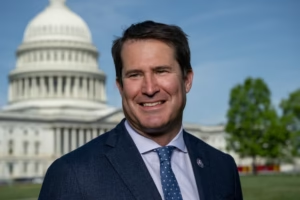
Markey’s general election opponent, John Deaton, is a familiar name in Massachusetts politics.
A cryptocurrency advocate and attorney, Deaton was the Republican nominee against Sen. Warren in 2024 and appeared alongside Moulton and third-party candidate Joe Tache of the Party for Socialism and Liberation at a U.S. Senate candidates’ forum in Lawrence in August that CTN covered. Given the state’s Democratic lean, he enters the fall as an underdog.
For Haitian immigrants in Massachusetts and nationwide, Markey’s victory will probably keep in office the senator who has been among the most active in Congress in the fight over Temporary Protected Status.
Over the past year, Markey repeatedly used his Senate seat to try to preserve protections for Haitians facing deportation. In June, he and Delaware Sen. Lisa Blunt Rochester, joined by Senate Democratic leader Chuck Schumer and more than a dozen colleagues, introduced legislation to designate Haiti for TPS, an effort to shield more than 300,000 Haitians. “It’s not safe for Haitians to return to Haiti,” Markey told The Boston Globe, arguing it would be “inhumane” to send people back to a country the U.S. government itself warns citizens against visiting.
Governor: Minogue Wins the GOP Nomination to Challenge Healey
In the race for governor, Michael Roger Minogue defeated Brian Shortsleeve for the Republican nomination, according to results reported by The New York Times and a call by The Associated Press.
Minogue took roughly 76 percent of the vote — 154,059 to Shortsleeve’s 48,384 — with about 75 percent counted. He will face Democratic Gov. Maura Healey, who was unopposed in her primary as she seeks a second term, in November.
Minogue is a West Point graduate and Army veteran of Operation Desert Storm who later served nearly two decades as chairman, president, and chief executive of Abiomed, a Danvers-based medical device company, according to his campaign biography as reported by Patch.
Shortsleeve, a former Marine and venture capitalist, had served as chief administrator of the MBTA under former Gov. Charlie Baker. Both men supported President Trump in 2024. “We are going to make history,” Minogue told supporters Tuesday night, according to CBS News Boston, while in a statement carried by WAMC, he declared, “Change is coming November 3rd.” Shortsleeve candidate November 3rd for party unity, urging Republicans to rally behind Minogue.
The Cook Political Report rates the governor’s race as solidly Democratic, and most polls show Healey with a significant lead heading into the fall. Immigration has already surfaced as a campaign theme: Minogue’s platform, according to Patch, pledges to end the state’s “right to shelter” access for immigrants without legal status. Healey, for her part, framed the coming contest around the president, telling supporters, according to GBH News, that a candidate who supported and funded Trump “can not be governor of Massachusetts.”
U.S. House: An Open November 3 to Koh; Incumbents Hold
The most consequential congressional contest was in the 6th District on the North Shore, the seat Moulton gave up to run for Senate. In a crowded six-way Democratic field, Dan Koh, a former aide in the Biden administration, won the nomination, defeating a group that included state Rep. Tram Nguyen — whose family came to the United States as refugees from Vietnam — along with Bethany Andres-Beck, John Beccia, Jamie Belsito, and Mariah Lancaster, according to CBS News Boston. The Republican nominee, Jones, was unopposed.
The 6th District field drew wide attention as one of the few open congressional seats in New England, and its outcome will send another son of immigrants toward Washington from the North Shore. Koh, who served as chief of staff to former Boston Mayor Marty Walsh before joining the Biden White House, prevailed in a race that also featured Nguyen, a state representative and one of the legislature’s few members from a refugee family. The seat is expected to remain Democratic in November.
In the 8th District, Rep. Stephen Lynch, 71, who has held the South Boston-anchored seat for 13 terms and has long-standing ties to organized labor, fended off a challenge from Patrick Roath, a 39-year-old attorney who argued for generational change in a changing district, with NBC News projecting Lynch the winner; he led roughly 57 percent to 43 percent. Elsewhere, Democratic incumbents held their seats where challenged: Richard Neal led about 54 percent to 46 percent in the 1st District, Jake Auchincloss won roughly 73 percent in the 4th, and William Keating took about 77 percent in the 9th. Rep. Katherine Clark, the House Democratic whip, won about 74 percent in the 5th.
Notably for the Haitian community, Rep. Ayanna Pressley of the 7th District, a co-chair of the House Haiti Caucus who has worked alongside Markey to extend Haitian TPS, ran unopposed, as did Reps. Jim McGovern in the 2nd and Lori Trahan in the 3rd.

Massachusetts’ other statewide Democratic officeholders faced no primary opposition and advanced to November uncontested: Attorney General Andrea Campbell, Auditor Diana DiZoglio, Secretary of State William Galvin, and Treasurer Deborah Goldberg. Lt. Gov. Kimberley Driscoll, running on Healey’s ticket, was also unopposed in the Democratic primary. On the Republican side, Shawn Oliver won the lieutenant governor primary with about 92 percent of the votes, according to results reported by The New York Times.
Two district attorney contests were among the more competitive races on the ballot.
In Suffolk County, incumbent District Attorney Kevin Hayden faced a field that included Rachael Rollins, who previously held the office, along with challenger Linda Champion; Hayden led with about 51 percent in partial returns, according to results reported by The New York Times, though the race was still being counted. In Norfolk County, seven Democrats competed to replace the retiring Michael Morrissey, and the race was tight, with Perkins narrowly ahead of Deitch, 28 percent to 26 percent, in incomplete returns.
Most state legislative incumbents who faced primary challenges survived, but a few competitive results stood out, several in districts with large immigrant populations.
In the 16th Essex District, centered on Lawrence, a city with one of the state’s largest immigrant communities, challenger Reyes ousted incumbent Rep. Paulino, taking about 66 percent of the vote with nearly all ballots counted, according to results reported by The New York Times.
In the Lowell area, where CTN recently covered a candidate forum on immigration and other community priorities, the results broke for two familiar names: John Drinkwater won the open 17th Middlesex Democratic primary with about 59 percent, and Rep. Tara Hong held the 18th Middlesex seat with about 67 percent against challenger Chau.
Among contested state Senate races, incumbent Sen. Nick Collins led in the 1st Suffolk District with about 56 percent, and several longtime incumbents in Boston-area and Middlesex districts held on in close votes, including Sen. William Brownsberger, who led about 52 percent to 48 percent, and Sen. Michael Rush, ahead by a similar margin. In an open 2nd Middlesex Senate contest, Uyterhoeven led a multi-candidate field. In the state House, most incumbents ran unopposed or won comfortably; among the closer results, Rep. Manny Cruz and other Democrats in immigrant-heavy Essex County districts advanced, and in the 34th Middlesex, challenger Mbah led a Medford-area open seat with about 54 percent. Where returns remained incomplete, several of these outcomes were not yet final as of the latest available counts.
With the primaries settled, Massachusetts heads toward a November 3 general election in which both contests lean heavily Democratic, by the Cook Political Report’s ratings.
Markey enters as the strong favorite over Deaton in the Senate race, and Healey as the favorite over Minogue for governor. However, both Republicans have signaled they intend to make immigration and the cost of living central to their campaigns.
For the Haitian community, the stakes extend well beyond any single race. The primary unfolded as TPS ended for roughly 350,000 Haitians nationwide and as the federal government began carrying out deportation flights to Haiti — a country the State Department warns Americans not to visit, and where the United Nations estimates gang violence has displaced some 1.5 million people. The lawmakers from Massachusetts who returned to the general election ballot Tuesday, including Markey and Pressley, have pledged to keep fighting to restore those protections, even as legal and legislative avenues remain narrow.
This article reports preliminary results as of the latest available counts; some races with incomplete returns may not reflect the final outcome. It is provided for general information and is not legal advice.
https://ctninfo.com/markey-wins-sena…the-2026-results/
https://www.nytimes.com/interactive/2026/09/01/us/elections/results-massachusetts-primary.html
This article was originally written in English. Other language versions are produced using AI translation software, and errors are possible — the English version is authoritative. CTN also uses AI to convert text into audio.