

There’s good news for CNAs and other health care workers in Massachusetts.
On Monday, Governor Maura Healey announced a major tax change for the state’s most vulnerable health care workers.
Thousands of Personal Care Attendants (PCAs) will no longer have to pay federal or state income taxes, which could save them $5,000 or more each year, according to the governor’s office. To illustrate, consider a live-in PCA earning $21 per hour. Under the new tax exemption, this PCA could see a roughly 10% increase in take-home pay, significantly easing day-to-day budgeting and financial planning.
About 18,000 personal care attendants who live with the people they care for will be exempt from federal and state income taxes.
“We are working every day to identify ways to make life more affordable for the people of Massachusetts,” Governor Healey said in a statement. “Personal Care Attendants do incredibly challenging work to care for the most vulnerable among us, and they shouldn’t have to also worry about being able to afford to meet their own basic needs.”
A Long-Awaited IRS Decision
The IRS ruling is a significant milestone for caregivers, providing crucial support at a time when many are re-evaluating their roles in the field. This exemption comes from an Internal Revenue Service (IRS) decision requested by Massachusetts’ PCA Workforce Council, which is part of the Executive Office of Health and Human Services. The council asked the IRS to confirm that money earned by PCAs who live with MassHealth care recipients, the state’s Medicaid program, could be counted as “Difficulty of Care” payments (essentially compensation for the extra strain of 24/7 live-in support).
This rule, set by IRS Notice 2014-7, allows some home care income to be excluded from federal taxable income. Because Massachusetts usually follows federal tax rules, these payments are also not taxed by the state, according to the State House News Service.
Only PCAs who live in the same home as the person they care for can get this exemption. Out of about 60,000 PCAs working through the MassHealth program, around 18,000 will qualify for this tax break, according to the Boston Globe.
A Workforce Facing a Hiring Crisis
This change comes at a time when the home care field is struggling to hire and keep workers. According to recent data, the vacancy rate in the home care sector in Massachusetts stands at a critical 15%, with a turnover rate of nearly 30% annually. These figures underline the staffing challenges faced by the industry and highlight the potential of tax relief to alleviate some recruitment pressures.
Unions for PCAs have pointed out that higher living costs and competition from other health care jobs make things tough for these workers.
“This exemption brings substantial tax relief for trained live-in friends and family members who are providing crucial health care services for MassHealth members with disabilities,” said Dr. Kiame Mahaniah, Secretary of Health and Human Services and former chair of the PCA Workforce Council.
The PCA program is a key part of the state’s long-term care and support system.
The care that PCAs, also called CNAs, provide helps over 50,000 MassHealth members with disabilities stay independent at home and in their communities, instead of moving to institutions.
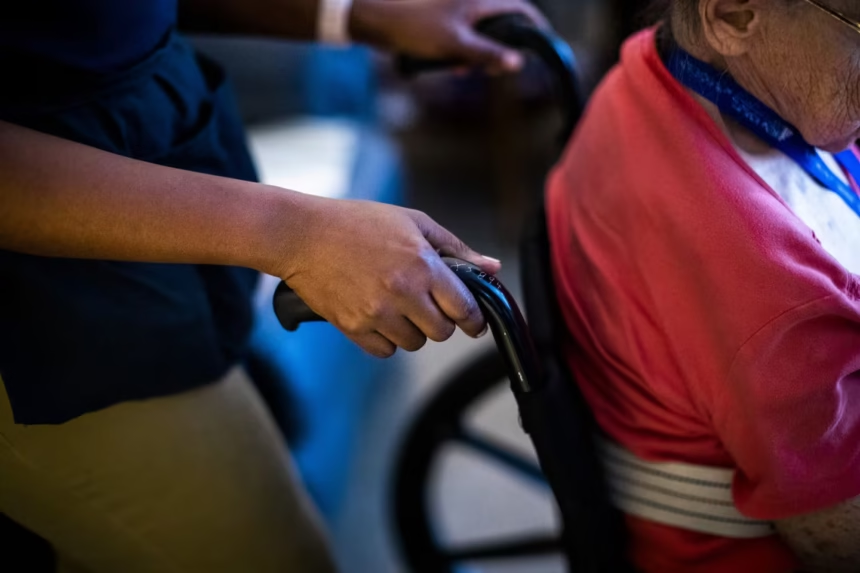
PCAs earn between $19.50 and $22.40 per hour and help people with daily tasks such as bathing, dressing, and moving around.
Ongoing Changes Since 2023
Since 2023, the Healey-Driscoll administration has made several positive changes for PCAs. These include raising hourly wages, implementing a seniority system, offering extra pay on some holidays, and beginning work on a retirement plan.
“The mission of the PCA Council is to ensure access to a quality workforce,” explained Jocelyn Gordon, Executive Director of the PCA Workforce Council. “By securing this tax relief, we’re not only enabling PCAs to keep more of their income, but we are significantly improving our state’s ability to hire and retain top-quality workers who do this critical work.”
Program Costs Are Going Up
The cost of the PCA program has increased significantly in recent years, from $1.2 billion in 2020 to $1.6 billion in 2023. It could reach $2 billion by 2027, according to the State House News Service. Most of this growth is due to an aging population, so the Healey administration is considering possible limits on the program. While state officials expect the revenue loss from the tax exemption to be small, it’s important to consider it alongside the $400 million increase in program costs over the last three years. This comparison invites policymakers to weigh the potential short-term revenue loss against continued program growth.
State officials haven’t said how much tax money will be lost because of this exemption, but they expect the impact to be small. However, it is essential to consider what public services these ‘small’ missing tax dollars might otherwise fund. From education and infrastructure to healthcare and social services, the potential opportunity costs need to be acknowledged in this context. This trade-off highlights the societal value of in-home care and the financial respite it provides caregivers, and it is crucial and deserves a balanced analysis that weighs the benefits of relieving financial strains on caregivers against the potential limitations on public service funding.
For program beneficiaries, this measure represents crucial support. Paul Bureau, a program beneficiary, testified, ‘I have been utilizing PCA services for 38 years, and in that time, I was able to attend college, work full time, and be a contributing member of my community.’ One can visualize Paul steering his powered wheelchair to a college lecture hall, emblematic of the independence these services facilitate. ‘This new ruling will ensure additional access to PCAs in a time of a national shortage of home care workers!’
PCAs who qualify can claim this exemption when they file their 2025 taxes and can start changing their withholdings in January.
Sources: Massachusetts Governor’s Office, Boston Globe, State House News Service, Mass.gov