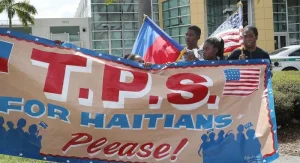



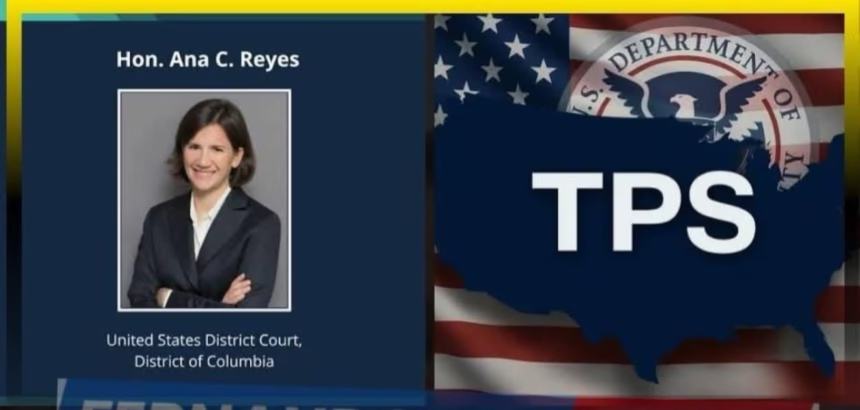
Federal Judge Ana C. Reyes made clear on Thursday, in no uncertain terms, that she would not reverse her decision protecting Haitian beneficiaries of Temporary Protected Status.
During a hearing that began at 10 a.m. at the federal court for the District of Columbia, the judge denied the Trump administration’s request to stay her February 2 order, which kept TPS for Haiti in effect for the duration of the litigation.
“Motion denied.” With those two words, Judge Reyes put an end to the administration’s attempt to reinstate the TPS revocation. She specified that she would issue a formal written decision before February 19, but the message delivered in the courtroom left no room for ambiguity: Haitian TPS is preserved.
The judge indicated that the government was free to take the matter to the court of appeals if it wished, but that, as far as she was concerned, her position remained unchanged. The statement was a direct response to repeated threats from the Trump administration, whose DHS spokesperson Tricia McLaughlin had vowed after the February 2 decision that “the final word will not come from an activist judge legislating from the bench.”
Thursday’s hearing was marked by tense exchanges between the judge and government attorneys.
From the opening of arguments, each side presented its case, and Judge Reyes wasted no time pressing the administration’s representatives with pointed questions.
The judge notably questioned the government on a revealing scenario: had the court not blocked the end of TPS, would the administration have immediately initiated deportation proceedings against Haitian beneficiaries? She also posed a question that laid bare the potential absurdity of the situation: if a TPS beneficiary were deported and the court subsequently ruled in their favor, would the administration allow that person to return to the United States?
These questions, which the government largely left unanswered, underscored the irreversible consequences of lifting protections for hundreds of thousands of people.
The Government Suffers No Harm, the Judge Rules
On the central question of harm, Judge Reyes was categorical: the government suffers no injury, no concrete prejudice from Haitian beneficiaries retaining their TPS while the case works its way through the courts.
This conclusion echoed the argument the day before by the plaintiffs’ attorneys in their opposition brief, who pointed out that the declaration filed by ICE Assistant Director Liana Castano confirmed that immigration operations were continuing normally despite the court’s order.
The judge also highlighted a damning fact for the administration: Homeland Security Secretary Kristi Noem had not consulted any other federal agency — neither the State Department nor any other relevant department — before deciding to end TPS for Haiti. This failure to meet the legal obligation to consult, already underscored in the 83-page opinion issued on February 2, weighed heavily in the judge’s reasoning.
As attorney Andrew Tauber revealed in an interview with WBUR, “the entirety of the consultation amounted to a one-line email from DHS and a one-line response from the State Department, which did not even address conditions in Haiti.”
Driver’s License Access for TPS Beneficiaries
The hearing also addressed a practical issue affecting the daily lives of TPS beneficiaries: access to driver’s licenses. Government attorneys informed the court that motor vehicle departments in several states were refusing to issue or renew driver’s licenses for TPS holders, despite the court order maintaining their legal status.
Judge Reyes responded firmly. She stated that there was no reason for a TPS beneficiary to be denied a driver’s license and ordered DHS to issue clear directives to all licensing agencies across the country, so that Haitian TPS beneficiaries can fully exercise their rights, including the right to drive.
The most striking moment of the hearing was arguably Judge Reyes’s threat of sanctions against the Trump administration.
The judge warned that she was prepared to take coercive measures if the Department of Homeland Security continued to ignore or incompletely enforce her order protecting Haitian TPS beneficiaries.
The judge explicitly stated that if DHS failed to comply with her decision concerning driver’s licenses, work authorization, or protections from deportation, she would impose significant sanctions.
Death Threats and Disparaging Comments Directed at Judge Reyes
In a moment of rare candor for a federal judge, Judge Reyes addressed the criticism and pressure she has faced since her February 2 decision. She revealed that she has received numerous threats against her life and the lives of her family members. But these intimidation attempts, she assured, are not enough to frighten her or sway her position.
“I am an immigrant,” Judge Reyes declared, responding to those who have questioned her impartiality because of her background. “My decision in favor of TPS beneficiaries has nothing to do with my origins as an immigrant.” She added that no one, whoever they may be, could dictate how she does her job or tell her what decisions to make. The judge reaffirmed that she would continue to stand on the side of the law, without yielding to any pressure.
These remarks come at a time when several federal judges across the country have been the target of sharp criticism from the Trump administration over their decisions blocking various immigration policies.
Judge Reyes’s formal written decision is expected before February 19.
The government has already appealed to the D.C. Circuit Court of Appeals. It is threatening to take the case directly to the United States Supreme Court, as it did in a similar case involving TPS for Venezuela.
For the more than 350,000 Haitian TPS beneficiaries, Thursday’s hearing provided a measure of relief while leaving some uncertainty about the future.
In the meantime, Judge Reyes has sent a powerful and reassuring message: as long as she presides over this case, the law will prevail over politics, and Haitian TPS beneficiaries will remain protected. While uncertainty about the final outcome persists, the hearing has reaffirmed that their rights are being actively defended in court. The next steps will depend on upcoming written decisions and the progress of ongoing appeals, leaving many watching closely for further developments.