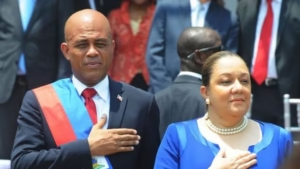



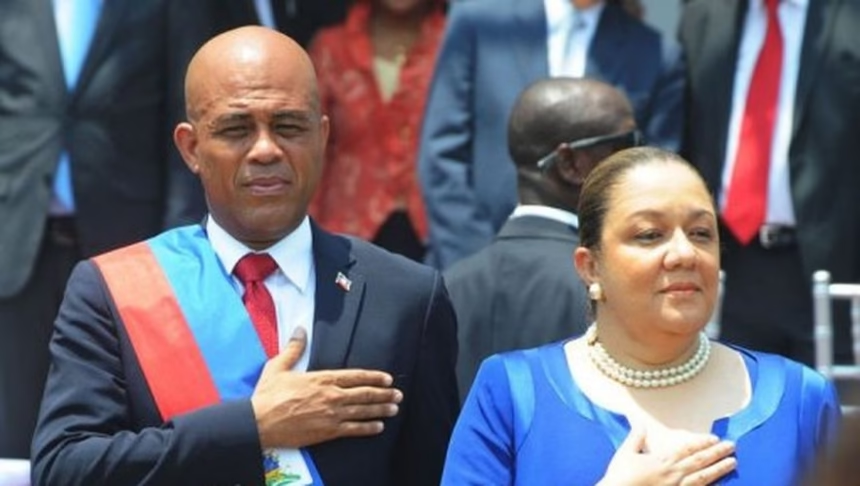
An explosive investigation by Haiti’s Corruption Control Unit (ULCC) submitted to judicial authorities on Monday, December 8, 2025, alleges that former president Michel Joseph Martelly (2011-2016) committed grave and systematic irregularities in his asset declarations. The investigative commission concludes that the former leader committed “discrepancies,” “significant omissions,” and deliberately provided false information, and recommends initiating criminal proceedings for “fraud.”
The report immediately highlights violations of legal deadlines. Martelly’s entry declaration, dated July 11, 2011, was submitted well after the mandatory 30-day window that expired on May 14, 2011, the day of his inauguration. More significantly, his exit declaration was filed in January 2018—nearly two years after his mandate ended in February 2016—constituting a “manifest violation” of the February 12, 2008 law. Both documents are deemed “null and void.”
The heart of the investigation centers on the concealment of assets. While Martelly declared four term deposits and three checking accounts at the time of taking office, bank statements obtained from CAPITAL BANK, BNC, SOGEBANK, and UNIBANK reveal that the Martelly couple held at least 20 bank accounts, along with a credit card. A $39,921 loan borrowed by his wife, Sophia Saint-Rémy Martelly, in September 2011, was never declared.
Upon leaving office, only eight accounts were declared, compared to seventeen accounts actually identified by the ULCC. The commission characterizes this under-reporting as “incomplete and false,” indicating “a deliberate intention to provide false information.”
Undisclosed Real Estate and Vehicles
The report documents the unexplained absence of several properties from the entry declaration:
- An apartment in Puits-Blain (Pétion-Ville), purchased in 1991 for 180,000 gourdes
- Two properties on Rue Moïse in Pétion-Ville, acquired in 2005 and 2007 for 120,000 and 400,000 US dollars, respectively
These assets, though predating his presidency, appear only in the 2018 exit declaration. The ULCC characterizes this pattern as potential “falsification” and “fraud.”
No explanation was provided regarding the financing of a house purchased for $180,000 in Bois-neuf, Saint-Marc, in 2012, during his presidential term.
Regarding vehicles, those declared in 2011 “disappeared” from the 2018 declaration without evidence of sale, while vehicles registered in his wife’s name acquired before 2011 were never disclosed.
Income Declarations Contradict Available Evidence
The analysis of income reveals glaring contradictions. Upon taking office, Martelly declared an annual artistic income of $100,000 but elsewhere indicated family income of the same amount, creating confusion. Upon leaving office, he declared conference income ($125,000) and rental income ($150,000) without providing any supporting documentation. The report also notes the absence of declarations for income received by his wife as Presidential Advisor (1,538,646.10 gourdes).
Concealed Business Interests
The investigation reveals that Martelly declared no ownership stakes in companies such as EUROPA VOCE GROUP S.A. or TRANSCOMEX S.A. upon entering office. Upon leaving office, only M&S CONSULTING S.A. is mentioned, without justification, while other holdings remain undisclosed.
Formal Recommendations for Prosecution
Faced with this pattern of “discrepancies, omissions, and false declarations,” the ULCC investigation commission formally recommends:
- Initiating public legal action against Michel Joseph Martelly for “fraud” and “false asset declaration,” pursuant to articles in the 2008 law and the Haitian Penal Code
This case, which exposes serious breaches of transparency obligations for Haiti’s highest office, could reignite debate over impunity and accountability in Haitian political life. The investigation documents alleged violations spanning both his entry and exit from office, suggesting a pattern rather than isolated irregularities.
As of publication, no immediate response from the former president has been recorded. The case now moves to judicial authorities to determine whether formal charges will be filed.