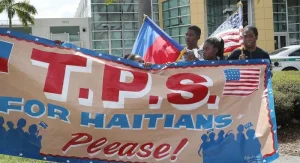



The second day of the federal hearing on Temporary Protected Status (TPS) for Haitian nationals began with strong remarks from Judge Ana C. Reyes, who stated that Haiti’s security and humanitarian conditions remain unsafe for the return of TPS beneficiaries.
At the start of the proceedings, Judge Reyes said it was “clear” that conditions in Haiti are not suitable for the return of TPS-protected nationals. “The reports are clear: the country is not safe at this time,” she said, citing assessments from international organizations and U.S. government agencies.
Judge Reyes added that she was “almost certain” the Trump administration knows conditions in Haiti remain dangerous, yet still seeks to terminate TPS for Haitians. She indicated the record points to a political decision to end the program, regardless of the situation on the ground.
Judge Reyes repeatedly highlighted a key contradiction: how can the United States claim Haitians can safely return while officially acknowledging that Haiti is largely controlled by armed gangs?
In response, government attorneys argued that some areas are considered “safe” and that “significant efforts are underway to put the country back on track.” Judge Reyes rejected this argument, stating it does not withstand scrutiny given the available evidence.
Citing a State Department report, Judge Reyes noted that gangs are the main source of instability in Haiti, threatening both the country and the wider region. The report states that these groups can destabilize Haiti in the long term and seek to overthrow the authorities.
“Given the acknowledged capacity of gangs to control territory and threaten regional stability, how can the government reasonably conclude that the country is ready to receive tens, or even hundreds, of thousands of returning people?” Judge Reyes asked.
Discovery Process Comes Under Scrutiny
The second day of hearings was also marked by an in-depth focus on the “discovery” process, the judicial procedure through which parties are required to produce documents relevant to the contested decision.
Judge Reyes stated she will closely review public statements by Donald Trump and his team regarding Haitian TPS, including those made before his reelection. She said these statements may show the administration intended to end TPS before seriously assessing Haiti’s security conditions.
She emphasized that the government has provided little information about current conditions in Haiti, relying instead on past events or speculative future developments without a concrete analysis of present realities. This lack of transparency, she said, reinforces the impression that the decision was predetermined.
The court ordered the government to produce, by Friday or earlier, all documents related to the process leading to the termination of TPS for Haitians, including statements by Donald Trump and his team from the pre-election period through inauguration day.
Judge Reyes also required the Department of Justice to appoint an experienced official to compile a complete inventory of all materials produced during discovery. She warned that withholding documents, procedural tactics, or political gamesmanship would not be tolerated and that violations would have consequences.
Disputed Figures on TPS Beneficiaries
The actual number of Haitian TPS beneficiaries was a key topic. Some U.S. government databases report over 568,000 Haitians currently hold TPS, while the Federal Register cites about 352,000. Judge Reyes highlighted this inconsistency.
The judge demanded immediate clarification, stressing that accurate figures are essential to assess the true impact of the government’s decision.6 Haitians had obtained TPS through fraud. Judge Reyes noted that this represents roughly 0.4 percent of all Haitian TPS beneficiaries, based on the government’s own data.
She then asked whether, based on fraud allegations involving less than 0.4 percent of beneficiaries, the Secretary of Homeland Security can reasonably invoke national security concerns to justify terminating TPS for all Haitian nationals.
At the end of the second day, Judge Ana C. Reyes reiterated her intent to thoroughly review all factual and documentary evidence before ruling. The hearings continue in a highly charged legal and political atmosphere, with the future of hundreds of thousands of Haitians in the United States at stake.
Beyond immigration policy, the case raises broader questions about administrative procedure, government transparency, and how humanitarian realities are considered in public decision-making.