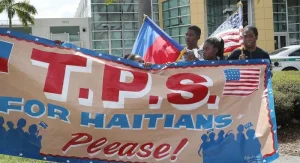



The case surrounding Temporary Protected Status (TPS) for Haitian immigrants in the United States will be reviewed by a federal court this Tuesday, January 6, 2026, during a closely watched hearing in Washington, D.C. The stakes are high for hundreds of thousands of Haitian nationals who face the potential loss of their legal protection and authorization to work in the United States.
According to a statement released by the Institute of Services to Immigrant Families (ISFI), a community-based organization advocating for immigrant rights, the hearing will take place before a federal judge on Tuesday. ISFI has called on members of the Haitian community and their allies to mobilize and attend the hearing, which it describes as “critical to the future of Haitians in the United States.”
During the hearing, attorneys representing Haitian TPS beneficiaries are expected to present arguments challenging the Trump administration’s decision not to renew the humanitarian program. TPS provides temporary protection from deportation and grants work authorization to nationals of countries experiencing armed conflict, natural disasters, or other extraordinary conditions.
Haiti has been designated for TPS since January 2010, following the devastating earthquake that killed more than 200,000 people. Since then, the designation has been extended multiple times by both Democratic and Republican administrations due to persistent political instability, widespread insecurity, and recurring humanitarian crises.
The current decision not to extend TPS for Haitians is part of a broader restrictive immigration policy pursued by the Trump administration, which argues that conditions in several TPS-designated countries no longer warrant continued protection.
Growing Pressure From DHS on Haitian Beneficiaries
Alongside the ongoing court proceedings, the Department of Homeland Security (DHS) has begun circulating official notices urging Haitian TPS holders to prepare to leave the United States within roughly one month, according to information shared by community organizations and immigration attorneys.
For legal advocates representing TPS beneficiaries, Tuesday’s hearing will be a critical opportunity to demonstrate that conditions are far from suitable for the return of more than 500,000 people to Haiti—a country mired in an unprecedented, multidimensional crisis.
Their arguments are grounded in assessments from the United Nations, the International Organization for Migration (IOM), and international humanitarian groups. Haiti is currently grappling with extreme insecurity marked by the proliferation of armed gangs, the collapse of state institutions, and a deepening humanitarian emergency.
According to United Nations data, more than 80 percent of the Port-au-Prince metropolitan area is under the control of armed groups. Hundreds of thousands of people have been internally displaced, while access to health care, education, and food remains severely limited.
The United States itself has acknowledged the severity of the situation through its own travel advisories, which warn U.S. citizens against traveling to Haiti due to the extremely dangerous security environment.
A Hearing Presided Over by Judge Ana C. Reyes
The hearing will be presided over by Judge Ana C. Reyes, who was appointed in 2023 by President Joe Biden to the U.S. District Court for the District of Columbia. According to an informational flyer distributed by ISFI, Judge Reyes will hear arguments from both sides before determining whether the administration’s decision complies with federal law and the United States’ humanitarian obligations.
TPS advocates argue that ending the program would expose entire families to deportation, including individuals who have lived in the United States for more than a decade, are fully integrated, work legally, and contribute to the American economy.
Beyond the legal debate, the case raises significant humanitarian and social concerns. Ending TPS for Haitians could lead to family separations, the loss of tens of thousands of jobs, and added strain on a country that is currently unable to absorb the large-scale return of its diaspora under dignified and safe conditions.