



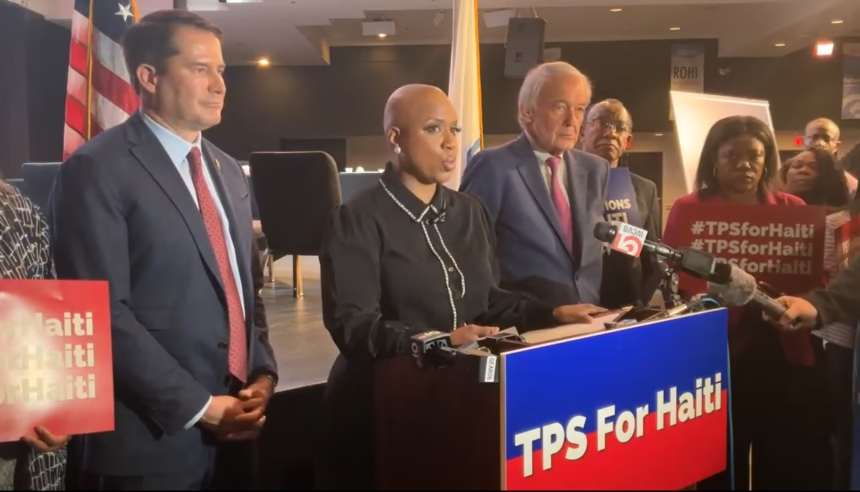
Democratic Representative Ayanna Pressley of Massachusetts’s 7th District, co-chair of the Haitian Caucus in the U.S. Congress, announced Thursday the filing of a discharge petition aimed at forcing a vote on extending Temporary Protected Status (TPS) for Haitian nationals in the United States.
Contents
“I just introduced a discharge petition to force a vote on extending TPS for Haiti,” the congresswoman said in a statement. “Our Haitian neighbors deserve to continue their essential work and contributions to our communities. And if Donald Trump won’t act to protect Haitian lives, then Congress must.”
What Is a Discharge Petition?
A discharge petition is a rare and complex parliamentary procedure that allows members of the House of Representatives to bypass majority leadership and congressional committees to bring a bill directly to a floor vote.
Under normal congressional procedure, it is the Speaker of the House and committee chairs who decide which bills will be considered and put to a vote. A bill can therefore remain indefinitely stalled in committee if the majority leadership refuses to place it on the agenda.
A discharge petition allows a bill to be “freed” from this procedural deadlock. To succeed, it must gather the signatures of 218 members of Congress—an absolute majority of the 435 representatives in the House.
Historically, discharge petitions rarely succeed. Since 1931, fewer than 30 discharge petitions have obtained the required 218 signatures, and of those, only a handful have actually led to the passage of a law. However, Congress has adopted at least two discharge petitions since Donald Trump’s return to the White House.
Republicans control Congress with only 218 seats compared to 213 for the Democrats. Four seats are currently vacant: Representative Sylvester Turner (D-TX) died in March 2025; Mikie Sherrill (D-NJ) resigned in November 2025; Marjorie Taylor Greene (R-GA), a former fervent MAGA supporter, resigned on January 5, 2026; and Representative Doug LaMalfa (R-CA) died on January 6, 2026.
The main difficulty is that members of the majority party are generally reluctant to sign such a petition, as doing so amounts to defying their own leadership. In the current context, with a Republican majority in the House, Representative Pressley will need to convince not only all Democrats but also several Republicans to sign the petition.
However, some discharge petitions have succeeded in the past when an issue transcended partisan lines. In 2015, for example, a discharge petition helped revive the debate on NSA surveillance reform.
Can This Petition Save Haitian TPS?
The crucial question is whether this petition can succeed in time to preserve TPS for Haitians, which is set to expire on February 3, 2026.
The answer is complex. Even if the petition obtained the required 218 signatures, several obstacles remain.
First, the process takes time. Once filed, the petition must remain with the clerk’s office for 30 legislative days before signatures can be collected. This delay alone far exceeds the TPS expiration date.
Second, even if a vote were obtained in the House and the bill passed, it would then need to pass the Senate and be signed by President Trump, which seems highly unlikely given that it was his administration that decided to terminate TPS.
In reality, the discharge petition serves more as a tool of political pressure than an immediate legislative solution. It highlights potential bipartisan support for protecting Haitian TPS beneficiaries and forces Republicans to take a public stance on the issue.
A Multi-Pronged Strategy
Representative Pressley and her allies appear to be relying on a strategy that combines multiple approaches. The discharge petition is part of a broader effort that includes ongoing legal battles in federal courts.
In Washington, D.C., Judge Ana C. Reyes granted the government until January 23, 2026, to submit documents related to the decision-making process leading to the termination of TPS. In California, Magistrate Judge Sallie Kim ordered the government to produce all required documents by February 17, 2026, in the case National TPS Alliance v. Noem.
Plaintiffs’ attorneys hope these documents will reveal that the Trump administration’s decision was motivated by improper political considerations rather than an objective assessment of conditions in Haiti, thereby justifying a judicial injunction.
Representative Pressley’s announcement follows a January 20 meeting in Mattapan, a Boston neighborhood considered the stronghold of the Haitian community in Massachusetts. At the event, she was joined by Senator Ed Markey and Representative Seth Moulton.
Senator Markey highlighted the government’s double standard: “How can you tell Americans not to travel to Haiti because of the security situation while at the same time claiming that conditions are perfectly suitable for Haitians to return?”
Pastor Dieufort Fleurissaint, a community leader who attended the meeting, expressed confidence that TPS will be preserved and confirmed that outreach efforts are underway with lawmakers. “The reception has been very positive,” he said.
The Human Stakes
According to data cited by Judge Ana C. Reyes, more than 560,000 Haitians hold Temporary Protected Status. However, the U.S. Federal Register reports more than 350,000 Haitian nationals currently holding TPS in the United States. This discrepancy may be due to differing methodologies in data collection, with legal filings potentially encompassing a broader scope of eligible persons. It is estimated that more than 60% of them have resided in the country for over 15 years, and nearly 40,000 own their homes.
Without judicial or legislative intervention, these individuals will lose their work authorization and protection from deportation as of February 3, 2026. Lawmakers have emphasized the potentially devastating consequences for the American healthcare system, which employs many Haitian TPS holders.
The discharge petition filed by Representative Pressley represents a strong political signal, even if its success remains uncertain. It reflects the growing mobilization in Congress to defend the rights of Haitian TPS beneficiaries as the countdown to February 3 continues.

https://ctninfo.com/?p=39548&preview=true

https://ctninfo.com/?p=39548&preview=true