


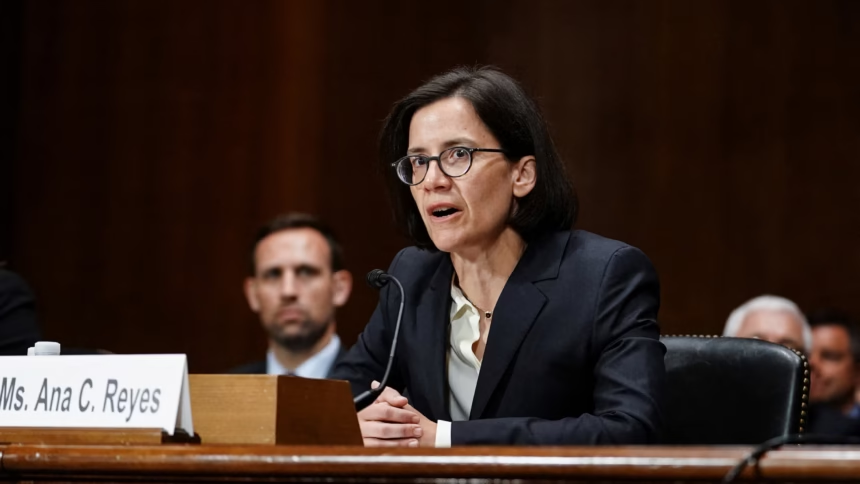
Judge Ana C. Reyes issued a stern order on Wednesday, January 28, 2026, threatening the federal government with sanctions if it fails to respond to plaintiffs’ requests by 8 p.m. the same day. This order marks a significant escalation in the procedural tensions that have characterized the Temporary Protected Status case for Haitian nationals.
In the order signed Wednesday, Judge Reyes noted that plaintiffs have not received responses to their recent requests regarding the discovery process.
The judge repeatedly emphasized that the parties must work cooperatively on discovery.
Faced with the government’s silence, the judge demanded that the administration provide direct and “non-dilatory” responses to every outstanding question from plaintiffs by 8 p.m.
Judge Reyes warned that failure to meet the deadline will result in a show-cause order regarding sanctions against the government.
The judge added: for every half-hour of delay past 8 p.m., the court will increase the amount of sanctions under consideration.
This threat of escalating sanctions reflects the judge’s exasperation with the government’s lack of cooperation in this case.
Government Responds to Order
Following the order, the government, through the Department of Homeland Security, filed a response regarding TPS designations and terminations.
This response follows Judge Reyes’s ultimatum. The court has not yet disclosed the content of the response.
The court also established a tight schedule for the coming days:
The parties must submit their response regarding the judge’s intention to use President Trump’s CPAC speech as evidence by 11:59 p.m. on January 29, 2026.
A joint status report on the state of discovery must be filed by 5 p.m. on January 29, 2026.
A status conference via videoconference is scheduled for January 30, 2026, at 10:30 a.m. before Judge Ana C. Reyes.
This order adds to a series of stern warnings from Judge Reyes. On January 27, 2026, she had already expressed her dissatisfaction with the discovery process.
She stated she would be “considerably irritated” if the parties failed to resolve their disputes and forced her to intervene on January 30.
On January 23, 2026, the judge partially granted plaintiffs’ discovery request while imposing limits: two document custodians and narrow search terms.
The judge warned she would be “considerably annoyed” if these directives were not followed.
The Stakes of Trump’s CPAC Speech
Meanwhile, Judge Reyes intends to take judicial notice of a speech Trump delivered at the Conservative Political Action Conference on February 22, 2025.
In that speech, the president declared: “If I hadn’t been elected president, there’d be nobody left in Haiti.” He also stated: “This week, I also canceled Temporary Protected Status for migrants from Haiti. They’re pouring into our country; pouring in.”
The president added that immigrants “were coming from prisons, mental institutions, insane asylums, jails, and gang members.”
The judge intends to use these statements to examine the plaintiffs’ claim based on the Equal Protection Clause of the U.S. Constitution.
These events come at a critical moment: Haitian TPS expires on February 3, 2026—less than a week away.
Without judicial intervention, more than 350,000 Haitians—and potentially up to 560,000 according to data cited by the judge—will lose their right to work and their protection from deportation.
Plaintiffs Rudolph Civil, Vilbrun Dorsainvil, Marica Merline Laguerre, Fritz Emmanuel Lesly Miot, and Marlene Gail Noble, represented by the ACLU, seek to prove that the Trump administration acted out of discrimination rather than an objective assessment of conditions in Haiti.
Judge Reyes’s threat of sanctions marks a major escalation. The court is signaling it will not tolerate dilatory tactics by the government while hundreds of thousands of people await a decision on their future in the United States.
https://ctninfo.com/?p=39686&preview=true
https://www.facebook.com/CaribbeanNewsMedia