


“If I hadn’t been elected president, there’d be nobody left in Haiti”: The Trump statement that could favor Haitian Temporary Protected Status beneficiaries in Washington, D.C., court.
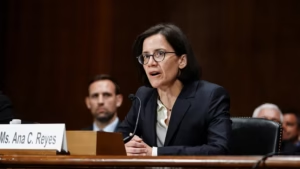
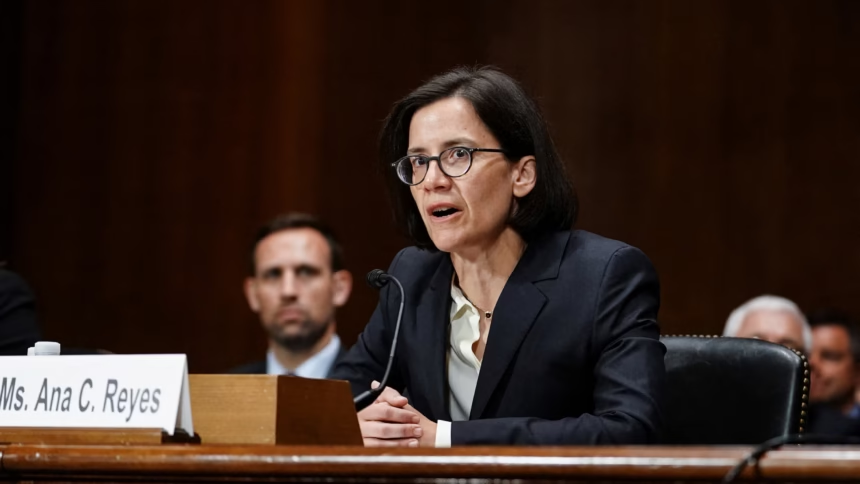
Judge Ana C. Reyes has stated she will use President Donald Trump’s CPAC speech as evidence to examine the plaintiffs’ discrimination claims in the Haitian Temporary Protected Status case, marking a decisive development.
In an order signed on January 27, 2026, the federal district court judge for the District of Columbia informed the parties that she intended to take judicial notice of a C-SPAN-archived video.
The video is of a speech delivered by President Trump at the Conservative Political Action Conference (CPAC) on February 22, 2025.
Judge Reyes will use this speech to examine the plaintiffs’ Equal Protection Clause claim. The 14th Amendment prohibits the government from treating similarly situated individuals differently without legitimate justification.
In the speech, President Trump declared, “If I hadn’t been elected president, there’d be nobody left in Haiti.” The president continued: “This week, I also canceled Temporary Protected Status for migrants from Haiti. They’re pouring into our country, pouring in.” He also added: “They [immigrants] were pouring in at levels [unprecedented], from other countries too, all over Africa, the Congo, all over South America. And they were coming in from prisons and mental institutions and insane asylums, jails, and gang members.”
Both parties have until 5 p.m. on January 29, 2026, to submit their responses regarding the judge’s intention to use the speech as evidence.
A Decision with Significant Implications
This announcement marks a turning point, as the judge sees the president’s statements as pivotal to determining whether ending Haitian TPS was driven by discrimination.
Trump’s CPAC remarks linking Haitian immigrants to prisons, institutions, and gangs suggest possible discriminatory intent rather than a neutral review of Haiti’s conditions.
Plaintiffs argue that the decision announced on November 28, 2025, was politically and discriminatorily motivated rather than based on humanitarian law criteria.
By reviewing the president’s speech, Judge Reyes enables an analysis of the Trump administration’s motives for ending Haitian TPS.
Judge Expresses Frustration with Parties
Judge Reyes expressed frustration with the discovery process.
She ordered both sides to file another joint status report by 5 p.m. on January 29, 2026, emphasizing this as the final opportunity before further court intervention.
If, in the January 29, 2026, report, the parties indicate unresolved disputes over search terms or a need for court intervention, the judge will hold a video conference at 10:30 a.m. on January 30, 2026.
The judge reminded the parties she had asked them to resolve disputes cooperatively and warned she’d be “considerably irritated” if they forced a January 30 conference.
Her frustration follows recent procedural tensions. On January 23, 2026, Judge Reyes partially granted the plaintiffs’ discovery request but imposed strict limits.
She ruled that plaintiffs can seek limited discovery on both APA and constitutional claims, but the process must remain narrow and phased.
In this first phase, plaintiffs had to name two document custodians and set narrow search terms.
Plaintiffs’ Arguments
Plaintiffs Rudolph Civil, Vilbrun Dorsainvil, Marica Merline Laguerre, Fritz Emmanuel Lesly Miot, and Marlene Gail Noble, represented in part by the ACLU, advance several arguments to challenge the legality of the Trump administration’s decision.
Plaintiffs say political advisors, including Corey Lewandowski, influenced the decision, suggesting partisan motives and an arbitrary process under the Administrative Procedure Act.
They also cite a disconnect between Haiti reports and the decision, noting that the decision memo analysts did not write the reports on conditions.
These updates come as Haitian TPS nears expiration on February 3, 2026—less than a week away.
Without judicial intervention, more than 350,000 Haitian nationals will lose their work authorization and protection from deportation. According to data cited by Judge Reyes, the number of beneficiaries could exceed 560,000.
In California, proceedings continue. Magistrate Judge Sallie Kim ordered the government to produce all documents by February 17, 2026, in National TPS Alliance v. Noem.
On the legislative front, Democratic Representative Ayanna Pressley, co-chair of the Haitian Caucus in Congress, has filed a discharge petition to force a vote on extending TPS. At a press conference on Capitol Hill, several Democratic lawmakers denounced the Trump administration’s decision.
The battle continues on several fronts—judicial, legislative, and now on the president’s public statements. Judge Reyes’s plan to examine Trump’s CPAC speech may mark a turning point, giving plaintiffs a chance to show the Haitian TPS decision was based on factors outside the law.