


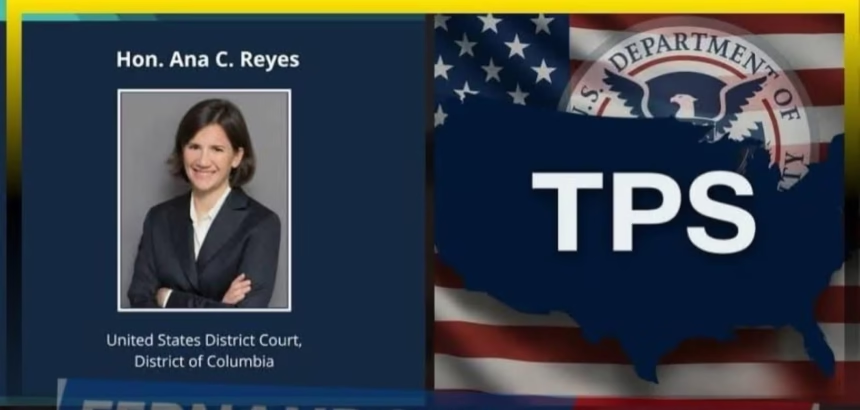
In a four-page decision issued Monday, February 23, Judge Ana C. Reyes refuses to suspend her order protecting 353,000 Haitian TPS beneficiaries. She takes the government to task for misrepresenting her findings and for failing to cite a single concrete harm.
Caribbean Television Network | February 23, 2026
Judge Ana C. Reyes of the United States District Court for the District of Columbia issued her written decision on Monday formally denying the Trump administration’s request to suspend her February 2 order protecting Haitian Temporary Protected Status (TPS) beneficiaries. The document, deliberately concise at just four pages, opens with a quote from Shakespeare: “Brevity is the soul of wit.”
The message is clear: the judge considers the government’s arguments undeserving of further elaboration.
“The Government offers no new merits argument,” Judge Reyes writes on the first page. “And it now bears the burden of establishing irreparable harm, a burden it cannot meet.”
Judge Reyes devotes the first section of her decision to rectifying a claim the government made in its appellate brief filed before the D.C. Circuit Court of Appeals on February 6. The government asserted that the judge “demanded that the Secretary consult some other unnamed ‘appropriate’ agency in addition to the State Department.”
Judge Reyes rejects this characterization in unequivocal terms. First, she did not demand anything — Congress did. Second, her finding was not that Secretary Noem had consulted the State Department but should have consulted additional agencies. Her finding was that Noem did not consult any agency, including the State Department.
“The Court found that the Secretary did not consult any agency, including that it did not consult with the Department of State,” she writes. She acknowledges that the statute’s use of the word “agencies” in the plural “confirms its intent that the consultation be meaningful,” but clarifies that she never reached the question of whether consulting only one agency would suffice, because the Secretary consulted none.
In a footnote, the judge adds that she has now checked the definitions of “consultation” and “consult” in dictionaries from 1990, the year Congress enacted the TPS statute. Those definitions mirror the later ones she originally cited, further reinforcing her analysis.
The Biden Argument Dismissed as a “Non-Starter”
The government had argued that if terminating all twelve TPS designations suggests a pattern or practice, then the Biden administration’s renewal of every TPS designation it reviewed over four years should be equally suspect.
Judge Reyes sweeps this argument aside, calling it a “he started it” grievance and declaring it “a non-starter.” She notes that the Biden administration’s TPS decisions were never challenged in court. Had they been, courts may well have found those uniform renewals to constitute a reviewable pattern or practice under the Administrative Procedure Act. “This Court, all else equal, assuredly would have,” she writes.
It is on the question of irreparable harm that the decision takes its sharpest edge. Judge Reyes recalls that at the February 12 hearing, the government’s attorney attempted to bypass the irreparable harm analysis entirely, telling her, “I can make this very simple. If Your Honor’s not going to rule for us on the likelihood of success on the merits, then that’s the end of the inquiry.”
The judge accepts the premise but not the conclusion: “Fair enough, since the Government has no legitimate interest in enforcing a likely unlawful Termination. But the irreparable harm standard exists, and so the Court considers it.”
She then reviews the facts. Her order preserves the status quo. Under that status quo, Haitian TPS holders continue to work, maintain health insurance, pay federal, state, and local taxes, and contribute to their communities. No additional Haitians gain TPS. She recalls asking the government at the hearing to cite a single concrete example of harm it would suffer if the stay remained in place. “It could not name one.”
Lacking any concrete harm, the government fell back on a matter of principle: that any court order suspending government action constitutes “an improper intrusion by a federal court into the workings of a coordinate branch of the Government.” Judge Reyes rejects this reasoning: “The argument, taken to its logical conclusion, is that anytime a court stays government action, the Government is irreparably harmed. That is not the standard.”
The Supreme Court’s Own Logic Turned Against the Government
Judge Reyes then invokes a recent Supreme Court decision — Trump v. Wilcox — to turn the government’s logic against it. In that case, the Supreme Court did not stop at finding the government was likely to succeed on the merits: it went on to weigh the comparative harms between the two parties. The judge applies the same framework here.
“Plaintiffs and other Haitian TPS holders face a greater risk of harm from an order allowing the Government to remove them to a ‘perfect storm of suffering’ than the Government faces from maintaining the status quo,” she writes.
On the question of stability, the judge draws on another passage from Wilcox, in which the Supreme Court found that a stay was appropriate to “avoid the disruptive effect of the repeated removal and reinstatement” during the course of litigation. Judge Reyes turns this reasoning on its head: here, granting a stay would cause disruption. “Indeed, with almost 353,000 TPS holders having, then losing overnight, and then potentially regaining legal immigration status, it would cause chaos.”
What This Means Going Forward
This decision is now part of the record before the three-judge panel of the D.C. Circuit Court of Appeals — Judges Justin R. Walker, Florence Y. Pan, and Bradley N. Garcia — which must rule on the government’s emergency stay request. The government’s reply brief was due on February 19. The panel’s decision will determine whether protections for the 353,000 Haitian TPS beneficiaries remain in place for the duration of the appeal.
Judge Reyes’s decision directly corrects what she considers a misrepresentation of her findings in the government’s appellate brief, provides additional legal reasoning for the appeals court to consider, and reaffirms her position: the government has no legitimate interest in enforcing a termination she considers likely unlawful.
The case Miot v. Trump (No. 25-cv-02471) is before the United States District Court for the District of Columbia. Judge Reyes’s decision (Document 135) was issued on February 23, 2026.