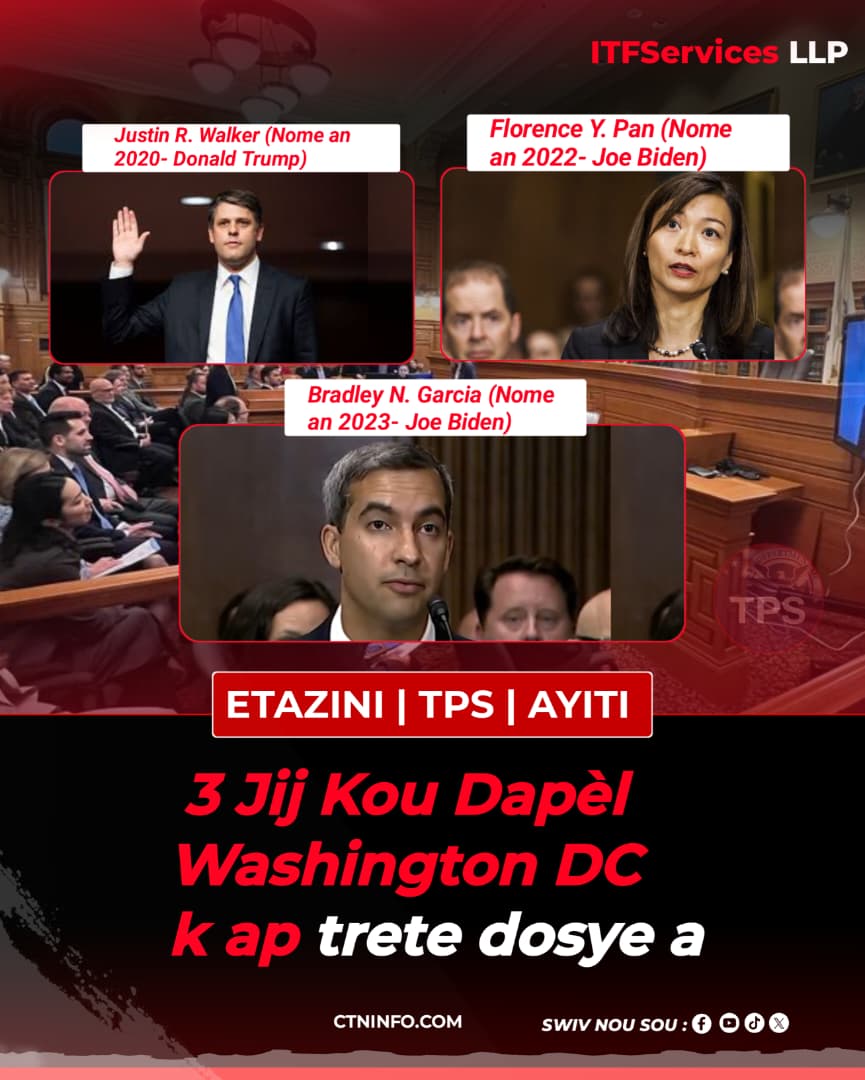
The identities of the three judges who will sit on the United States Court of Appeals for the District of Columbia Circuit in the Haitian TPS case have been revealed. They are Judges Justin R. Walker, Florence Y. Pan, and Bradley N. Garcia. Two of the three — Judges Pan and Garcia — were nominated by Joe Biden. Judge Walker was nominated by Donald Trump.
The makeup of the panel carries significant weight in the legal battle between the Trump administration and Haitian beneficiaries of Temporary Protected Status. Before this three-judge panel, the government’s appeal will be heard. The appeal challenges the ruling issued by Judge Ana C. Reyes of the federal court for the District of Columbia, who blocked the revocation of TPS for Haiti, thereby preserving protections for more than 350,000 people.
Justin R. Walker: The Trump-Appointed Judge
Judge Justin R. Walker is the only member of the panel to have been nominated by President Donald Trump. He was confirmed to the D.C. Circuit in June 2020. Prior to that appointment, he served as a federal judge in the Western District of Kentucky.
Judge Walker graduated from Duke and Harvard Law and clerked for Justice Brett Kavanaugh. Observers may note his background, but it does not dictate case outcomes.
Florence Y. Pan: A Trailblazer Nominated by Biden
Judge Florence Y. Pan, confirmed in 2022, is the D.C. Circuit’s first Chinese American judge. Her nomination marked a milestone in court diversity.
Before joining the appellate court, Judge Pan had extensive experience on the bench. She served on the federal court for the District of Columbia and on the Superior Court of the District of Columbia. She brings significant experience in federal law and administrative procedure — two areas at the heart of the Haitian TPS litigation.
Bradley N. Garcia: The Court’s First Latino Judge
Judge Bradley N. Garcia, confirmed on May 15, 2023, is the first Latino to serve on the D.C. Circuit. His nomination by President Biden represented another landmark in the court’s diversification.
Before his appointment, Judge Garcia was a partner at O’Melveny & Myers, one of the nation’s most prominent law firms. He also clerked for Supreme Court Justice Elena Kagan, nominated by President Barack Obama and widely regarded as a member of the Court’s progressive wing.
A Panel Poised to Shape the Future of Haitian TPS
The panel will decide whether to uphold Judge Reyes’s block on TPS revocation for Haiti, based on claims of procedural flaws and possible racial bias.
The Trump administration contends that Judge Reyes overstepped her authority by reviewing Secretary Noem’s decision, arguing that the law makes executive-branch TPS decisions unreviewable by the courts. The plaintiffs respond that their challenge is not to the Secretary’s discretion itself, but to the legal and procedural steps she followed, which they argue were unlawful and preordained.
The D.C. Circuit Court of Appeals is often regarded as the second-most-important court in the country, after the Supreme Court, given its jurisdiction over disputes involving the federal government and its agencies. Rulings from this court frequently have nationwide implications, particularly in administrative law and immigration.
What It Means for the Haitian Community
For the more than 350,000 Haitian TPS beneficiaries, the panel’s composition offers cautious hope. The presence of two Biden-appointed judges out of three members could be seen as a positive sign, but it would be premature to predict the outcome of the case based solely on who the judges are.
The panel’s decision will be closely watched by Haitian communities across the country, particularly in Massachusetts, New York, Florida, and Ohio, where many families await a verdict affecting whether their protections stand or whether deportation to conditions of violence and instability is possible.