


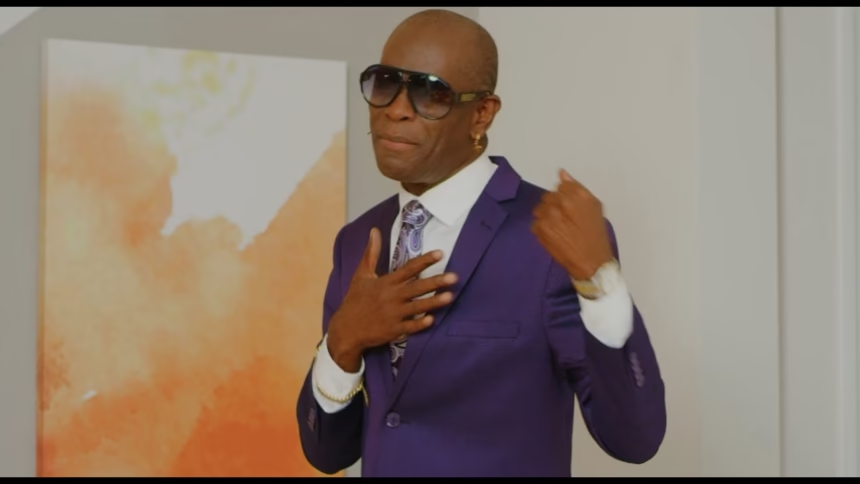
The legendary singer, an iconic figure in Haitian konpa for nearly 5 decades, has passed away at 80, leaving behind an invaluable musical legacy.
Haitian music is in mourning.
Dieudonné Larose, one of the most iconic voices of konpa and Haitian protest music, has reportedly passed away.
For 48 years, this artist of incomparable charisma touched generations with songs that became classics, an unmistakable voice, and an unwavering commitment to his people.
Dieudonné Larose did not become a singer by chance or opportunism. Music flowed through his veins from earliest childhood. As Haiti Inter reports, “raised by a mother passionate about salsa, merengue, and cumbia, and a stepfather who loved parties, he grew up in an atmosphere where music was a daily breath of life.”
From a very young age, little Dieudonné sang everywhere—in the streets, by the sea—without yet realizing that this voice would propel him toward an extraordinary career spanning nearly five decades.
For Larose, the question of choice never arose. “I didn’t choose music, it chose me,” he said in an interview with Haiti Inter at the radio station’s Paris studios. This deep conviction accompanied him throughout his life: “Every artist will tell you: you don’t choose to be an artist, you’re born an artist,” he added.
And he, as he liked to emphasize with unabashed pride, was born “an ARTIST in capital letters.”
The Roots of a Diverse Haiti
Born in the Haitian capital, Dieudonné Larose carried within him all the richness and diversity of his native country. A son of the North, with roots extending to Jacmel, the Artibonite, and Limbé, he embodied that plural and vibrant Haiti that shone through in each of his compositions.
This geographic and cultural diversity was naturally reflected in his musical repertoire, where traditional konpa, Spanish ballads, Afro-Caribbean rhythms, and socially conscious lyrics blended harmoniously. Larose did not merely entertain; he told the story of his country, its joys, its sorrows, and its hopes.
Dieudonné Larose’s career began modestly, with small neighborhood groups where he cut his teeth. But his talent could not remain in the shadows for long. The group Shoogar Combo gave him his first real professional springboard, allowing him to reach a wider audience.
It was with Dixie Band, however, and especially with Missile 727, that his talent truly exploded onto the world stage. Songs that became emblematic—such as “Accident,” “Mandela,” “Jolie Minou,” and “Guerre Mondiale”—made him an undisputed monument of Haitian konpa.
These songs, covered and hummed by generations of Haitians in Haiti and throughout the diaspora, have transcended eras and borders, testifying to the universal reach of his art.
A Voice of Engagement in Service of the People
Over the years, Dieudonné Larose honed his pen and transformed his microphone into a true weapon of conscience. His voice became a platform for denouncing injustice, uniting hearts, and challenging minds.
His album “Rassemblé” marked a decisive turning point in his artistic career. For Larose, fame carried responsibility: “We have a platform. We must say something that serves the young, the old, everyone,” he explained to Haiti Inter.
His credo was unequivocal: “I say out loud what others don’t even think quietly.” This boldness, this sometimes cutting frankness, earned him as many admirers as detractors. But Larose never wavered from his path, faithful to his convictions to the very end.
Despite his immense talent and popularity, Dieudonné Larose’s road was not without obstacles. The artist never hid the betrayals, failures, and aborted projects that marked his journey.
Missile 727, which for a time became 747, held the promise of a true musical empire. But the realities of the industry, conflicts with producers, and internal struggles slowed that ambition. “I was a victim of the system. But I’m a fighter,” he confided to Haiti Inter with the resilience that defined him.
Despite these trials, one thing never wavered: the Haitian people’s unwavering love for him. This mutual love was the fuel for his artistic longevity and the source of his perseverance.
The Wisdom of a Man at Peace
At 80, Dieudonné Larose spoke of life with remarkable serenity and depth. A man of faith, he claimed to see life “with eyes closed,” rejecting hypocrisy and constantly seeking inner peace.
He spoke of love, respect, humanity—values he carried throughout his life and transmitted through his music. Perhaps that was his secret to remaining eternally young in the hearts of his audience: living without hatred, creating with passion, and singing as naturally as breathing.
“I always see life further than my dreams,” he would say. A philosophy of life that perfectly encapsulates the man he was: a visionary, a dreamer, a fighter.
With Dieudonné Larose’s passing, a major chapter in Haitian musical history comes to a close. But his legacy lives on. His songs will continue to resound at celebrations, family gatherings, and in the hearts of millions of Haitians worldwide.
He leaves behind not only a rich and varied discography but also the example of an artist of integrity—committed and profoundly human. New generations of Haitian artists will be able to draw inspiration from his journey, resilience, and unconditional love for music and his people.
Dieudonné Larose is no longer among us, but his voice will resound for eternity.