

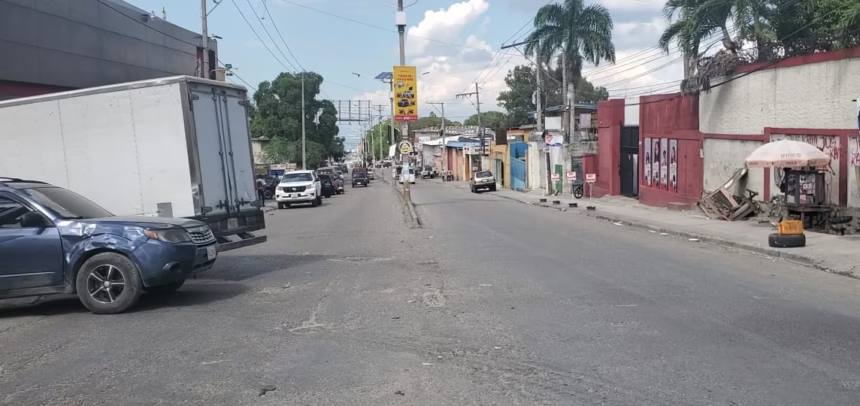
The Haitian capital, Port-au-Prince, experienced a morning of paralysis this Monday, November 17, 2025. In response to attack threats issued by the powerful criminal coalition “Viv Ansanm”—a network of armed gangs led by known figures—schools and businesses were closed. Public transportation slowed as the Haitian National Police (PNH), the main law enforcement body, operated in ‘offensive mode’ to contain the threat and protect civilians.
From the early morning hours, fear gripped Port-au-Prince. Its streets, usually bustling and congested, were calm and empty. Most schools and businesses, operated by civilians, remained closed in compliance with gang threats. Public transportation, run by local drivers, functioned minimally, as residents—caught between police advisories and gang warnings—chose to stay home.
This paralysis follows a series of videos shared on social media by notorious gang leaders. Among them were Jimmy Chérizier, alias “Barbecue,” and Christ-Roi Chéry, known as “Krisla,” both key figures in Viv Ansanm. They announced their coalition’s coordinated attacks against the capital starting this Monday, openly challenging the state and its police force.
In response to this direct threat from organized criminal groups, the PNH General Directorate—the command unit of the police—took drastic measures. In an internal communication, police leadership announced the suspension of all leave for officers starting Sunday, November 16, and “until further notice.”
Chief of Staff Berson Soljour justified the decision as necessary to “guarantee optimal security for the population and enable a rapid and effective response to any eventuality.” The directive assigned department heads, who manage local police forces, personal responsibility for enforcing these security measures.
On the ground, police adopted a counteroffensive stance. At the Anti-Gang Tactical Unit (UTAG) base, the PNH Director General—a top police official—emphasized a strategic shift: “We are no longer just securing our positions and waiting to be attacked. We are in offensive mode. Now it’s the gang members who must expect our attacks.”
Large-Scale Operations and Material Losses
These threats coincide with intensified police operations, especially in Croix-des-Bouquets, a stronghold of the “400 Mawozo” gang—a prominent criminal group. On Friday, the PNH, aided by drones and helicopters, conducted a major raid resulting in at least seven gang members killed and a cache of seized weapons, including a Barrett anti-materiel rifle and an armored bulldozer.
However, the operation came at a high cost: law enforcement lost a helicopter, which was forced into an “emergency landing due to mechanical failure.” Spokesperson Gary Desrosiers explained that the aircraft was deliberately destroyed after evacuating the eight officers on board to prevent it from falling into gang hands.
The violence also impacted U.S. diplomatic personnel. According to The Washington Post, U.S. Marines stationed at the U.S. Embassy in Tabarre exchanged gunfire with individuals suspected to be gang members on the evening of Thursday, November 13. Captain Steven Keenan, spokesperson for the Marine Corps, confirmed his troops were fired upon before returning fire. No Marines were injured, but Keenan described it as “the most significant” incident against U.S. staff this year.
This event underscores that the gangs—now emboldened—possess both the audacity and capability to challenge even the U.S. military presence in Haiti.
As the population anxiously awaits developments, the Haitian National Police (PNH) continues to assert its commitment to protecting Port-au-Prince. The confrontation now pits the police, in an aggressive posture, against heavily armed, coalition-led gangs. The capital’s paralysis highlights a state whose sovereignty is now overtly and directly challenged by criminal organizations.