

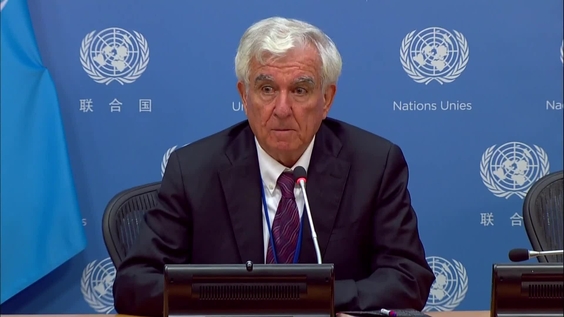
Port-au-Prince, Tuesday, March 17, 2026 – “The human rights crisis in Haiti is causing enormous suffering for the population,” declared UN independent expert William O’Neill on Monday at the end of a ten-day mission to the country.
Speaking to journalists in New York, he painted a picture of a nation caught between armed violence, mass displacement, and weakened institutions, while nevertheless mentioning a fragile “glimmer of hope.”
According to him, recent operations aimed at reclaiming certain territories from gangs, accompanied by a more “motivated and visible” police presence, show that change is still possible.
However, these advances remain limited given the scale of the security crisis gripping the Haitian capital. Today, at least twenty-six gangs control up to 90% of Port-au-Prince and some surrounding areas.
In these neighborhoods fragmented by violence, armed groups impose their law through kidnappings for ransom, extortion, rape, and assassinations. They also clash with security forces in a constant struggle for territorial control.
This territorial war has triggered an unprecedented internal displacement crisis. At least 1.4 million people have been forced to flee their homes, primarily in the metropolitan area of Port-au-Prince. Thousands of others remain trapped in gang-dominated areas or along shifting front lines, unable to move freely within their own city.
“Residents live behind invisible borders,” O’Neill explained. Crossing a street or changing neighborhoods can be life-threatening. In this context, women and girls face increased vulnerability. They are victims of discrimination because they live in gang-controlled areas, because they are poor, and because they are women.
During his meetings on the ground, the UN expert was struck by the testimony of a young girl living in one of these neighborhoods. “I just want to live well and in safety, because this is my country,” she told him.
The security crisis is compounded by a critical humanitarian situation. The persistent violence, combined with frequent natural disasters – floods, droughts, and earthquakes – exacerbates the precariousness of an already vulnerable population. At the same time, the political impasse has continued since the assassination of President Jovenel Moïse in 2021, leaving the country without an elected president and with weakened institutions.
Despite this bleak picture, O’Neill believes that Haiti is going through “a difficult but promising time.” But to transform this fragile opening into a genuine way out of the crisis, he warns that the country must tackle three major challenges: insecurity, corruption, and impunity.
National strategy against insecurity
Optimizing the deployment of mobile patrols and fixed points, intensifying prevention and crackdown operations in the ten geographical departments, strengthening the police presence by increasing substations and forward posts, enhanced internal control of troops and strict identification of officers: these are the main measures decided during a high-level strategic meeting on Wednesday, February 25, 2026.
The discussions also reaffirmed a clear intention: to restore State authority, protect lives and property, and neutralize criminals, while strictly respecting the law and fundamental rights, the statement reads.
The Government insisted on the need for structured collaboration with the population, considered an essential partner in public safety, particularly through alert mechanisms in case of kidnapping or suspicious activities.