


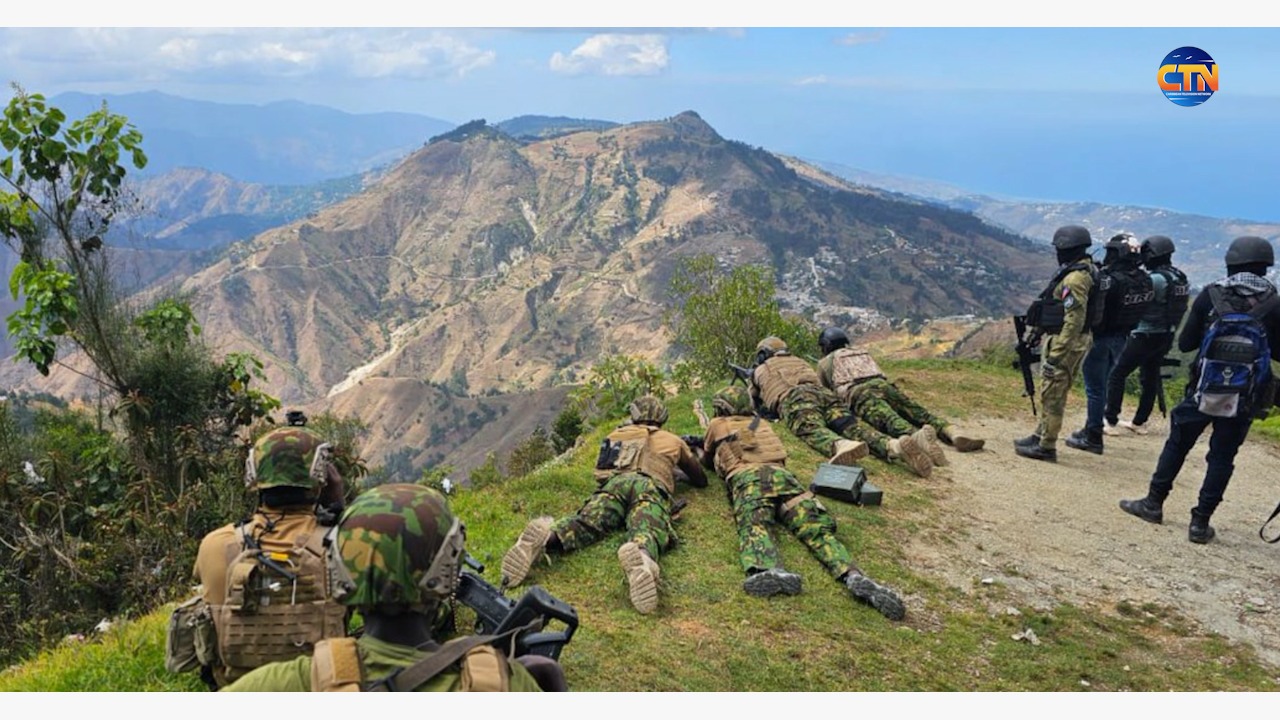
As all eyes are fixed on the imminent deployment of the first contingents of the Gang Repression Force (GRF) in Haiti, the United Nations is holding meetings to finalize the last logistical details. A high-level UN delegation was indeed visiting Port-au-Prince and the Dominican Republic this week to accelerate the implementation of the support mechanism, even as clouds gather over international commitment.
The new United Nations Support Office in Haiti (UNSOH/BANUH), established by Security Council Resolution 2793, is set to become operational as of April 1, 2026. Its role will be crucial in supporting the GRF, whose first contingents are expected in the coming days. The stated objective is to achieve the full deployment of 5,550 international soldiers and police officers “by summer, or fall at the latest,” according to the UN.
It was in this context that Haitian Prime Minister Alix Didier Fils-Aimé received a UN delegation on Tuesday at the Prime Minister’s Office, led by Mr. Atul Khare, Under-Secretary-General for Operational Support. Accompanied by Ms. Daniela Kroslak, Head of UNSOH, and Mr. Stephen McOwan, Director of Mission Support, Mr. Khare held a working session focused on “the operational, logistical, and institutional conditions necessary for the rapid and effective implementation of the international mechanism,” according to a statement from the Prime Minister’s Office.
The Haitian head of government reaffirmed his “full mobilization” in the face of the security emergency, recalling that restoring public safety is an “absolute priority.” Discussions centered on BANUH’s central role in infrastructure planning, logistical coordination, and technical support, including access to water and essential basic services on the ground.
Yet, the optimism expressed by Haitian authorities contrasts with the current geopolitical realities. The GRF, for which the United States is the main architect and expected contributor, comes at a time of particularly tense international context. Washington, deeply engaged in the Middle East conflict, sees its military and financial resources drained by other strategic priorities
This situation fuels concerns in Port-au-Prince: could the promised deployment be slowed down, or even reduced, in light of American imperatives elsewhere in the world? Historical precedents – where international commitments to Haiti have often been scaled back – fuel skepticism.
Adding to these fears is the chronic reluctance of the international community to contribute to the fund dedicated to the mission. Despite repeated appeals, financial contributions have been slow to materialize, casting doubt on the ability to sustainably support an operation of this scale. Several countries show little eagerness to back their words with action.
The success of the GRF, whose deployment is awaited as a breath of fresh air by a population suffocated by gang violence, will therefore depend as much on effectiveness on the ground as on the political will of international donors.
In its statement, the Prime Minister’s Office insists on “a spirit of close partnership, respect for national sovereignty, and operational efficiency.” It remains to be seen whether the commitments made will be reflected in reality, as the countdown for the arrival of the first contingents has now begun. The coming weeks will be decisive.