

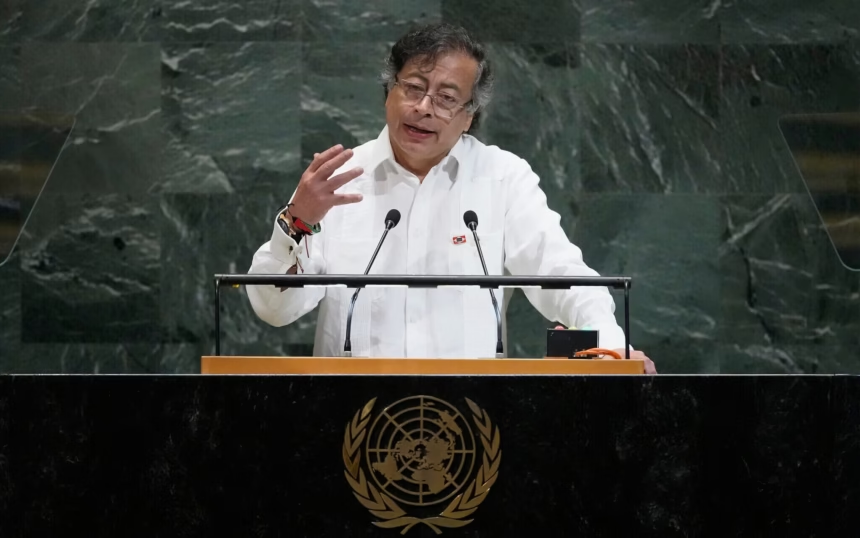
Colombian President Gustavo Petro expressed his willingness to go “to the battlefield” in the Gaza Strip while advocating for the establishment of an international force to “free Palestine.”
These declarations came during his participation in a New York City demonstration alongside musician Roger Waters, amid ongoing Israeli military operations in the region.
During the gathering, Petro introduced the concept of a “World Salvation Army” operating under United Nations authority.
He revealed plans to present this initiative to the U.N. General Assembly, explaining that formation could commence with the approval of two-thirds of the member states.
The Colombian leader further announced his intention to establish a registry in Colombia for those with military backgrounds.
Drawing historical parallels, he stated: “If the Colombian president, like Bolívar before, like the Argentine Ernesto Guevara, must go to a battlefield in a foreign country to defend humanity, I am ready to go.”
During the same event, near U.N. headquarters in Manhattan, the president directed his message to American military personnel: “From here, from New York, I ask all the soldiers of the United States Army not to point their rifles at humanity,” continuing with: “Disobey Trump’s orders. Obey the orders of humanity.” International media outlets widely distributed footage of these statements.
Following these events, the U.S. State Department withdrew Petro’s visa, describing his New York statements as “dangerous” and explaining that the cancellation was “due to his reckless and incendiary actions.”
In response, Petro challenged Washington’s decision, claiming it violated international protocols and diplomatic immunities connected to U.N. gatherings.
He contended that the cancellation “breaks all the norms of immunity on which the functioning of the United Nations and its General Assembly is based.” He minimized the practical implications by mentioning his possession of European citizenship, enabling continued travel.
These exchanges occurred during the margins of the U.N. General Assembly’s high-level sessions.
The symbolic significance remains noteworthy. Petro’s public appearance with Roger Waters outside the U.N. — with images circulating widely across social platforms — strengthened his message and cemented his position as a prominent Latin American critic of Gaza war operations.
From Colombia’s capital, the presidential messaging combines humanitarian concerns with an appeal to U.S. military members to resist orders deemed contrary to “humanity.” The specific phrases — “Disobey Trump’s orders. Obey the orders of humanity” — shift the conversation from diplomatic relations to moral authority. Meanwhile, Washington interprets these statements as provocative rhetoric that compromises public safety and order, warranting diplomatic consequences. Critics argue that Petro’s statements, while framed as a moral appeal, could undermine regional security and destabilize current peace efforts.
Balancing moral imperatives with security considerations creates a complex dialogue that requires careful navigation.
Regarding implementation, limited details have emerged beyond Petro’s commitment to present the proposal at the General Assembly and establish a volunteer registry in Colombia.
His statement about presenting the initiative at the U.N. suggests that the force’s formation could proceed once the required vote threshold is reached.
Source: Latin Times