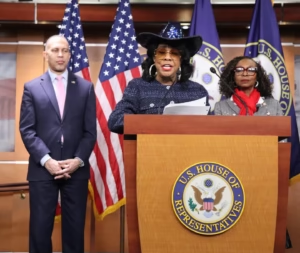



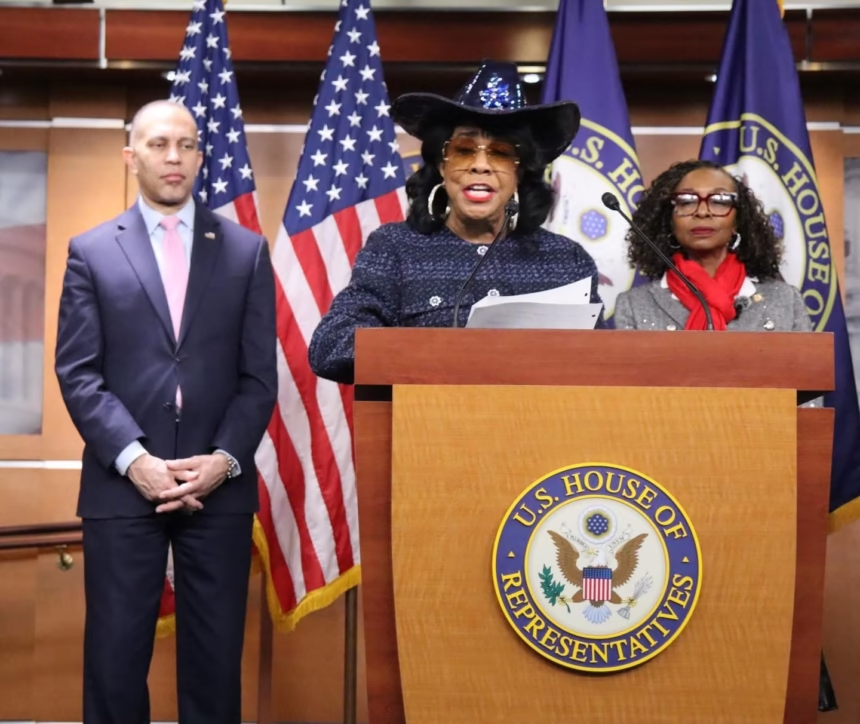
Congresswoman Frederica Wilson sent a letter to President Trump and Homeland Security Secretary Noem, insisting on the urgent continuation of Temporary Protected Status (TPS) for Haitian nationals.
Wilson wrote on her official page that ending TPS would endanger 350,000 hardworking Haitian families, emphasizing their crucial roles as neighbors, workers, and community contributors.
The letter, dated Friday, January 24, comes ten days before the program’s scheduled expiration on February 3, 2026. This deadline places approximately 560,000 Haitians—including those who benefited from the 2024 redesignation under the Biden administration—in acute legal uncertainty.
“Extend TPS now!” urged Representative Wilson, whose district in South Florida includes a significant Haitian community. She called on the President and Secretary Noem to take immediate action to protect Haitian families by extending TPS before the February 3, 2026, deadline. Florida hosts one of the largest Haitian populations in the United States, with substantial concentrations in Miami-Dade and Broward counties.
Congressional Mobilization
Other actions are also underway at the congressional level to prevent the termination of TPS, which allows hundreds of thousands of Haitians to maintain legal status in the United States.
This week, Representative Ayanna Pressley of Massachusetts’s 7th district introduced a discharge petition in Congress aimed at blocking the Trump administration’s decision to end Temporary Protected Status for Haitian immigrants in the United States.
A discharge petition lets a House majority (218 of 435 members) force a floor vote on a bill stuck in committee. If it secures enough signatures, it can allow TPS preservation regardless of the administration’s stance.
Ongoing Legal Battle
Meanwhile, all eyes are on the federal district court in Washington, where Judge Ana C. Reyes is expected to rule on a lawsuit by TPS advocates against the Trump administration.
National TPS Alliance et al. v. Noem et al. challenges if DHS legally ended TPS for Haiti without fully assessing conditions there.
The judge plans to rule by February 2. A favorable verdict could temporarily block TPS’s end, as courts did in 2017.
Alarming Security Situation in Haiti
TPS was granted to Haiti after the 2010 earthquake, which killed over 300,000 people and displaced 1.5 million. The program continues due to ongoing instability.
Gang coalitions now control 85% of Port-au-Prince, making repatriation perilous. In 2025, over 5,000 were killed and nearly 700,000 displaced, says the UN.
Haiti’s transitional government has said it cannot guarantee citizens’ safety or absorb the costs of mass deportations.
The Trump administration has not yet publicly responded to Representative Wilson’s request for an extension. President Trump had previously attempted to end Haitian TPS during his first term in 2017, but that decision was blocked by federal courts following legal challenges that continued until the Biden administration reversed the decision in 2021.
Secretary Noem and DHS have maintained their position on ending TPS, despite feedback from immigration specialists and local officials on the humanitarian and economic consequences of the decision.
With less than ten days left, the fate of hundreds of thousands of Haitians—whose futures depend on TPS—hangs in the balance, awaiting imminent judicial and political decisions.