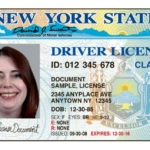



After months of legal sparring, the case reached a decisive turning point when the Trump administration and New York State clashed over the rights of undocumented immigrants. This legal battle marks a critical moment in the ongoing conflict between the two parties.
On Tuesday, a federal judge rejected the government’s attempt to block the “Green Light Law,” which allows New York residents to obtain a standard driver’s license without proving lawful immigration status.
U.S. District Judge Anne M. Nardacci ruled that the Justice Department did not demonstrate that the state law violates the federal Constitution.
The decision is a significant victory for immigrant rights advocates and a defeat for the Trump administration in its challenge to the immigration policies of progressive states.
In February, the Justice Department filed a lawsuit against New York Governor Kathy Hochul and Attorney General Letitia James.
The federal government argued that the New York law encroached on federal immigration authority, unlawfully regulated the federal government, and discriminated against it.
Judge Nardacci rejected each of these arguments in her ruling.
She emphasized that her role was to determine whether the administration violated the Supremacy Clause of the U.S. Constitution (the clause that says federal law outranks state law), not to assess the policy itself.
The judge concluded unequivocally that the administration “failed to state such a claim.”
Attorney General Letitia James welcomed the decision. “As I said from the start, our laws protect the rights of all New Yorkers and keep our communities safe,” she said in an official statement. “I will always stand up for New Yorkers and the rule of law.”
Officially titled the “Driver’s License Access and Privacy Act,” the measure was adopted in 2019 to improve road safety in New York State.
Supporters argued that making licenses accessible would encourage more people to take driving tests and obtain auto insurance, regardless of immigration status. The law allows applicants without a valid Social Security number to submit alternative identification, such as a valid passports or a foreign driver’s license. To support the safety claims, a study from the AAA Foundation for Traffic Safety found that states that implemented similar laws experienced a 10% reduction in car accidents involving uninsured drivers. Another report highlighted that insurance rates in states with such policies dropped by an average of 5%.
Applicants must still obtain a learner’s permit and pass a road test to receive a standard license. The law does not apply to commercial driver’s licenses, which remain subject to federal requirements.
Trump Administration Denounces “Frontal Assault”
When announcing the lawsuit, U.S. Attorney General Pam Bondi accused Governor Hochul and Attorney General James of putting “illegal aliens over American citizens.” She argued that the law limits federal immigration agents’ access to certain driving record information during traffic stops. In fact, federal agents can still obtain data through established legal channels such as subpoenas or warrants.
In its complaint, the Justice Department described the legislation as “a frontal assault on the federal immigration laws.” The administration cited a provision requiring the state’s DMV commissioner to notify applicants when a federal immigration agency requests access to their personal information.
The federal government also argued that broader access to New York driver data would support its immigration enforcement efforts.
The Green Light Law faced renewed criticism after a fatal shooting in Vermont last January, when a U.S. Customs and Border Protection agent was killed near the Canadian border during a traffic stop involving a German national. Critics pointed to the incident to express safety concerns surrounding undocumented individuals’ access to driver’s licenses, although there has been no direct evidence linking the shooting to New York’s DMV data rules. This distinction is crucial to understand, as federal agents still have access to necessary information through appropriate legal channels.
Hector Garza, vice president of the National Border Patrol Council, sharply criticized the New York legislation at the time. “Any information that can help law enforcement stay safe as they conduct their duties has pretty much been taken away with this Green Light Law,” he said.
The union official added that the law can limit the information officers obtain during routine vehicle registration checks before a traffic stop, including whether a person has outstanding warrants or is considered armed and dangerous.
Judge Rejects Security Arguments
In her decision, Judge Nardacci dismissed these concerns, referencing a prior appeals court ruling. She noted that the information “remains available to federal immigration authorities” through legal processes, such as a court order or a warrant issued by a judge. To clarify, this means that federal agencies must first obtain a warrant signed by a judge. Once this legal document is in hand, the DMV is then authorized to release the requested data to the federal authorities. This two-step process ensures that, while access may be delayed by necessary legal procedures, it is not denied, preserving the balance between state regulations and federal requirements.
This clarification is important: the New York law does not prohibit access to data but regulates the conditions under which federal agencies can obtain it, requiring adherence to judicial procedures instead of direct administrative access.
New York is one of about a dozen U.S. states that have adopted similar legislation allowing undocumented residents to obtain driver’s licenses. These states, mostly led by Democratic administrations, view such policies as pragmatic public safety measures rather than statements on federal immigration policy.
At its heart, the case tests how far Washington can reach into state traffic policy, sparking a federalism showdown. This decision comes amid growing tensions between the Trump administration and “sanctuary” states that limit cooperation with federal immigration agencies. It highlights the constitutional limits of federal executive power compared to states’ authority to regulate traffic and issue driver’s licenses.
The Trump administration may appeal this decision, continuing a legal battle that is one of many disputes between Washington and progressive states over immigration. The administration has 30 days to file an appeal.