


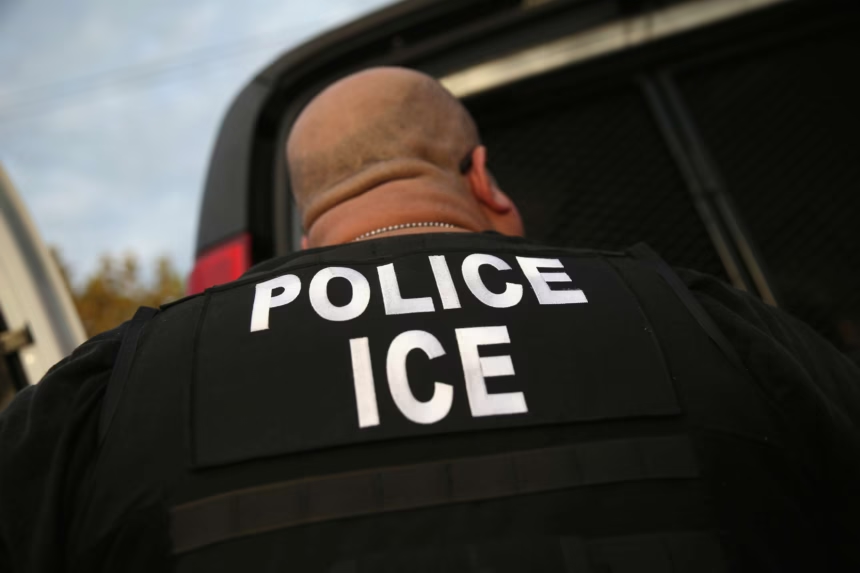
On December 24, a federal judge in San Francisco barred U.S. Immigration and Customs Enforcement (ICE) agents from conducting civil arrests inside immigration courthouses in Northern California. The court issued this decision under its authority in 6 U.S.C. § 202.
U.S. District Judge P. Casey Pitts found that these arrests force individuals in removal proceedings into a “Hobson’s choice between two irreparable harms.”
“First, they may appear in immigration court and face likely arrest and detention,” the judge wrote. “Alternatively, noncitizens may choose not to appear and thereby forfeit their opportunity to pursue asylum claims or other forms of protection from removal.”
The ruling prohibits ICE and the Justice Department’s Executive Office for Immigration Review (EOIR) from detaining asylum seekers during routine court hearings in the region, restoring the previous prohibition that existed before the Trump administration.
For decades, U.S. authorities have restricted immigration arrests in so-called “sensitive locations,” including hospitals, places of worship, and schools, placing them largely off-limits to routine civil immigration enforcement. That designation dates back to the former Immigration and Naturalization Service, ICE’s predecessor, according to the Los Angeles Times.
Courthouses were added to the list during the Obama administration. The policy barring most courthouse arrests was suspended during President Trump’s first term, then reinstated under President Biden.
Under Biden-era ICE guidance, “enforcement actions of civil immigration law in or near a courthouse can deter individuals from accessing the courts and therefore undermine the fair administration of justice.”
Court appearances decline amid renewed arrests.
Despite this guidance, ICE reversed its courthouse policy earlier this year, resulting in increased arrests and a significant decline in court appearances, according to court filings.
Monthly in absentia removal orders more than doubled this year, increasing from fewer than 1,600 in 2024 to 4,177, according to Justice Department data. Since January, over 50,000 asylum seekers have received removal orders after missing hearings, exceeding the total from the previous five years combined.
“ICE cannot choose to ignore the ‘costs’ of its new policies—which deter noncitizens from participating in their removal proceedings—and consider only the purported ‘benefits’ to immigration enforcement,” Judge Pitts wrote.
The lawsuit, Garro Pinchi v. Noem, filed in October by the ACLU and partner law firms, alleges that ICE arrested immigrants who posed neither a danger nor a flight risk, departing from four decades of established practice and violating due process rights.
Among the plaintiffs is Yulisa Alvarado Ambrocio, a 24-year-old Guatemalan asylum seeker who avoided detention only because her 11-month-old breastfeeding baby accompanied her to court, according to court records. Government attorneys indicated that ICE would likely arrest her at her next hearing.
The decision may bring the San Francisco case into conflict with other lawsuits seeking to limit ICE’s presence in previously protected spaces.
A federal district judge in Manhattan reached the opposite conclusion in a similar case this fall, creating the possibility of a circuit split and of the Supreme Court reviewing courthouse arrests as early as 2026.
Currently, the ruling applies only to ICE’s San Francisco area of responsibility, which includes Northern and Central California as far south as Bakersfield, as well as Hawaii, Guam, and Saipan.
This geographic limitation reflects a recent Supreme Court emergency decision that removed district judges’ authority to block federal policies nationwide except in narrowly defined circumstances.
The administration informed the court it intends to appeal the ruling to the 9th U.S. Circuit Court of Appeals, where recent appointments have shifted the court’s traditional composition.
Sources: Los Angeles Times (Sonja Sharp), San Francisco Chronicle, Mission Local, ACLU, KQED