



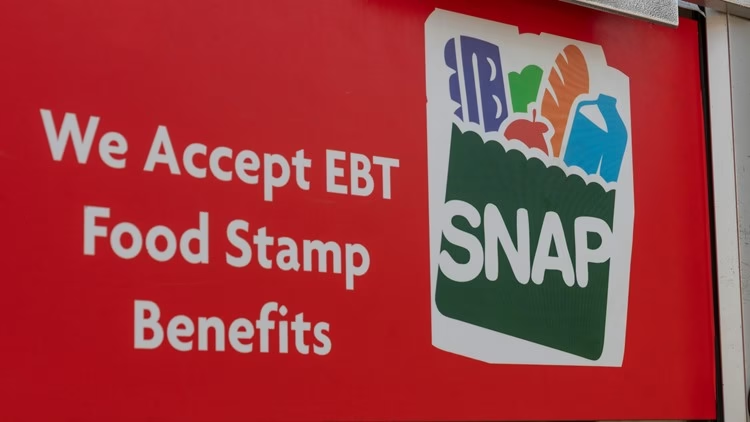
The Department of Homeland Security announced a final rule on July 16, stripping away the written limits on how immigration officers weigh a green card applicant’s use of public benefits, and the Commonwealth’s senior refugee legal official is warning Haitian families that the most likely damage will be self-inflicted.
Susan Church, Chief Operating Officer and Legal Adviser at the Massachusetts Office for Refugees and Immigrants, told CTN that the rule reaches a far narrower group than the panic sweeping the diaspora suggests, and that families who drop MassHealth or SNAP out of fear may be surrendering food and health coverage to protect an immigration benefit that was never at risk.
“The first and foremost most important thing is don’t panic and dump all of your benefits that your family desperately needs because you think it applies to you.”
The distinction that matters most for this community: if your pathway to a green card is asylum, public charge does not apply to you at all. That exemption is written into the statute, not the regulation DHS is rescinding, and it covers the single most likely route for a Haitian family whose Temporary Protected Status ends this month.
The rule will be published in the Federal Register on July 20 and takes effect roughly 60 days later, in September. It is landing on Haitian households in the same week TPS collapses, two unrelated federal actions hitting the same families at once — and in the confusion, people are conflating them
The chilling effect is the policy

There is a well-documented pattern in immigration policy: a rule is announced, the announcement is louder than the rule, and hundreds of thousands of families who are not covered by it withdraw from food assistance, health coverage, and housing help anyway — out of fear.
“Speak with an attorney,” Church said. “Sometimes attorneys will just do a simple consultation on this issue and say, ‘Hey, can I continue using benefits? Is it safe for me?’ And an attorney can go through that process with you and tell you whether or not it is.”
That advice costs a phone call. The alternative, a family quietly dropping its children off MassHealth because of something forwarded on WhatsApp, costs a great deal more and buys nothing.
What actually happened, precisely
Church described the timing in the interview: “The government announced, I think yesterday, that as of Monday, they are going to publish guidelines on what is called the public charge rule. It won’t take effect on Monday. It takes effect 60 days after Monday. So that’s like, what is that, July, August, September 20th, around that time frame.”
The Department of Homeland Security announced a final rule on July 16, 2026. It is scheduled for publication in the Federal Register on Monday, July 20, 2026, as Church said. Under the rule’s own terms, it takes effect 60 days after publication. Most immigration practitioners analyzing the rule this week, including the Immigrant Legal Resource Center and Capitol Immigration Law Group, put the effective date at September 18, 2026.

Who does this rule actually reach?
Now, the part that should lower the temperature in many Haitian households.
“I want to make it clear to everyone, this rule does not apply to people who are obtaining their green card through the asylum process. Okay? So, if you’re currently receiving benefits and those benefits are essential for your health and your family’s health, and your safety and your financial security, and your pathway to a green card is through asylum, public charge doesn’t apply.”
She listed who is covered instead: “Public charge only applies to those people who are obtaining their green card through marriage to a United States citizen, or through a family petition, or through an employer petition. Doesn’t apply to asylum. If you are a victim of a violent crime and are obtaining a U visa green card, none of it applies to those things.”
The legal foundation for this — and the reason the rescission does not disturb it — is that the exemptions are statutory, not regulatory.
Under INA § 209(c), asylees and refugees adjusting to lawful permanent resident status are expressly exempt from the public charge ground of inadmissibility at INA § 212(a)(4). Congress wrote that exemption into the statute in the first place. DHS cannot rescind it by pulling a regulation. The exemptions currently cataloged at 8 C.F.R. § 212.23 include, among others:
- Refugees, at admission and at adjustment
- Asylees, at grant of asylum and at adjustment
- U visa petitioners and holders
- T visa applicants
- Certain VAWA self-petitioners
- Special Immigrant Juveniles
- Afghan and Iraqi interpreters and U.S. government employees
- Haitians applying under the Haitian Refugee Immigration Fairness Act of 1998 (HRIFA)
- TPS applicants and re-registrants
That last pair is worth pausing on for this audience. HRIFA is a Haiti-specific statute. And TPS itself has never been subject to public charge, which means every Haitian family that has been re-registering for TPS for sixteen years while receiving SNAP or MassHealth has never been exposed to this analysis, and is not being exposed to it now.
Church also flagged the Cuban-Haitian Entrant category elsewhere in the interview — a designation that has kept many Haitians eligible for benefits, including emergency shelter assistance and SNAP. CLINIC’s practitioner guidance lists Cuban/Haitian entrants among those who may qualify for an exemption. Whether that applies to a specific person is exactly the kind of question a lawyer answers, and a Facebook post does not.
It does not reach backward
Susan Church made two points about timing that families should hold onto.
On pending cases: “It doesn’t apply to people who have already filed for their green card through marriage. So let’s say you filed your green card application a couple of months ago. The rule doesn’t retroactively apply to you. It only applies to people who have filed for adjustment of status after the 60th date has run.”
On benefits already received: the federal notice states that means-tested public benefits received before the rule’s effective date will not be considered under the new framework. Benefits received before implementation are evaluated under the policies in effect at the time, which, over the past three and a half years, have meant the narrow 2022 standard. What continues to be considered, as it always has been, is public cash assistance for income maintenance and long-term institutionalization at government expense.
There is also a paperwork consequence that will catch people. To implement the change, USCIS is publishing a revised Form I-485, the application to register permanent residence or adjust status. Older versions postmarked or filed electronically on or after the effective date will not be accepted. Anyone with an adjustment application sitting half-finished on a kitchen table should get it reviewed before September.
Church’s final observation was a practitioner’s instinct, and the history supports it:
“I will also say that last time this rule was sued over, and it seems pretty likely that it will be again challenged in the courts by some organization.”
The record: the first Trump administration published an expansive public charge regulation in 2019 that pulled Medicaid, SNAP, and housing assistance into the analysis. It was challenged immediately and repeatedly, enjoined in multiple district courts, and ultimately vacated. The Biden administration declined to defend it, withdrew the pending appeals, and then issued the 2022 rule that DHS is now rescinding.
What immigrant families should actually do
Not in order of drama — in order of usefulness.
One. Identify your pathway. If it is asylum, this rule does not touch you, and you should not change a single thing about your family’s benefits. If it is a marriage, family, or employer petition, keep reading.
Two. If you are in one of the covered categories, do not guess. A short consultation on this one question is inexpensive and sometimes free. Ask a lawyer: given my specific pathway and my household’s benefits, am I exposed?
Three. If you have a green card application in progress or nearly ready, ask about filing before the effective date and about the new Form I-485.
Four. Do not cancel MassHealth. Do not cancel SNAP. Do not walk away from a housing subsidy your children depend on because of something you read on WhatsApp. The 2019 chilling effect drove eligible families — including U.S. citizen children — off benefits they had every right to. It is the most predictable harm in this entire policy, and it is the one families can actually prevent themselves.
Mrs. Church’s line is this: don’t dump the benefits your family desperately needs because you think they apply to you.
Find out whether it does.
https://ctninfo.com/dont-panic-and-d…ually-applies-to/
https://www.facebook.com/CaribbeanNewsMedia
This article was originally written in English. The other language versions are produced using AI translation software, and errors are possible — the English version is authoritative. CTN also uses AI to convert text into audio.