


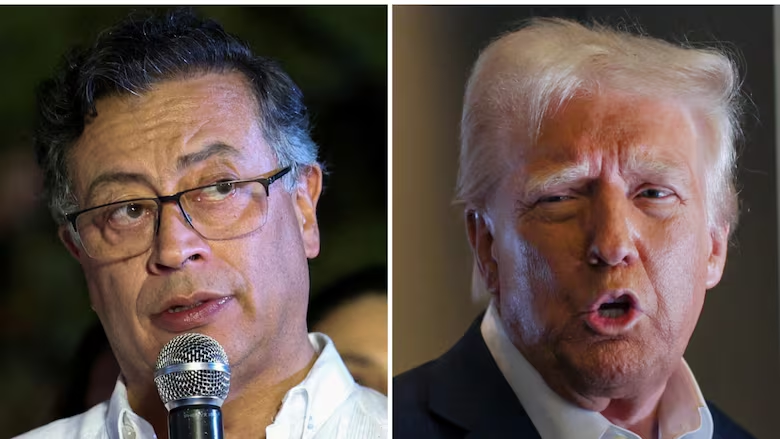
After initially refusing to accept deported Colombian immigrants from the United States as a protest against the inhumane treatment of its citizens during deportations, Colombian President Gustavo Petro quickly relented under the pressure of the powerful Donald Trump.
Colombia eventually agreed to accept deportation flights from the United States, marking a swift end to the diplomatic standoff between Colombian President Gustavo Petro and U.S. President Donald Trump.
The latter had threatened Colombia with severe economic sanctions, forcing Bogotá to yield under pressure.
A Rapid Escalation of Tensions
It all began when Gustavo Petro, Colombia’s president and the country’s first leftist leader, refused to allow two U.S. military planes carrying deported Colombians to land. This refusal, motivated by Petro’s desire to denounce what he described as the “inhumane treatment” of migrants, quickly prompted a harsh response from Donald Trump. The U.S. president announced immediate economic sanctions, including a 25% tariff on all Colombian imports, which would have doubled within a week if the situation was not resolved.
In response, Gustavo Petro retaliated by imposing equivalent tariffs on American exports to Colombia. However, this symbolic gesture was short-lived.
Under the threat of an economic escalation that could have severely impacted Colombia’s economy—heavily reliant on trade with the United States—the Petro administration eventually backed down.
In a statement released Sunday evening, the White House confirmed that Gustavo Petro had accepted all conditions imposed by Washington.
Although the tariffs were suspended, other sanctions, such as visa restrictions for Colombian officials, would remain in place until the first deportation flights had landed, the White House stated.
Meanwhile, Colombia’s Ministry of Foreign Affairs assured that the country would guarantee dignified conditions for its deported citizens. It also stated, “The impasse with the U.S. government has been resolved,” as reported by The New York Times.
A Conflict Reflecting Broader Migration Tensions
According to The New York Times, the decision to use military planes for deportations is part of a series of executive measures aimed at expediting mass deportations. However, Colombia is not the primary country of origin for undocumented migrants in the United States. With approximately 190,000 undocumented Colombians reported in 2022, according to the Pew Research Center, Colombia trails behind countries like Mexico, El Salvador, and Guatemala. Nevertheless, this did not stop Donald Trump from pressuring countries considered natural allies of the U.S.
An Ally Under Pressure
The standoff between the two presidents highlights the economic and political challenges Colombia faces. The United States remains Colombia’s largest trading partner, with bilateral trade reaching $53.5 billion in 2022, according to official data.
Key exports, such as coffee, cut flowers, and crude oil, form the backbone of Colombia’s trade with the U.S.
Will Freeman, a Latin American studies expert at the Council on Foreign Relations, stated in a comment cited by The New York Times that the dispute represented “a bold escalation on both sides,” but Colombia had much more to lose due to its economic reliance on the U.S.
A Longstanding Critique of Washington
Gustavo Petro, a former guerrilla fighter turned president, has often been critical of U.S. influence in international affairs. Since taking office in 2022, he has denounced economic imbalances between his country and its powerful northern neighbor while advocating for human rights, particularly those of migrants.
Despite these convictions, the episode highlights the limitations of his power against a determined U.S. administration.
By ultimately agreeing to the deportation flights, Petro aims to avoid an economic crisis while ensuring that the reception conditions for deported migrants are respectful.
A Worrisome Precedent
This confrontation between Bogotá and Washington sets a precedent that could influence U.S. relations with other Latin American nations.
Although Colombia eventually conceded, countries like Mexico and Honduras are still weighing their positions on the new U.S. policy of using military planes for deportations.
According to The New York Times, Mexican authorities have yet to clarify whether they will accept such flights, while Guatemala recently received two military planes carrying deported immigrants.