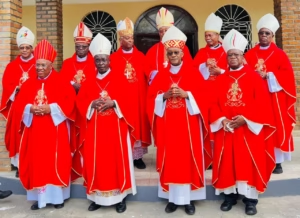



Amid the darkness of crisis, Haiti’s Catholic bishops have released a Christmas 2025 message centered on active hope, calling for national renewal and laying out clear conditions for credible elections in 2026: respect for the Constitution and the restoration of security.
As the nation navigates “the dark night of uncertainty and pain,” the Haitian Episcopal Conference (CEH) has issued a forceful Christmas and year-end message that blends spiritual consolation with urgent political appeals. Titled “The Light of Christ Shines in Our Darkness,” the text exhorts Haitians to become “peacemakers” and establishes explicit prerequisites for the upcoming transition.
The bishops, identifying themselves as “Pilgrims of Hope,” reject both fatalism and passive optimism. “We call for hope not as naive optimism, nor as a denial of difficult realities, but as responsible action grounded in faith,” they wrote. Acknowledging “glaring limitations in our state institutions” and “structural violence,” they urge all sectors of Haitian society to prioritize the common good and human dignity in the face of ongoing chaos.
Constitution and Security as Foundational Pillars
The message places particular emphasis on constitutional governance and security as essential foundations for resolving the crisis. The bishops “exhort all political actors to be guided by the Constitution of 1987” as Haiti approaches February 7, 2026, the end of the Transitional Presidential Council’s (CPT) mandate. They directly link the holding of “democratic, inclusive, and transparent elections” to the prior establishment of “a secure climate throughout the country,” a condition they deem “indispensable.”
Echoing principles of Catholic social teaching, the bishops advocate for “hearts formed to recognize the common good.” They call for leadership embodying “integrity, service, and self-sacrifice,” invoking what they describe as modern “martyrdom”: “not through bodily death, but through truth that demands sacrifice and the courage to abandon privilege in order to serve the people.” This statement represents a direct challenge to corruption and what they term “easy money”—illicit enrichment.
National Football Victory as Symbol of Hope
The bishops briefly note Haiti’s recent qualification for the 2026 World Cup as evidence of the Haitian people’s “remarkable capacity for transcendence” when they choose “unity and solidarity.” The message concludes with faith placed in “Christ Jesus, Prince of Peace,” and a prayer to the Virgin Mary to protect the nation and comfort its people.
Signed by the entire episcopate, including President Mgr Max Lefoys Mésidor and Cardinal Chibly Langlois, this 2025 Christmas message transcends traditional holiday greetings. Instead, it functions as a comprehensive spiritual and civic roadmap for a year presented as decisive in Haiti’s trajectory.
A Larger Context
The bishops’ message arrives at a pivotal moment in Haiti’s political calendar. With the CPT’s mandate set to expire in February 2026, the nation faces critical decisions regarding the framework and timing of elections. The CEH’s emphasis on constitutional adherence reflects longstanding concerns among church leaders about maintaining institutional legitimacy amid profound state weakness.
The insistence on security as a precondition for elections acknowledges the stark reality facing Haiti: ongoing gang violence, kidnappings, and criminal activity have already disrupted governance and displaced hundreds of thousands of citizens. Without demonstrable improvements in public safety, the bishops argue, any electoral process risks becoming compromised and lose public confidence.
For Haiti’s Catholic leadership, this message signals that 2026 must be more than a technical return to democratic procedures—it must represent a genuine reorientation toward governance rooted in constitutional principles, social justice, and the protection of human dignity.