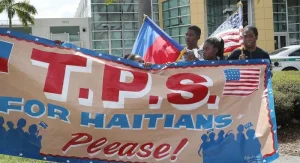



As the expiration date for Temporary Protected Status (TPS) for Haitians approaches, a legal dispute is underway in the U.S. Court of Appeals for the Northern District of California regarding access to government documents related to the program’s termination.
In a joint brief filed on January 15, 2026, attorneys representing the National TPS Alliance and individual Haitian beneficiaries are locked in a dispute with representatives of the Trump administration over the scope, timeline, and terms of disclosure for crucial documents that could reveal the true motivations behind the decision to terminate Haitian TPS.
Plaintiffs’ attorneys, led by Ahilan T. Arulanantham of the Center for Immigration Law and Policy at UCLA and Emilou MacLean of the ACLU Foundation of Northern California, are seeking expedited access to internal government communications to prepare a potential emergency relief motion.
A Three-Front Battle
The dispute centers on three main aspects of document discovery: the time period covered by the search, the search terms used to identify relevant documents, and the government officials whose communications must be reviewed.
Plaintiffs’ attorneys request that the search period extend from the date of the last search through November 28, 2025, when the Federal Register notice announcing TPS termination was published. They argue this 11-month period will capture all relevant communications.
The government proposes a narrower window, from July 15 to November 19, 2025, covering four months. Department of Justice attorneys argue that this period, starting with the Eastern District of New York ruling that overturned the initial partial vacatur of Haitian TPS, sufficiently covers the decision-making process.
On search terms, plaintiffs propose using the same terms agreed upon in previous cases: [“Temporary Protected Status” OR “TPS” OR “1254a”] AND [“Haiti”]. They maintain that these terms have been successfully used in prior cases and produced crucial documents.
The federal government proposes adding more restrictive terms that, according to plaintiffs, would exclude “the vast majority of previously produced relevant documents,” including key State Department communications and emails related to data searches on Haitian TPS holders.
The parties have agreed to review communications from 12 government officials, including Department of Homeland Security Secretary Kristi Noem, USCIS Director Joe Edlow, and General Counsel Joseph Mazzara. Plaintiffs also request the inclusion of six additional officials, such as Corey Lewandowski, DHS Senior Advisor, and James Percival, former DHS General Counsel.
Plaintiffs’ attorneys state these individuals “were deeply involved in TPS decision-making” and were included in previous agreements or court orders in similar cases.
A Critical Question of Timing
The parties also disagree on the deadline for document production. Plaintiffs’ attorneys request that the government produce all relevant documents within 10 days of the court order, citing “the urgent nature of the proceedings.”
“We must act with urgency: Haiti’s TPS is due to terminate imminently, and plaintiffs need timely production to seek relief if that becomes necessary, depending on developments in the Miot case,” the plaintiffs’ attorneys write in their brief.
The Miot v. Trump case, currently before the District of Columbia District Court, also challenges the termination of Haitian TPS.
The attorneys state they will promptly seek relief in their own case if the Miot case does not result in a favorable decision.
The government requests 30 days to respond to production demands, arguing that the 10-day deadline is “wholly inappropriate in the context of the second Haiti termination.” Government attorneys note that while a 10-day deadline was suitable for producing about five weeks of documents in a previous case, “it stands to reason that a much longer discovery deadline is needed for documents spanning several months.”
A History of Non-Compliance
Plaintiffs allege that the government has repeatedly failed to meet its discovery obligations in previous cases. They ask the court to “admonish the government representatives to comply with the court’s discovery orders.”
They cite several previous court orders that found the government had:
- Inappropriately invoked deliberative process privilege.
- Mischaracterized about one-third of the documents in a court-reviewed sample as covered by the attorney-client privilege
- Improperly withheld or failed to log documents as non-responsive, with the court finding that 16 of 40 reviewed documents were incorrectly withheld.
“The fact that the government attorneys working on this case have changed since the court issued its prior orders does not allow the government to ignore them,” the plaintiffs’ attorneys write.
A New Discovery Request
In addition to requesting an update to previously ordered discovery concerning the Haitian TPS termination, plaintiffs also served a new production request on January 8, 2026, seeking “all documents (including communications) concerning the Trump administration’s general policies and practices with respect to the TPS program and TPS periodic reviews.”
This request follows a January 6 court order granting in part the plaintiffs’ request for additional discovery concerning “‘high-level’ documents that essentially reflect a TPS agenda (not country-specific).”
The government indicated by email that it “intends to oppose” this request without explanation, and stated it would respond within 30 days.
The brief also highlights the significant human impact of the case. Plaintiffs’ attorneys note that “defendants cannot make any showing of burden, as plaintiffs’ discovery is narrowly tailored, particularly when weighed against the liberty interests of 350,000 people.”
An unfavorable decision could result in the deportation of hundreds of thousands of Haitian nationals to Haiti, “a country currently gripped by a severe security and humanitarian crisis, marked by gang violence, institutional collapse, and chronic political instability.”
Attorneys for Haitian TPS beneficiaries argue that reducing the protection period violates established administrative procedures and does not reflect current conditions in Haiti. Government representatives maintain that the administration has the legal authority to determine the duration of TPS designations.
Next Steps in the Proceedings
The joint brief now asks the judges to resolve these discovery disputes.
The court’s decision will determine which documents are produced and when, and could significantly affect the plaintiffs’ ability to challenge the TPS termination before the February 3, 2026, expiration date.
As the plaintiffs’ attorneys note, “the overbroad scope of discovery and expedited timeline proposed by plaintiffs will almost certainly devolve into potential non-compliance motions, clawback litigation, and supplemental production, all of which will delay the resolution of this case in contravention of the exigent circumstances to which plaintiffs repeatedly refer.”
The dispute over access to government documents is one part of a broader litigation that could affect hundreds of thousands of Haitian families living and working legally in the United States.
As the deadline approaches, legal observers and the Haitian community await the court’s decision on these important procedural matters with increasing concern.