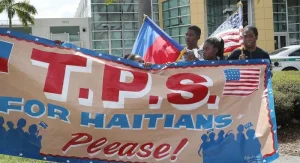



Plaintiffs in the case challenging the termination of Temporary Protected Status (TPS) for Haitian nationals have filed new legal arguments before the U.S. District Court for the District of Columbia.
This supplemental memorandum aims to strengthen their request for emergency relief to prevent the expiration of TPS on February 3, 2026.
The document, filed by attorneys for plaintiffs Rudolph Civil, Vilbrun Dorsainvil, Marica Merline Laguerre, Fritz Emmanuel Lesly Miot, and Marlene Gail Noble, provides additional information in support of three separate procedural motions previously submitted to the court. These motions are now pending decision after having been fully briefed, which helps guide readers without legal training.
The supplemental memorandum first reinforces the request for emergency interim relief, effectively a pause that keeps work permits valid, filed under 5 U.S.C. § 705. This federal rule allows judges to suspend the implementation of an administrative decision while a legal challenge is pending.
In addition to the request for emergency interim relief, the plaintiffs also seek to bolster their opposition to the government’s motion to dismiss the case. Beyond this, the document supports their reply in favor of the requested emergency measures, thus reinforcing their overall legal strategy.
Attorney Andrew Tauber, representing the plaintiffs, submitted this memorandum as part of a multi-pronged legal strategy to demonstrate that the Trump administration’s decision to terminate Haitian TPS is tainted by irregularities. Since the beginning of the proceedings, plaintiffs have argued that the decision announced on November 28, 2025, was not based on the humanitarian criteria required by law, but rather was influenced by improper political considerations. To draw attention to this discrepancy, the plaintiffs present a clear contrast between the criteria established by law—which require an objective assessment based on security and stability—and the alleged motivations, which are said to be influenced by political factors. This contrast highlights a potential deviation from the original legislative intent.
This supplemental memorandum comes at a critical juncture in the proceedings, as Judge Ana C. Reyes recently ordered the government to produce additional documents related to the decision-making process that led to the termination of TPS. These newly requested documents could reveal internal deliberations and the motivations behind the TPS termination, potentially significantly shaping the direction of the case. By exposing these internal discussions, the court may gain a clearer picture of whether the decision was made on lawful grounds or was potentially influenced by political considerations.
This new filing comes amid a particularly intense legal landscape for Haitian TPS beneficiaries. On January 20, Judge Reyes granted the government a brief extension to January 23, 2026, to submit certain documents cited in the parallel California case, National TPS Alliance v. Noem.
On the same day, in California, Magistrate Judge Sallie Kim ordered the government to produce all required documents by February 17, 2026. The California court also ruled in favor of the plaintiffs on the issue of search terms and document custodians, potentially broadening the scope of internal communications the government must provide.
A Race Against Time
The stakes in these proceedings are considerable. More than 350,000 Haitian nationals currently hold TPS in the United States. Most of them have lived in the country for over a decade, hold stable jobs, and have U.S. citizen children. It is estimated that more than 60% of these beneficiaries have resided in the United States for over 15 years, and nearly 40,000 of them own their homes, further demonstrating their integration and contribution to American society. Among these individuals is Marie, a dedicated nurse in Miami who cares for her patients with compassion every day while raising her two American-born children. Her life, like that of many others, is woven into the fabric of her community, illustrating the deep and personal impact of TPS on individual lives.
The status expiration date is set for February 3, 2026, which is less than two weeks away. Without judicial intervention, these individuals will lose their work authorization and protection from deportation. Only thirteen days remain. Will the court act in time to prevent families from losing their status and facing potentially life-altering consequences?
Plaintiffs’ attorneys, including those from the ACLU, have repeatedly emphasized the “imminent harm” facing TPS beneficiaries. They hope that the new arguments submitted to the court will convince Judge Reyes to grant an emergency stay before the critical deadline.
The plaintiffs advance several arguments to challenge the legality of the Trump administration’s decision. They contend that political advisors, including Corey Lewandowski, influenced the decision-making process, suggesting partisan rather than technical motivation. By explicitly linking Lewandowski’s alleged role to the “arbitrary and capricious” standard under the Administrative Procedure Act, the plaintiffs strengthen their case. This standard requires that administrative decisions be supported by reasonable and unbiased justification. Any deliberate political influence could therefore constitute a violation of this standard, reinforcing the argument that the decision was driven by improper considerations.
They also point to a disconnect between reports on actual conditions in Haiti and the final decision. Information indicates that the analysts who drafted the final decision memo did not participate in writing the reports on the instability prevailing in the Caribbean nation.
Finally, the plaintiffs believe that State Department communications regarding consultations on the security situation in Haiti could demonstrate that the government knowingly ignored warnings about the dangers of forced return.
Political Support
This legal battle also enjoys political support. On January 20, Massachusetts lawmakers, including Representative Ayanna Pressley, co-chair of the Haitian Caucus in Congress, Senator Ed Markey, and Representative Seth Moulton, met with the Haitian community in Mattapan, Boston.
The three elected officials condemned the Trump administration’s decision and pledged to do everything in their power to protect TPS for Haitians. Senator Markey notably highlighted the government’s double standard: advising Americans not to travel to Haiti while simultaneously claiming that conditions are suitable for TPS beneficiaries to return.
The legal battle thus continues on multiple fronts, with the hope that these new arguments will help preserve Temporary Protected Status for the hundreds of thousands of Haitians who have built their lives in the United States.