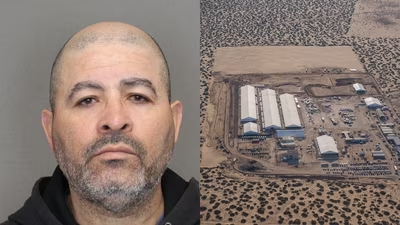
What truly happened to Geraldo Lunas Campos, the 55-year-old Cuban immigrant who died in a Texas detention center? Despite government assertions of suicide, forensic evidence tells a different story.
An autopsy report, as reported by the New York Times, found that Mr. Campos died from asphyxiation and ruled his death a homicide.
According to the report, on January 3 at the Camp East Montana ICE detention center, Mr. Lunas Campos became unconscious while being physically restrained by law enforcement. One officer pressed his knee into Mr. Campos’s back while another pinned his arms to the cold, concrete floor. The room buzzed with tension as the muffled sounds of struggle echoed. Emergency responders arrived swiftly, attempting resuscitation, but despite their efforts, Mr. Campos was pronounced dead at the scene.
The autopsy determined that the cause of death was “asphyxia due to neck and torso compression.”
The report also details injuries to Mr. Lunas Campos’s head and neck, including burst blood vessels in his neck and on his eyelids, according to the New York Times.
A Medical Classification, Not a Legal Determination
The medical examiner’s determination classifies the manner of death but does not establish legal guilt, as clarified by the New York Times.
Mr. Lunas Campos’s death has renewed scrutiny of the detention center following a Washington Post report. His family alleges he was killed by facility guards, citing a witness who claims to have seen guards choke him. The family is preparing a wrongful death lawsuit, according to their attorney, Will Horowitz, as reported by the New York Times.
“He was being abused and beaten and choked to death,” Jeanette Pagan Lopez, the mother of two of Mr. Lunas Campos’s children, told the New York Times last week. On Wednesday, Ms. Pagan Lopez said she had not yet seen the autopsy report.
Two Contradictory Versions
Federal officials have provided a different account. In a January 9 statement, they said Mr. Lunas Campos died on January 3 after experiencing medical distress. After the Washington Post article, they described his death as a suicide.
In an emailed statement on Wednesday, a Department of Homeland Security official reiterated that Mr. Lunas Campos attempted suicide, stating he “violently resisted the security staff” who were trying to assist him and that emergency responders attempted resuscitation.
The official did not respond to questions about the autopsy report, according to the New York Times.
Medical History and Witnesses Threatened with Deportation
The El Paso County Medical Examiner’s Office also released a toxicology report indicating Mr. Lunas Campos had a history of bipolar disorder and anxiety. The report found trazodone and hydroxyzine, prescription medications used to treat depression and anxiety. While such references to mental health history can provide context, they also raise important questions about whether they are used to deflect institutional responsibility for the circumstances surrounding his death.
On Tuesday, Mr. Lunas Campos’s family petitioned a federal judge to prevent the deportation of two individuals they say witnessed the death or events leading up to it. The family claims one detainee saw guards choke Mr. Lunas Campos, while another saw him struggle with guards before his death.
Both detainees have received deportation notices. Mr. Lunas Campos’s children asked the court to halt the deportations so the witnesses can testify in the family’s wrongful death lawsuit.
Background and Context
Federal officials stated that Mr. Lunas Campos was arrested in July in Rochester, New York, and transferred to the El Paso facility in September. Since entering the United States in 1996, he had been convicted of at least 10 crimes, including criminal possession of a weapon, reckless driving, and petit larceny.
Mr. Lunas Campos is one of three people in custody at Camp East Montana who have died since the facility opened in August on the Fort Bliss military base in El Paso. Since then, a pattern of fatalities has emerged that warrants attention. On December 3, Francisco Gaspar-Andres, 48, of Guatemala, died approximately two weeks after being admitted to an El Paso hospital, officials said. An autopsy report in his case indicates he died of complications from alcohol-related liver disease. On January 14, Victor Manuel Diaz, 36, of Nicaragua, died of a “presumed suicide,” according to federal officials, who said the official cause of death was under investigation. Mr. Diaz’s autopsy was being performed at the William Beaumont Army Medical Center, not the medical examiner’s office, according to Tricia McLaughlin, a spokeswoman for Homeland Security. The timing and frequency of these deaths call for a closer examination of the facility’s operations and oversight.
Source: New York Times