


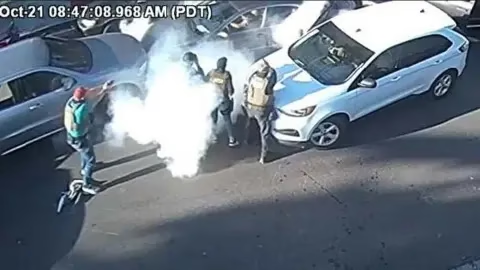
ICE officers are no longer authorized to chase drivers who refuse to pull over.
Under new guidance issued September 30, Immigration and Customs Enforcement has banned vehicle pursuits and PIT maneuvers and limited which officers may conduct a stop, a change the agency insists alters nothing, issued weeks after officers killed two men who were not their targets.
The document, obtained by ABC News, draws its hardest line around pursuits. “Under no circumstances are officers authorized to engage in vehicle pursuits or PIT maneuvers for vehicles that fail to pull over,” it reads. The PIT maneuver is a tactic that rams a fleeing car until it spins to a halt. Instead of chasing, officers are told to note the vehicle’s details and investigate later. The memo also sets who may conduct a stop: only Enforcement and Removal Operations officers with specific training can lead one; untrained officers may assist but not lead; and any vehicle used to make a stop must have working lights and a siren.
The agency says the memo “makes no changes” to its practices and that stops and arrests will continue as before. Yet a ban on pursuits, a training requirement, and a rule that enforcement vehicles must look like enforcement vehicles are, by any plain reading, changes. The agency is rewriting how its officers operate on the road while refusing to call it a rewrite.
On July 7 in Houston, an ICE officer fatally shot Lorenzo Salgado Araujo during an attempted vehicle stop. The Department of Homeland Security later admitted he was not the man agents were hunting; he had simply “resembled the target.” ICE said he turned his vehicle on an officer, who fired in self-defense.
Six days later, in Biddeford, Maine, an officer shot and killed Johan Sebastián Guerrero, a 26-year-old Colombian, during another attempted stop. Sen. Angus King of Maine, after Homeland Security Secretary Markwayne Mullin briefed him, said Guerrero was not the intended target either. ICE said he tried to flee; state authorities said his car moved toward an officer.
Strip away the competing accounts of each final moment and one fact survives both: the men who died were not the people ICE had set out to find. That is the failure the September memo answers — and the one it never names.
ICE’s handling of vehicle stops has shifted from one position to another in a matter of months.
After the two killings, Mullin ordered most vehicle stops halted while the agency reviewed what went wrong and built new training. Trump border czar Tom Homan insisted the pause was “not a policy change,” only a review. President Trump then overturned the pause, and stops resumed. The September memo keeps them going but fences them with limits.
Three stances in one season — stop, restart, restrict — describe an agency adjusting its tactics faster than it is willing to concede it is adjusting its policy.
A rule against chasing a car governs how an encounter ends. It does not address how these encounters began, with agents twice closing in on the wrong person. The memo is silent on the identification failures that put Salgado Araujo and Guerrero in an officer’s sights and on who answers for the outcomes.
For officers who come across a car that won’t pull over, the instruction is finally clear: leave it alone.
https://ctninfo.com/?p=44800&preview=true
Source: https://www.newsbreak.com/
AI Use Policy:
Some of CTN’s journalists are not native English speakers and draft their work in French or Haitian Creole. We then use AI-assisted translation software to produce the English versions, and traces of machine-generated phrasing may occasionally remain. Every article — in any language — is written, reviewed, and edited by CTN’s staff writers and editors, who remain responsible for its accuracy. CTN also uses AI to convert text into audio.