



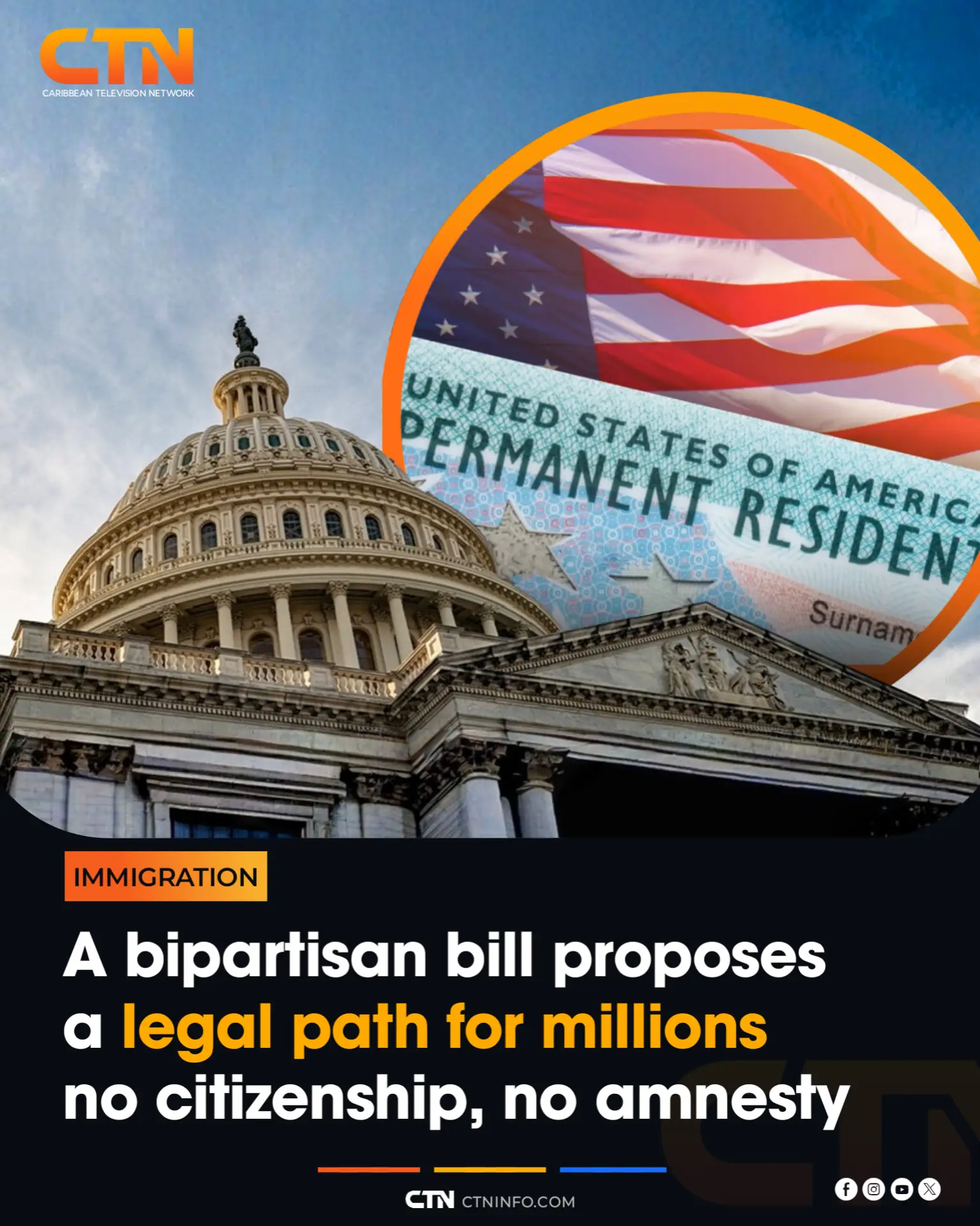
A group of Republican and Democratic lawmakers is pushing a sweeping immigration reform bill that would give millions of undocumented immigrants living in the United States a structured path to legal status — without offering citizenship or amnesty.
The legislation, known as the Dignity Act, is the most comprehensive bipartisan immigration proposal to move through Congress in decades, and its sponsors argue it addresses something that neither party has managed to fix in over thirty years.
The bill — H.R. 4393 — was introduced on July 15, 2025, by Representative María Elvira Salazar, a Republican from Florida, and Representative Veronica Escobar, a Democrat from Texas. It is an updated version of legislation Salazar had introduced previously, this time with a stronger bipartisan architecture and a broader coalition of supporters.
As of January 2026, the bill had secured 35 congressional cosponsors. It also had endorsements from 60 national organizations, including employers, veterans groups, faith communities, farmers, small businesses, construction industries, higher education institutions, and immigrant advocacy organizations. These endorsements make it the most broadly backed immigration reform proposal in decades, according to Newssweek.
What the bill contains
The Dignity Act does not offer a single solution. It is a multi-layered piece of legislation that tries to address the immigration system from several angles simultaneously — border enforcement, asylum processing, legal status for long-term residents, worker protections, and modernization of the legal immigration framework.
At its center is what the bill calls the Dignity Program. Under this provision, undocumented immigrants already living in the United States could apply for temporary legal status. Applicants must pass background checks, pay restitution and taxes, and maintain employment. The program is not a shortcut. It carries financial obligations and strict eligibility conditions. It also explicitly excludes anyone with a criminal record. The bill offers neither amnesty nor a path to citizenship. Its stated goal is to give long-term undocumented residents the stability of being able to live and work legally. They will be able to pay taxes and avoid living under constant threat of deportation.
To finance the program, the bill creates the Immigration Infrastructure and Debt Reduction Fund, supported by a 1% levy on income from those granted work authorization under the Dignity Program, projected to generate at least $50 billion—enough to cover costs and reduce the national debt. Separately, the American Worker Fund, financed through participant restitution payments, will cover upskilling and retraining for at least one American worker per immigrant in the Dignity Program.
On border security, the bill takes an enforcement-first posture. It requires the Department of Homeland Security to deploy physical barriers, technology, and personnel along the most strategically critical sections of the border. The bill mandates that most asylum claims be adjudicated by an asylum officer within 60 days. This would prevent most individuals from being released into the country while their cases are pending. Three humanitarian campuses would be established along the southern border to hold migrants during that adjudication window.
Nationwide mandatory E-Verify would also be codified under the bill, requiring every American business to confirm the legal work eligibility of its employees — a provision that targets the demand side of unauthorized labor rather than focusing exclusively on migrants at the border.
The legislation also reaches into legal immigration reform. It incorporates the American Families United Act. Under this act, family separation constitutes a presumption of hardship. The bill gives the Department of Homeland Security case-by-case authority to preserve family unity in proceedings involving the spouses or children of U.S. citizens. It also expands dual intent for international student visa applicants. This removes the requirement that F-1 visa holders prove they have no intention of remaining in the United States after their studies. This change aims to retain skilled graduates in the American workforce, rather than pushing them toward other countries. For unaccompanied minors, the bill would require criminal background checks for potential sponsors, with biometric samples where appropriate.
When will the bill be presented?
The Dignity Act is currently advancing through the House, having been referred to multiple committees, including the Judiciary Committee, the Committee on Homeland Security, and the Committee on Ways and Means, according to records on Congress.gov.
According to a Newsweek report, Representative Salazar is scheduled to present the bill at a Capitol Hill event on April 16, 2026, at 10 a.m. People familiar with her office’s plans told Newsweek she will face direct questions at the event. These will include pointed ones about how the bill fits within a political environment shaped by the Trump administration’s mass deportation agenda.
What the bill would accomplish if approved
The scale of what this legislation would change is hard to overstate. The last time Congress passed comprehensive immigration reform was in 1986, forty years ago, under President Ronald Reagan. Since then, the immigration system has remained structurally frozen. Meanwhile, the country, its economy, and the demographics of its immigrant population have changed dramatically.
If the Dignity Act became law, its most immediate consequence would be bringing millions of long-term undocumented residents out of legal limbo. Many have lived in the United States for decades, raised children who are U.S. citizens, paid into Social Security and Medicare without access to those benefits, and built lives in communities across the country. The Dignity Program would give them formal legal standing. It is not citizenship, but it allows them to work openly, pay taxes transparently, and live without the constant risk of deportation.
Polling cited during the bill’s introduction found that eight out of ten Americans believe immigration benefits the country. Most also support allowing undocumented immigrants to earn legal status if they meet requirements over time. This level of public consensus rarely shows up on any policy question in today’s political environment.
The asylum reforms would carry equally significant practical effects. The current immigration court backlog stretches into the millions of cases, with wait times of 3, 4, or 5 years. A 60-day adjudication standard, backed by properly funded asylum officers, would compress that timeline dramatically — reducing the limbo period for migrants, reducing the administrative burden on courts, and producing faster, more legally sound outcomes.
Colleen Putzel-Kavanaugh, an associate policy analyst at the Migration Policy Institute, told Newsweek that immigration policy has historically focused almost exclusively on enforcement at the southern border while other parts of the system stagnated under massive backlogs. The Dignity Act, she noted, examines the full length of the immigration process and proposes solutions at multiple points — with bipartisan support.
On the economic front, the mandatory E-Verify provision and the American Worker Fund together attempt to rebalance the labor market. By requiring businesses to verify worker eligibility, the bill would reduce the underground economy that has long kept undocumented workers in exploitative conditions. This problem also undercuts wage floors for American workers in certain industries. The retraining fund would direct resources specifically toward American workers in sectors where immigrant labor is concentrated.
For the estimated population of Dreamers — young people brought to the United States as children — the bill would provide conditional permanent resident status to children who have been continuously present in the U.S. since January 1, 2021, were 18 years old or younger when they entered, and meet additional eligibility requirements. For this group, the stakes are existential: their entire lives are American, and their legal status has been mired in political uncertainty for years.
The reactions
The bill’s bipartisan makeup has not shielded it from sharp criticism, particularly from within the Republican Party. Hardline members of the MAGA wing of the GOP have labeled it amnesty. They argue it betrays the mass-deportation mandate that was a core pillar of Donald Trump’s 2024 campaign.
Representative Brandon Gill of Texas has been among the most vocal opponents. He calls the legislation a betrayal of Republican voters and insists that legal status for undocumented immigrants, under any conditions, is incompatible with the administration’s immigration posture. Salazar, herself the daughter of immigrants and a representative of a heavily Hispanic district in Miami, pushed back forcefully. She accuses critics of distorting the bill’s contents without reading it.
David Bier, director of immigration studies at the libertarian Cato Institute, told Newsweek that the tension between mass deportation and the Dignity Act is real but not necessarily irreconcilable. Trump’s stated enforcement priorities, Bier noted, have centered on removing criminal elements — and the Dignity Act specifically bars anyone with a criminal record from participating in the program, which he argued was consistent with the GOP platform and the administration’s stated direction.
From the left, some critics have argued that a bill without a citizenship pathway falls short of meaningful reform, leaving long-term residents in a permanent second-class legal status rather than fully integrating them into the country’s civic fabric.
What neither side disputes is that the status quo is untenable. A system that has gone substantially unchanged for 40 years, that leaves millions in legal uncertainty, that processes asylum claims over years rather than months, and that has failed to establish workable labor verification at scale is not serving anyone well. Whether the Dignity Act is the vehicle that finally changes it — or whether it becomes another casualty of a polarized Congress — will depend on whether enough members on both sides are willing to accept a bill that gives neither side everything it wants.

Sources: Representative María Elvira Salazar’s official congressional website (salazar.house.gov); National Immigration Forum bill summary (forumtogether.org); NAFSA: Association of International Educators; Congress.gov — H.R. 4393, 119th Congress; Floridian Press; WLRN Public Media; Newsweek, April 8, 2026.