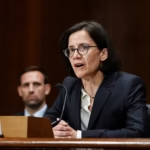



U.S. District Judge Ana C. Reyes on Thursday, February 6, 2026, responded to a motion for a stay filed by the Trump administration.
Judge Reyes found the government’s proposed timeline unreasonable and delayed the administration’s request for a rapid decision, instead scheduling a hearing for February 12, days after the administration’s requested deadline of February 9 at noon.
Judge Reyes immediately highlighted the asymmetry between the time the government allotted itself to prepare its motion and the time it was asking the court to rule.
The government took three business days to file its motion. Now it asks the court to rule in one business day and three hours, without any justification for this expedited schedule, the judge wrote.
Due to this imbalance, the court found that the plaintiffs—Haitian TPS beneficiaries—should be given equal time to prepare their response.
Judge Reyes ruled that plaintiffs should have equal time to the government to draft their opposition, citing the seriousness of the issues.
The plaintiffs have until noon on February 11, 2026, to respond. The government must submit a sworn declaration by February 10, 2026, at 10:00 a.m.
A hearing on the motion will be held on February 12, 2026, at 10:00 a.m., where both sides will present arguments.
Government Ordered to Justify Its Claims
Judge Reyes expects detailed explanations from the government at the hearing.
“At the hearing on the government’s motion, the court expects the government to articulate, among other things, how irreparable harm and the other stay factors weigh in its favor,” she wrote.
The government argued in its 25-page motion that the court’s order interferes with the functions of another branch of government, specifically by preventing the administration from terminating TPS for Haiti as planned.
Judge Reyes said this claim remains abstract: it lacks any concrete example.
The most consequential part of the order addresses what the judge identified as a contradiction in the government’s position.
Previously, the administration stated that the likelihood of detaining or initiating removal proceedings against Haitian nationals if TPS were terminated was minimal. It described these risks as unlikely, speculative, or merely hypothetical.
Judge Reyes said this position is a major problem: “This is troubling given the government’s statements that it was ‘remote conjecture,’ ‘speculation,’ and ‘theoretical’ that it would detain or remove Haitian nationals if TPS ended.”
Judge Reyes highlighted a central contradiction: if the government has no plan to remove Haitian TPS holders, its claim of irreparable harm is weakened; if it does, its claim that plaintiffs face no irreparable harm is suspect.
This analysis exposes the government’s contradiction: it cannot claim irreparable harm while saying TPS beneficiaries have nothing to fear if the order ends.
Sworn Declaration Required
To clarify, Judge Reyes ordered the government to provide concrete evidence of its intentions.
“So that the court has all relevant information, it ORDERS the government to submit a sworn declaration from a senior member of the Department of Homeland Security stating what steps, if any, DHS has taken in anticipation of the February 3, 2026, termination (now stayed),” the order states.
The government must say whether DHS took steps to deploy ICE agents to areas with many Haitian TPS beneficiaries, including Springfield, Ohio, and South Florida.
The court also anticipated a possible negative response: “If the government has taken no action in anticipation of the termination, the declarant must say so.”
This requirement puts the government in a tough spot: if it took no steps, its ‘irreparable harm’ claim is weaker; if it did, it contradicts its own assertions.
The order represents a setback for the Trump administration, which had sought a rapid decision while already appealing the case to the U.S. Court of Appeals for the D.C. Circuit.
In its February 5 motion, the government argued that the situation required urgent resolution. Justice Department attorneys requested a quick ruling by noon on February 9, indicating that if Judge Reyes did not grant the stay, they would promptly seek relief from a higher court.
The government cited two prior Supreme Court cases involving Venezuelan TPS beneficiaries, in which the Court granted emergency stays in 2025, suggesting that these precedents supported its request for immediate action in the current case.
By declining to rush, Judge Reyes ensured procedural fairness by allocating equal time to each side, underscoring the central issue of equal treatment in the case.
Background of the Case
The order comes during an intensifying legal fight.
On February 2, 2026, Judge Reyes issued an order blocking the termination of TPS for Haiti, on the eve of the program’s scheduled expiration on February 3.
That decision followed two days of hearings in January, during which the judge sharply questioned government attorneys about inconsistencies in the administration’s justification for ending TPS.
Three days later, on February 5, the government simultaneously filed a notice of appeal and a motion to stay Judge Reyes’s decision. The appeal was officially docketed at the D.C. Circuit Court of Appeals on February 6.
The schedule is now set:
- February 10, 2026, at 10:00 a.m. The government must submit the sworn declaration from a senior DHS official.
- February 11, 2026, at noon: The plaintiffs must file their response to the motion for a stay.
- February 12, 2026, at 10:00 a.m.: Judge Reyes will hold a hearing on the motion for a stay.
For over 350,000 Haitian TPS beneficiaries, Judge Reyes’s order blocks the termination of their status and work authorization pending the court’s final decision, highlighting the stakes at the center of the dispute.