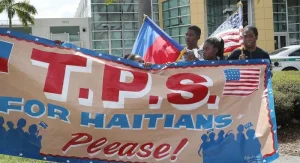



Hours after filing a notice of appeal, the Trump administration asked Judge Ana C. Reyes to stay her own order protecting beneficiaries of Temporary Protected Status (TPS) from Haiti.
In a 25-page motion filed on February 5, 2026, the government advanced a battery of legal arguments to overturn the ruling issued three days earlier.
Justice Department attorneys are demanding a swift response: “Defendants request that the Court rule on this motion no later than Monday at 12:00pm so that they may seek appropriate appellate review.”
The government’s primary argument is that the court lacked authority to review this case.
The government contends that Congress explicitly prohibited judicial review of the Secretary of Homeland Security’s TPS decisions, citing the TPS statute.
“By foreclosing ‘judicial review,’ Section 1254a(b)(5)(A) bars all of Plaintiffs’ APA and constitutional challenges to Secretary Noem’s vacatur and termination determinations,” the government attorneys write.
They quote a 1989 congressional report: “Moreover, none of the [Secretary’s] decisions with regard to granting, extending, or terminating TPS will be subject to judicial review.”
The government argues that its interpretation is supported by two Supreme Court orders that paused similar rulings in Venezuelan TPS cases, suggesting it is likely to prevail on appeal.
The administration criticizes Judge Reyes for reviewing the internal consultation process between federal agencies, claiming this review exceeds judicial authority.
The government argues that the Court intruded on a well-established principle by reviewing the sufficiency of consultation. That principle requires ‘judicial deference and restraint’ when ‘internal Executive Branch communications’ are involved. The government cites a 2025 Supreme Court decision in United States DOGE Service v. Citizens for Responsibility & Ethics in Washington.
The government also challenges the judge’s analysis of conditions in Haiti. “The Court looked at the country conditions in Haiti and described it as a ‘country in chaos and crisis,’ effectively taking on the role of a foreign policy expert. But in doing so, the Court reached its own conclusion based on its review of the evidence, and that it cannot do.”
Secretary Noem Claims Return to Haiti Is Possible
The government says Secretary Noem decided there are no extraordinary, temporary conditions in Haiti preventing Haitian nationals from safely returning. They add that allowing the aliens to remain temporarily in the United States is against the national interest.
The government argues that considering ‘national interest’ is within the Secretary’s discretion, as permitted by Congress in TPS decisions, and ensures a consistent immigration policy.
The government firmly rejects Judge Reyes’s conclusion that the TPS decision was ‘preordained,’ presenting this as a key point of dispute.
Prosecutors argue, “The Federal Register Notice and Certified Administrative Record show that the Secretary made a decision based on evidence before her. This makes it an independent decision.”
They quote the Supreme Court: “It is hardly improper for an agency head to come into office with policy preferences and ideas, discuss them with affected parties, sound out other agencies for support, and work with staff attorneys to substantiate the legal basis for a preferred policy.”
The government adds that agencies must follow binding executive orders unless overruled by lawful procedures. The court, they argue, cannot fault the Secretary for acting in accordance with the law.
The administration challenges the court’s use of President Trump’s public statements to establish discriminatory intent.
“The Supreme Court declared that statements made ‘remote in time and in unrelated contexts’ do not qualify as contemporary statements probative of the decision at issue,” the motion cites, referencing the 2020 ruling in DHS v. Regents of the University of California.
Regarding statements made after the inauguration, the government invokes presidential immunity: “A president maintains ‘broad powers to speak on matters of public concern’ including ‘a vast array of activities that touch on nearly every aspect of American life,’” citing the 2024 ruling in Trump v. United States.
“Cat’s Paw” Theory Rejected
The court accepted the so-called “cat’s paw” theory, under which the President influenced Secretary Noem’s decision. The government vigorously disputes this analysis.
“That is not a viable legal theory, especially in the TPS context,” the prosecutors assert, citing the Ninth Circuit Court of Appeals in Ramos v. Wolf: “We doubt that the ‘cat’s paw’ doctrine of employer liability in discrimination cases can be transposed to the particular context of TPS terminations.”
The government warns that such a theory opens the door to impermissible intrusion on privileged Executive Branch deliberations and prompts potential litigation-driven discovery that would disrupt a president’s execution of the laws.
The administration disputes the breadth of Judge Reyes’s order, arguing its impact should be limited to the plaintiffs of the case.
Only five plaintiffs are parties to the case, yet Judge Reyes granted protection to all Haitian TPS beneficiaries.
The government argues that the Supreme Court has made clear that a universal injunction falls outside a federal court’s equitable authority under the Judiciary Act, citing the 2025 ruling in Trump v. CASA, Inc.
That decision says a court may give complete relief to parties. However, it should not issue broader injunctions that affect implementation more widely.
The prosecutors note that on February 3, 2026, the Court expressly declined to rule on Plaintiffs’ motion for class certification. “Therefore, the Government is likely to succeed in maintaining that relief under § 705 should be and is limited only to the five named plaintiffs.”
Government Claims “Irreparable Harm”
The administration claims the order causes harm by interfering with the Secretary’s authority to make national security and interest determinations granted by Congress.
The prosecutors write that the Court’s order improperly intrudes into the workings of a coordinate branch of the Government, citing a 1993 decision by Supreme Court Justice O’Connor.
The government emphasizes that “Congress delegated the Secretary’s ‘sole and unreviewable’ discretion to make this determination.”
The administration downplays the fears expressed by TPS beneficiaries. None of the Plaintiffs alleged that they have outstanding removal orders. Therefore, the Government is likely to prevail on its argument that Plaintiffs’ fear is based on conjecture and nothing else.”
The government asserts that the plaintiffs have demonstrated that nothing stops them from affirmatively seeking relief from removal by filing applications with U.S. Citizenship and Immigration Services.
If removal proceedings start, plaintiffs can present fear claims before an immigration judge, appeal any adverse ruling to the Board of Immigration Appeals, and file a petition for review with the appropriate court of appeals.
Regarding the loss of employment cited by plaintiffs, the government maintains that the court for using old sworn declarations. They argue these are now several months out of date. The court for relying on sworn declarations that are several months old.
The government states that by relying on stale declarations, the Court effectively found that Plaintiffs’ harm from months ago is the same harm they suffer today, citing a 2025 decision holding that courts should decline to consider stale declarations when assessing irreparable harm.
Order Allegedly Violates Another Statutory Provision
In a separate argument, the government contends that the court’s order violates Section 1252(f)(1) of the U.S. Code, which strips courts (other than the Supreme Court) of jurisdiction or authority to enjoin or restrain the operation of certain immigration law provisions.
“This Court granted relief that enjoins or, at the very least, restrains the Government’s ability to enforce the Secretary’s decision to terminate Haiti’s TPS designation. That relief squarely falls within the limitation imposed by § 1252(f)(1), and this Court respectfully lacked the authority to grant such relief,” the government argues.
The motion was filed by Assistant United States Attorneys Dhruman Y. Sampat and Amanda L. Torres, under the authority of United States Attorney Jeanine Ferris Pirro.
If Judge Reyes refuses to stay her own order, the government has clearly signaled its intention to seek relief immediately from the D.C. Circuit Court of Appeals and, potentially, the Supreme Court.
For the more than 350,000 Haitian TPS beneficiaries, this legal uncertainty remains unresolved as the government’s strategy plays out in court.
Their fate now depends on a legal race against time between the federal courts and an administration determined to end their protection.