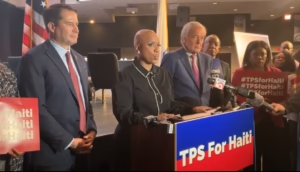



In an exclusive interview with Caribbean Television Network, Representative Ayanna Pressley, who serves as co-chair of the House Haiti Caucus, discusses the bipartisan momentum behind efforts to extend Temporary Protected Status for Haitians, the recent court victory, and why she says, “Don’t underestimate me.”
As the legal battle over Temporary Protected Status for Haitian nationals continues in federal courts, Congresswoman Ayanna Pressley is spearheading an urgent legislative fight in Congress.
Through a discharge petition, she aims to force action on protections for Haitian TPS holders—an effort gaining unexpected bipartisan support.
In an exclusive interview with Caribbean Television Network’s Emmanuel Paul, the Massachusetts Democrat and co-chair of the House Haiti Caucus, outlined a multipronged strategy to protect more than 350,000 Haitian TPS holders from deportation, while revealing that several Republican lawmakers have joined the effort.
Congresswoman Pressley began by addressing the recent ruling by Judge Ana C. Reyes, who stayed the Trump administration’s termination of TPS for Haiti just hours before it was set to expire on February 3, 2026.
“This recent ruling marks an essential step in defending Haitian families, but it is only temporary,” Pressley told CTN. “It’s encouraging. It’s a testament to the impact, the strength, and power of public outcry and pressure. But it is only temporary. So, our work is not done.”
The congresswoman made clear that the court’s decision, while a reprieve, highlights the temporary nature of relief and increases the urgency of legislative action.
“It buys us some time until the case is fully litigated, but it could still go to the Supreme Court,” she explained. “That’s why we have to continue in our fight for extended protections because if the president won’t act to protect Haitian lives, then the courts and Congress must.”
The Discharge Petition: A Legislative Tool to Force Action
With the Republican-controlled House unlikely to bring TPS extension legislation to the floor voluntarily, Pressley has turned to a rarely used procedural mechanism known as a discharge petition.
“Given the dysfunction of a Republican majority Congress, increasingly you’ve heard about Democrats using the tool of discharge petition,” Pressley explained. “A discharge petition forces a vote on the House floor, and you need 218 signatures.”
She noted the discharge petition has gained over 100 bipartisan signatures, including support from Congresswoman Maria Salazar of Florida.
“We have tremendous momentum where over a hundred signatures have been collected, and it is also bipartisan,” she said. “We have a congresswoman from Florida, Maria Salazar, who has signed the discharge.”
Pressley also pointed to recent statements from Ohio Governor Mike DeWine, a Republican, who publicly stated that TPS must be extended for Haitian nationals.
“I think that just underscores the impact that Haitian TPS holders have on our economy, in our communities, in civic life,” Pressley said. “Whether you’re talking about the governor from Ohio or whether you’re talking about Congresswoman Salazar from Florida, they know that to not extend TPS, to separate people from their families, to deport them to a country that is beautiful but very much in the grips of political instability and violence and recovering from assassinations and natural disasters—that it would be a death sentence.”
Economic Consequences of Ending TPS
Representative Pressley stressed that ending TPS would have urgent, extensive consequences across many communities, intensifying the need for immediate legislative action.
“Moreover, ending TPS would have a severe impact on key sectors of our economy. Health care systems, construction companies, and hospitality businesses rely heavily on Haitian TPS holders. Their loss would create staffing shortages and disrupt services in these industries,” Pressley warned. “So, we’re just going to continue to leverage every tool at our disposal to fight for TPS for Haitians for three more years.”
Her comments echo those made by Governor Maura Healey of Massachusetts, who noted that many Haitian TPS holders work as nurses, home health aides, and certified nursing assistants—roles essential to keeping hospitals and care facilities running smoothly.
When asked about her confidence in securing the additional Republican votes needed to reach the 218-signature threshold, Pressley was characteristically direct.
“Well, I won’t make any predictions, but what I will say is don’t underestimate me and the strength of this coalition,” she said. “I’m encouraged by where we are, and we just have to keep pushing. It’s a matter of life and death.”
The congresswoman noted that a congressman from New York has also signaled willingness to sign the petition, in addition to Congresswoman Salazar from Florida.
“I’m appealing to all of my colleagues on both sides of the aisle to support extending TPS,” Pressley continued. “It is certainly not a charitable appeal. This is reciprocity. This is the very least we can do. And what our Haitian neighbors and constituents are owed for the many contributions that they’ve made.”
She added a personal note about why she believes TPS holders deserve to stay.
“I want TPS holders to remain in this country because they are already home,” said Mrs. Pressley, one of the fiercest defenders of Haitian immigrants in Congress.
No Deadline, But Relentless Pressure
When asked whether there was a specific deadline for reaching the 218 signatures needed to force a floor vote, Pressley said the effort would continue indefinitely.
Pressley explained, “I don’t have a deadline. We keep pushing to reach 218 signatures because the stakes are urgent. We’re leveraging legal and legislative paths—necessary interventions and protections must happen now. Failing to extend TPS would be devastating.”
The congresswoman acknowledged ongoing coordination with Senator Edward J. Markey, who has been a vocal advocate for Haitian TPS holders and filed an amicus curiae brief in the Miot v. Trump case that was referenced in Judge Reyes’s decision.
“I can’t speak to that because conversations are ongoing and the outcome of those conversations is an emerging situation,” Pressley said when asked about efforts to secure Republican support in the Senate. “I won’t speak to that except to say that I’m grateful for the partnership of Senator Markey and that this legislation is bicameral.”
She emphasized that her immediate focus is on the House.
“My job right now is to hit the 218 and to force that vote in the House, which, of course, it’s unfortunate that we have to continue to resort to discharge petitions given the dysfunction under the Republican majority,” she said.
However, Pressley noted that Democrats have recently had success with this approach.
“The Democrats have had success both with the Affordable Care Act subsidies extension, along with the release of the Epstein files,” she said.
Protecting the Haitian Community from ICE
With rumors circulating in the Haitian community about potential ICE operations targeting immigrants, Pressley addressed the broader threat facing her constituents.
“If it is not extended, we know that will put the Haitian community right in the sightline as targets of the rogue and racist agency that is ICE,” Pressley said. “The Haitian community is right at the intersection of anti-Blackness and xenophobia.”
The congresswoman sharply criticized the Trump administration’s rhetoric toward Haitians.
“When you have an administration that traffics in anti-Blackness and xenophobia, that has referred to Haiti as a ‘shithole country,’ that has trafficked in outright lies and racist tropes about the Haitian community, it puts everyone at risk,” she said. “Their rhetoric is inflammatory and incendiary and dangerous. Their policies are dangerous. And the Haitian community constantly finds itself in the crosshairs of this administration.”
Pressley expressed gratitude for state and local officials who have stepped up to defend the Haitian community.
“I’m so grateful for my colleagues on the municipal and the state level who recognize the contributions of the Haitian community, those TPS holders, and how essential it is that we fight, defend, and protect the Haitian community,” she said.
As the interview concluded, Pressley argued that grassroots organizing and community pressure are the driving forces behind the TPS fight’s momentum.
“I just want to acknowledge that I can’t do this work alone,” she said. “I’m so grateful for the activism, for the organizing that is occurring not only in the Haitian community but all people of conscience.”
She continued: “It is that pressure. It is that public outcry. It is that communal collective commitment to one another, to one another’s humanity and dignity and the integrity of their families and their livelihoods and lives, that is why we have the momentum that we have in this moment.”
Pressley urged supporters to continue their efforts.
“I saw a number of folks yesterday that were participating in phone banking efforts in Massachusetts,” she said. “Keep it up. Keep it up.”
The Road Ahead
The fight over Haitian TPS remains on multiple fronts.
In the courts, the Trump administration has announced its intention to appeal Judge Reyes’s decision, potentially all the way to the Supreme Court.
Assistant Secretary of Homeland Security Tricia McLaughlin called the ruling “lawless activism” and vowed that “the final word will not be from an activist judge legislating from the bench.”
In Congress, Pressley and her allies continue to gather signatures for the discharge petition, aiming to force a floor vote that would bypass the Republican leadership’s refusal to bring TPS legislation to a vote.
Haitian families across the country wait as their futures depend on outcomes in the courts and Congress.
For now, the court-ordered stay remains in effect, and Haitian TPS holders can continue to live and work legally in the United States. But as Congresswoman Pressley made clear, the fight is far from over.
“Something must be done,” she said. “There must be necessary interventions. There must be protections. TPS must be extended.”
Congresswoman Pressley represents the Massachusetts 7th Congressional District, which includes parts of Boston, Cambridge, Somerville, Randolph, Everett, Chelsea, and Milton. The district is home to the third-largest Haitian diaspora in the United States.
As co-chair of the Haiti Caucus, Ayanna Pressley stands out as a leading advocate for Haitian immigrants in Congress. She is joined by Yvette Clarke of New York and Frederica Wilson of Florida, both active Caucus members, as well as several other members of the Congressional Black Caucus.
The Haiti Caucus, founded by former Representative Andy Levin of Michigan, represents a cornerstone of congressional support for Haitians in the United States.