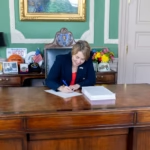



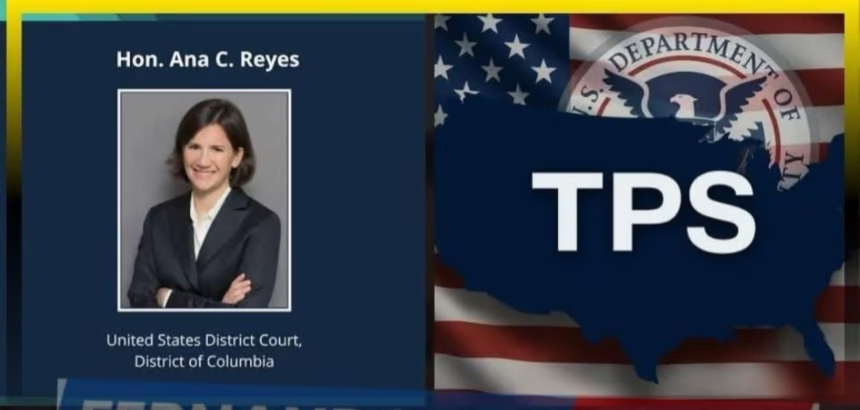
A federal judge in the District of Columbia has granted Haitian plaintiffs a significant legal victory by staying Secretary of Homeland Security Kristi Noem’s revocation of Temporary Protected Status (TPS) for Haiti.
This decision, issued just hours before the scheduled TPS expiration on February 3, 2026, provides crucial relief to hundreds of thousands of Haitian nationals living and working in the United States.
In her ruling, Judge Reyes granted the plaintiffs’ renewed motion for a stay under 5 U.S.C. § 705, thereby staying “the effective date of Department of Homeland Security Secretary Kristi Noem’s Termination of the Designation of Haiti for Temporary Protected Status, 90 Fed. Reg. 54733 (Nov. 28, 2025).”
The judge was categorical regarding the effects of this stay: “During the stay, the Termination shall be null, void, and of no legal effect.”
This language clearly defines the scope of protection for Haitian TPS beneficiaries.
Judge Reyes’s order specifies the protections that remain in effect during the judicial stay.
“The Termination therefore does not affect the protections and benefits previously conferred by the TPS designation, including work authorization and protection from detention and deportation, and the valid period of work authorization extends during the stay,” the judge wrote, citing the relevant provisions of the U.S. Code (8 U.S.C. § 1254a(a)(1)–(2), (d)(4)).
The decision also protects individuals whose TPS applications are pending. “The Termination also has no effect on the eligibility for work authorization and protection from detention and deportation for individuals, if any, with pending applications,” the order specifies.
Government’s Motion to Dismiss Denied
In addition to granting the stay, Judge Reyes denied the government’s motion to dismiss, though the denial is “without prejudice,” meaning the government could file a new motion in the future.
The judge explained her decision in these terms: “The Court’s conclusion that it has jurisdiction to hear Plaintiffs’ Motion applies equally to the Government’s Motion. The Court’s separate conclusion that Plaintiffs are likely to succeed on the merits of their claims necessarily entails its view that they plausibly stated their claims.”
This statement is significant because Judge Reyes affirms that the plaintiffs are “likely to succeed on the merits,” indicating the strength of their legal arguments against the TPS revocation.
However, the judge left the door open for the government: “To the extent the Government believes that arguments for dismissal remain outstanding, it may refile a motion to dismiss limited to those issues.”
The order also addresses an argument raised by the government regarding the possibility for plaintiffs to bring a claim under the Administrative Procedure Act (APA) against the President of the United States.
“The Government contends that Plaintiffs cannot bring an Administrative Procedure Act claim against the U.S. President,” Judge Reyes notes in her order.
However, the court found it unnecessary to decide this issue, as the plaintiffs had forfeited their APA claim against the President: “The Court need not address this issue, as Plaintiffs have forfeited their APA claim against the President.”
The judge acknowledges the limits of her decision: “In any event, nothing in the Memorandum Opinion or this Order, which stays the Secretary’s Termination, should be construed as an order constraining the President.”
This clarification distinguishes Secretary Noem’s action, which is stayed, from any potential action by President Trump, which is not affected by this order.
The Plaintiffs in This Case
The case, “Fritz Emmanuel Lesly Miot et al. v. Donald J. Trump, et al.” (Case No. 25-cv-02471), was brought by Haitian nationals who are TPS beneficiaries. Lead plaintiff Fritz Emmanuel Lesly Miot and others challenged the legality of the Trump administration’s decision to terminate the program.
Judge Reyes’s decision is based on her review of the “Second Amended Complaint” (Dkt. 90), counsel’s briefs and arguments, and the evidence submitted for and against the plaintiffs’ renewed motion.
This diligence reflects the judge’s earlier remarks that “Snow notwithstanding, the Court and its clerks have worked remotely through the weekend” on this case.
Judge Reyes’s order has immediate and direct implications for Haitian TPS beneficiaries:
First, work authorizations remain valid and are extended for the duration of the judicial stay. Employers cannot terminate employment based on immigration status.
Second, TPS beneficiaries are protected from detention by immigration authorities and cannot be arrested or detained based on their immigration status during the stay.
Third, they are protected from deportation. No removal proceedings can be initiated due to the expiration of their TPS, as that expiration is now stayed.
Fourth, individuals with pending TPS applications remain eligible for these protections.
Judge Reyes’s order stays the revocation “pending judicial review,” meaning the case will continue as the court examines the merits of the plaintiffs’ arguments.
The government may appeal this decision to the D.C. Circuit Court of Appeals and, if necessary, to the Supreme Court.
For now, Haitian TPS beneficiaries can breathe a sigh of relief. Judge Ana C. Reyes’s decision grants them significant legal respite and maintains the protections established when the Department of Homeland Security designated Haiti for TPS in 2010 after the devastating earthquake.
The judge’s decision is available through the links below.