


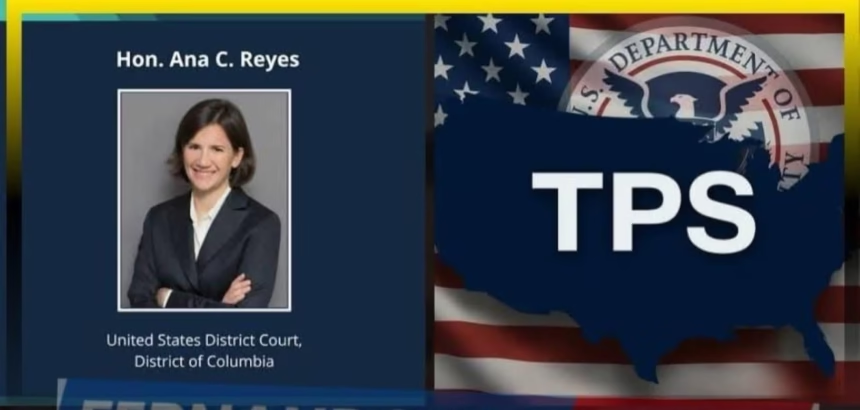
Judge Ana C. Reyes canceled the status conference scheduled for Friday, January 30, 2026, in the case pitting five Haitian nationals against the federal government over Temporary Protected Status (TPS).
The decision, issued as a Minute Order, followed correspondence from both parties stating that they no longer considered the hearing necessary. Judge Reyes thus streamlined the immediate procedural calendar, allowing the parties to focus on other aspects of the litigation.
Despite the canceled hearing, active discovery and evidence exchanges continue behind the scenes, as court documents show.
A notice filed by Geoffrey Pipoly on behalf of the plaintiffs, Rudolph Civil, Vilbrun Dorsainvil, Marica Merline Laguerre, Fritz Emmanuel Lesly Miot, and Marlene Gail Noble, highlights technical negotiations dating back to January 23.
The filing includes two crucial attachments:
A counterproposal regarding search terms, dated January 23, indicates that the parties are negotiating how electronic data and documents should be filtered and extracted for the case.
An email correspondence documenting direct exchanges between legal counsel regarding these technical parameters.
These documents show substantive discussions on evidence search protocols continue despite the hearing’s cancellation.
The plaintiffs also filed a notice regarding the government’s motion for reconsideration, referenced as Document 111 in the court registry.
Judge Reyes called the government’s reconsideration motion, which challenged a directive that had already been met, ‘moot’ in an earlier order.
“The Court does not understand why the Government felt compelled to submit a nine-page motion to reconsider a directive the Government had already met,” Judge Reyes wrote, adding that the government “has only itself to blame for wasting time drafting a motion that was moot from the jump.”
The Plaintiffs and Their Representatives
The plaintiffs in this case are five Haitian nationals: Rudolph Civil, Vilbrun Dorsainvil, Marica Merline Laguerre, Fritz Emmanuel Lesly Miot, and Marlene Gail Noble. They are represented in part by the ACLU (American Civil Liberties Union) and seek to demonstrate that the Trump administration’s decision to terminate TPS was motivated by discriminatory considerations.
Geoffrey Pipoly, who filed the notice about ‘search terms’ (the criteria for identifying relevant electronic documents), is part of the plaintiffs’ legal team managing these procedural tasks.
The case is now focused on highly technical, procedural management, as shown by the hearing’s cancellation and search term negotiations.
Judge Reyes’s role in validating that a formal meeting on January 30 was unnecessary allows the parties to focus on resolving the motion for reconsideration and refining the data-collection methods initiated on January 23.
These developments come just before TPS for Haitians is set to expire on February 3, 2026.
Judge Reyes must still rule on the government’s motion to dismiss and on the plaintiffs’ request for emergency relief before that deadline.
If the court does not rule favorably, over 350,000 Haitian nationals—and possibly up to 560,000—could lose work authorization and deportation protection.
The judge has also announced her intention to use as evidence a speech by President Trump at CPAC in which he declared: “If I hadn’t been elected president, there’d be nobody left in Haiti.”
The case awaits further judicial directives, depending on search term negotiations and rulings on pending motions.
The plaintiffs continue to structure their response to the government’s arguments as the February 3 deadline approaches.