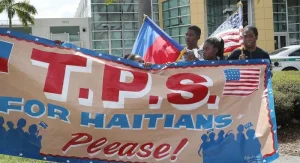



On January 28, 2026, the Ninth Circuit upheld the invalidation of Secretary of Homeland Security Kristi Noem’s efforts to revoke TPS for Venezuelan and Haitian nationals.
For Haitian beneficiaries, however, this decision may not have the desired effect, as their TPS is set to expire on February 3, 2026—less than four days away.
The Court ruled that the administration not only exceeded its legal authority, meaning it acted beyond the powers granted by law, but also acted in an arbitrary and capricious manner. In legal terms, “arbitrary and capricious” means making decisions without reasonable grounds or adequate consideration of the circumstances, often implying a lack of fair process or rational basis.
The issue centered on whether the TPS law (8 U.S.C. § 1254a) allows the Secretary to vacate an existing designation or extension beyond her authority to designate, extend, or terminate TPS.
Noem moved to vacate Venezuela’s 18-month extension and shorten Haiti’s extension from 18 to 12 months.
The Court rejected these actions, stating that “the power to do does not necessarily entail the power to undo.” Congress designed the TPS program to be predictable and insulated from political shifts, guaranteeing stability for periods of six to eighteen months, the judges noted. By attempting to cancel these protections while they were still in effect, the Secretary violated the plain text of the law, which stipulates that a designation remains in effect until its expiration date or lawful termination with 60 days’ notice.
Government’s Jurisdictional Arguments Rejected
The government attempted to block judicial review by invoking two provisions: Section 1254a(b)(5)(A), which bars review of the Secretary’s “determinations,” and Section 1252(f)(1), which restricts courts’ ability to enjoin enforcement of immigration laws.
The Court firmly rejected these arguments. It clarified that the bar on judicial review does not apply when a Secretary acts entirely outside the authority delegated by Congress.
According to the judges, accepting the government’s position would create an absurd result: a Secretary could, for example, grant TPS for an illegal 30-year period without anyone being able to challenge the decision.
Regarding restrictions on injunctions, which are court orders requiring parties to do or refrain from doing specific acts, the Court noted that setting aside an agency action under the Administrative Procedure Act (APA) constitutes a form of relief distinct from an injunction and does not violate the statutory limits on injunctions.
The administration argued that it possessed inherent authority to reconsider its predecessors’ decisions, citing the need to correct errors or change policy.
The Court countered that this inherent authority is strictly limited to correcting minor clerical or administrative errors.
In this case, the TPS revocation was not an error correction but a deliberate attempt to impose a new immigration policy, the judges explained, noting that Congress explicitly established procedures for terminating TPS, including an assessment of conditions in the affected country and adequate notice. Allowing immediate revocation would render these legislative protections meaningless.
Devastating Human Consequences
The Court extensively documented the devastating impact of Secretary Noem’s actions.
By abruptly canceling the status extensions, the government disregarded the reliance interests of hundreds of thousands who built their lives on these protections.
The judges cited examples of people—doctors, artists, mechanics, students—who were detained, deported, lost jobs, or became homeless after losing TPS.
The Court criticized the government for minimizing these consequences and failing to provide a sufficient explanation for its policy reversal.
Judge Mendoza Denounces Racial Pretext
In a particularly scathing concurring opinion, Judge Mendoza emphasized that the Secretary’s actions should have been invalidated regardless due to their arbitrary and capricious nature.
He asserted that the official justifications published in the Federal Register were merely a pretext masking hostility based on race or national origin.
Judge Mendoza identified a “significant mismatch” between the factual record and the government’s explanations. For example, the administration claimed that the revocation was necessary to reduce administrative confusion, while the evidence showed that previous consolidation measures had actually simplified the processes.
The judge also cited public statements by Secretary Noem and President Trump to illustrate this bad faith:
Secretary Noem called TPS beneficiaries “dirtbags” and claimed without evidence that Venezuela was emptying its prisons and psychiatric facilities to send detainees to the United States.
President Trump declared that immigrants are “poisoning the blood of our country” and referred to some nationals from these countries as “animals.”
Judge Mendoza concluded that such racist stereotypes can never form the basis of the “reasoned decision-making” required by the APA.
Universal Scope
Finally, the Court rejected the government’s argument that the invalidation should apply only to the individual plaintiffs named in the case.
The judges ruled that it is impossible to limit the scope of the decision to individuals when the challenge concerns the Secretary’s very authority to act. Consequently, the invalidation applies to all TPS designations for Haiti and Venezuela, restoring the status quo ante.
The Court emphasized that while the executive branch may shape policy within the limits set by Congress, it cannot circumvent the law or act on the basis of prejudice.
The decision ensures that TPS for Haiti and Venezuela remains valid until their original expiration dates, reaffirming legal protections for hundreds of thousands of affected individuals.
The Trump administration is expected to appeal this decision to the Supreme Court.