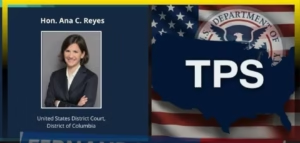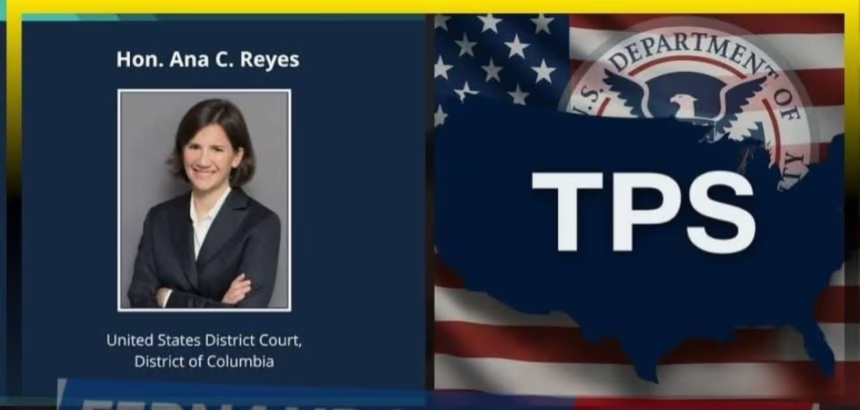
Judge Ana C. Reyes issued an order on Wednesday, January 29, 2026, rejecting the government’s motion for reconsideration and noting frustration with delays caused by both the government and the plaintiffs in the Temporary Protected Status case for Haitian nationals.
She noted the motion was moot since the administration answered the plaintiffs’ discovery questions before filing it.
“The Court does not understand why the Government submitted a nine-page motion to reconsider a directive the Government had already met,” Judge Reyes wrote in her order.
The judge stated that the government “has only itself to blame for drafting a motion that was moot from the start.”
The government’s motion claimed the January 28 order forced counsel to divert time from advancing discovery.
Judge Reyes rejected this complaint, calling it “misplaced.”
She noted that it took the government eight days to provide a hit report that can typically be generated in hours, if not minutes.
“Snow notwithstanding, the Court and its clerks have worked remotely through the weekend and this week on this matter. Presumably, Government counsel likewise had remote access to its computer systems,” the judge noted.
While the government was particularly targeted for its actions, Judge Reyes acknowledged that both the government and plaintiffs contributed to delays in the case, with the government responsible for slow document production and plaintiffs for filing broad discovery requests.
Due to these delays, the court will not have the benefit of any discovery materials before issuing its decision on the government’s motion to dismiss and the motion to stay.
“The Government’s concern seems to be the Court’s speed; the Court notes its concern is the parties’ lack of it,” the judge wrote. “In the future, the Court will move more slowly if the parties move faster.”
Limited Discovery Reaffirmed
The judge, however, sided with the government on one point: she has ordered—and repeatedly emphasized—narrow discovery. She noted that plaintiffs’ reliance on cases concerning overly broad searches was inappropriate, which should be obvious given the court’s repeated warnings regarding limited discovery.
Judge Reyes noted that in the past 24 hours, both the government and the plaintiffs have submitted three separate filings or correspondence regarding discovery, increasing the court’s workload as a critical deadline approaches.
She warned that if parties request a status conference the next day, all attorneys must appear in person—not by Zoom.
This order comes as Temporary Protected Status for Haitians is set to expire February 3, 2026—less than a week away.
Judge Reyes must issue her decision on the government’s motion to dismiss and on the plaintiffs’ request for emergency relief before that deadline.
Over 350,000 Haitian nationals, and possibly up to 560,000, could lose work authorization and deportation protection if the ruling is not in their favor.
Plaintiffs, represented in part by the ACLU, argue that the Trump administration’s termination of TPS was discriminatory. The judge plans to use President Trump’s CPAC speech, in which he said, “If I hadn’t been elected president, there’d be nobody left in Haiti,” as evidence.
Tension is rising at the Washington court as the February 3 deadline approaches.