



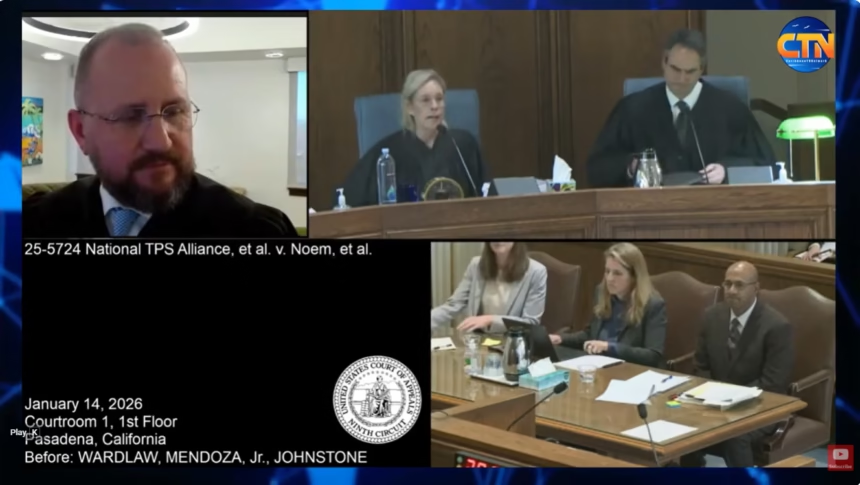
As the trial court judge in Washington, D.C., has just granted the federal government a three-day extension, the California court has also extended the deadline for the Trump administration to produce the required documents.
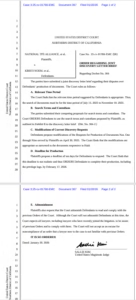
In an order issued Monday, January 20, 2026, Magistrate Judge Sallie Kim of the U.S. District Court for the Northern District of California ordered the federal government to produce all documents requested in the case National TPS Alliance v. Noem by February 17, 2026. This decision marks a new phase in the legal battle over Temporary Protected Status (TPS) for Haitian nationals in the United States.
Judge Kim’s order resolves several disputes between the parties regarding document production in the case challenging the Trump administration’s decision to terminate TPS for Haitian immigrants.
On the issue of search terms and document custodians, the court ruled in favor of the plaintiffs. The judge ordered defendants to use the search terms and custodians proposed by the plaintiffs, as outlined in Exhibit B of the joint discovery letter submitted to the court.
This ruling is significant because it potentially broadens the scope of documents the government must provide, allowing plaintiffs’ attorneys access to internal communications that could shed light on the decision-making process that led to the termination of Haitian TPS.
Defined Search Period
Regarding the relevant time period for the document search, however, the court accepted the government’s proposal. Judge Kim ordered that the document search cover the period from July 15, 2025, to November 19, 2025.
This timeframe is crucial because it encompasses the months leading up to the official announcement on November 28, 2025, of the decision not to renew TPS for Haitian nationals. Documents produced from this period could reveal internal deliberations and the factors that influenced the controversial decision.
The court also accepted the defendants’ proposed modifications to Requests for Production of Documents Nos. One through Nine, originally served by plaintiffs on April 30, 2025. Judge Kim found these modifications appropriate, provided they are limited to documents related to Haiti.
This clarification ensures that document production remains focused on Haitian TPS, avoiding a diversion of efforts toward other TPS designations that are also subject to legal challenges.
Plaintiffs had initially proposed a ten-day deadline for the government to produce the requested documents. Judge Kim rejected this proposal, deeming it unrealistic given the scope of the task.
The court therefore set the production deadline for February 17, 2026, giving the government nearly a month to gather and produce documents, including privilege logs identifying documents withheld on confidentiality grounds.
A Warning to Government Attorneys
In a notable section of her order, Judge Kim addressed the plaintiffs’ request that the court admonish defendants for failing to comply with previous court orders.
Although the court chose not to formally admonish defendants at this time, Judge Kim nonetheless issued a clear warning: “The Court expects all lawyers, including lawyers who have recently joined the litigation, to be aware of previous Orders and to comply with them.”
The magistrate added that the court “will not accept as an excuse for noncompliance of an order that a lawyer new to the case is not familiar with previous Orders.”
This warning reflects the procedural tensions that have marked this case and underscores the court’s importance of compliance with its rulings.
This order from the California court comes on the same day a crucial hearing was held in Washington, D.C., before Judge Ana C. Reyes in a parallel case concerning Haitian TPS.
In Washington, Judge Reyes granted the government an extension until January 23, 2026, to submit certain documents cited in the California case National TPS Alliance v. Noem that do not appear in the certified administrative record.
The two cases, though distinct, are closely linked. Judge Reyes’s order explicitly cites documents referenced in the California court’s decision, illustrating the coordination between the two jurisdictions in examining the legality of terminating Haitian TPS.
A Race Against Time
These legal developments come amid an atmosphere of absolute urgency for Haitian TPS beneficiaries. The status expiration date is set for February 3, 2026, less than two weeks after these orders are placed.
The February 17 deadline set by Judge Kim in California extends beyond this critical date, raising questions about the effectiveness of these discovery proceedings in influencing the immediate fate of TPS beneficiaries.
However, plaintiffs’ attorneys hope that the documents obtained will help demonstrate that the Trump administration’s decision was tainted by bad faith or improper political influence, thereby justifying a permanent injunction against terminating TPS.
More than 350,000 Haitian nationals currently hold TPS in the United States. Most of them have lived in the country for over a decade and have U.S. citizen children.
Massachusetts lawmakers, who gathered the same day in Mattapan to meet with the Haitian community, highlighted the potentially devastating consequences of ending TPS, particularly for the American healthcare system, which employs many Haitian TPS holders.
The legal battle continues on two fronts, with deadlines mounting and the countdown to February 3, 2026, ticking relentlessly forward.
https://ctninfo.com/?p=39498&preview=true

