


In January 2026, the futures of 350,000 Haitians hinge on three judges in Pasadena. Additional information is now available about the three judges who will preside over the pivotal Temporary Protected Status (TPS) hearing for Haitian immigrants, scheduled for January 15, 2026, at the Ninth Circuit Court of Appeals in Pasadena, California.
All three federal judges, each appointed by a Democratic president, will review the Trump administration’s appeal of a decision that prevented the reduction of TPS duration for Haitian nationals.
The panel consists of judges with distinguished legal careers, each bringing unique perspectives to the case.
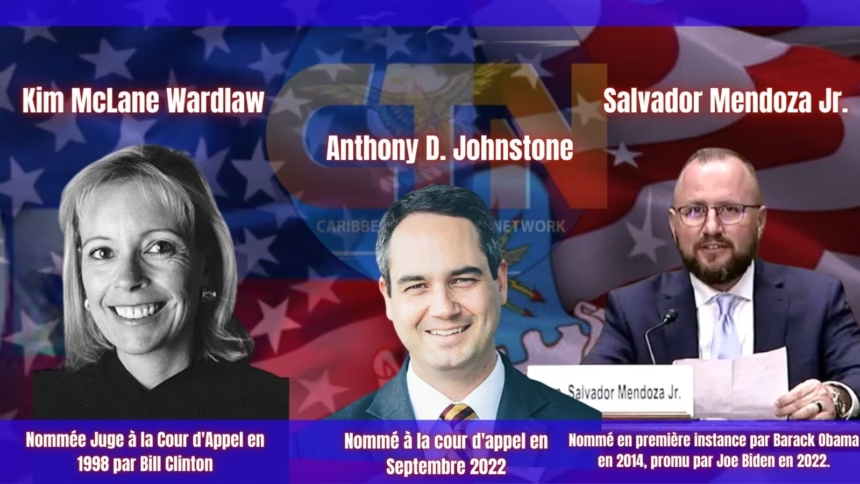
Kim McLane Wardlaw, often seen as a pivotal and experienced figure in the judiciary, was appointed to the Court of Appeals in 1998 by President Bill Clinton. At 71, she became the first Hispanic American woman appointed to a federal appeals court. During the Obama administration, she was shortlisted for a U.S. Supreme Court vacancy, reflecting her recognized legal expertise. She currently serves in Pasadena.

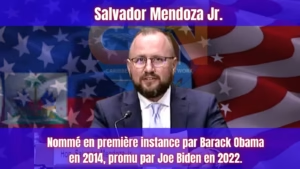
Salvador Mendoza Jr., 54, known for his comprehensive grasp of complex legal issues, was appointed to the district court in 2014 by President Barack Obama and elevated to the Ninth Circuit Court of Appeals by President Joe Biden in September 2022. His extensive experience at the district court level informs his understanding of appellate deference standards, which emphasize respect for trial-level findings. This background could provide him with unique insights into how trial court proceedings shape appellate review.
Anthony D. Johnstone, 53, the panel’s insightful and contemporary voice, was appointed by President Joe Biden. He brings a contemporary legal perspective and is recognized in legal circles as a meticulous and accomplished jurist.

What’s at Stake in the Hearing
As the February 3, 2026, expiration date for Haitian TPS looms, creating significant uncertainty for beneficiaries, the judges will review a September 2025 ruling by Judge Edward M. Chen, who also serves on the Ninth Circuit. Judge Chen overturned the Trump administration’s decision to reduce TPS duration for Haitians by six months, which would have significantly shortened protection for hundreds of thousands of Haitian nationals living legally in the United States. Following that decision, the federal government complied with Judge Chen’s order while appealing to the Ninth Circuit, leading to Wednesday’s hearing. The urgency of the deadline adds pressure to the proceedings, as the court’s decision will have a heavy impact on the Haitian community’s future.
The hearing will be held at the Ninth Circuit headquarters in Pasadena, California. The Ninth Circuit is the largest in the United States by geographic jurisdiction, covering nine states: Alaska, Arizona, California, Hawaii, Idaho, Montana, Nevada, Oregon, and Washington. It also has the largest population under its jurisdiction and handles the highest volume of immigration cases nationwide.
The Ninth Circuit has played a crucial role in immigration litigation, often issuing decisions with national impact. Its rulings on TPS and immigrant protection are frequently cited by other circuits.
Implications for the Haitian Community
This hearing is critically important for Haitian TPS beneficiaries.
Recent estimates indicate that several hundred thousand Haitian nationals live and work legally in the United States under TPS. An unfavorable decision could subject them to deportation to Haiti, which is currently experiencing a severe security and humanitarian crisis, including gang violence, institutional collapse, and ongoing political instability.
Attorneys for Haitian TPS beneficiaries argue that reducing the protection period violates established administrative procedures and fails to account for current conditions in Haiti. They assert that under the Administrative Procedure Act, such a reduction could be deemed ‘arbitrary and capricious,’ thus highlighting the need for a thorough consideration of the prevailing humanitarian concerns in Haiti. Government representatives assert that the administration has the legal authority to determine the duration of TPS.
The panel’s decision could set a precedent for other countries with TPS, extending its impact beyond the Haitian case. Legal observers will closely monitor the proceedings and the decision, which may be issued weeks or months after the hearing.
The appeals court judges are not required to meet the February 3, 2026, deadline, which marks the expiration of Temporary Protected Status for Haitian immigrants. Judge Ana C. Reyes cited an estimated 560,000 beneficiaries during the January 6-7 hearing, while the Federal Register recorded 350,000 Haitians with this status.