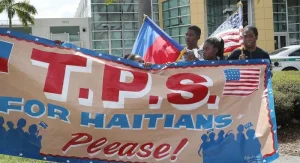


The Trump administration ended Temporary Protected Status (TPS) for people from 11 countries and stopped humanitarian parole for more than 530,000 individuals. Haitians and Venezuelans were most affected.
Since Donald Trump took office, more than 1.5 million immigrants have lost or are expected to lose temporary legal status, such as work permits and protection from deportation, because of changes to legal immigration programs, according to States Newsroom.
Experts say this is the fastest and largest loss of legal immigration status in recent U.S. history.
“I don’t think we’ve ever, as a country, seen this many people lose their immigration status at the same time,” said Julia Gelatt, associate director of the U.S. Immigration Policy Program at the Migration Policy Institute.
The Trump administration greatly reduced legal immigration by ending TPS for more than one million people and taking away humanitarian parole from another 530,000.
“We’ve never seen this many people lose legal status in U.S. history,” said David Bier, director of immigration studies at the Cato Institute. “This is entirely unprecedented.”
Before the Trump administration, more than 1.3 million immigrants from 17 countries had TPS protection. By the end of Trump’s first term, only about 400,000 immigrants were still covered. Homeland Security Secretary Kristi Noem ended TPS for people from 11 countries, putting over one million at risk of losing protection by February. The affected countries are Afghanistan, Myanmar, Cameroon, Ethiopia, Haiti, Honduras, Nepal, Nicaragua, South Sudan, Syria, and Venezuela.
Haiti and Venezuela: 935,000 people could lose protection
Nearly 935,000 of those losing TPS protections are from Haiti and Venezuela.
Venezuelans make up 605,000 of those affected. They first received TPS protections during the Trump administration, which gave them 18 months of protection from deportation on its last day in office in 2021 because of instability under President Nicolás Maduro.
Michael Clemens, an economics professor at George Mason University, estimates that taking away legal status from 935,000 Haitians and Venezuelans would shrink the U.S. economy by more than $14 billion.
During the Biden administration, almost 750,000 immigrants received humanitarian parole, which gave them temporary legal status and work permits. This was in response to Russia’s war in Ukraine and efforts to manage migration from Central America.
The Department of Homeland Security has decided to end humanitarian parole for 532,000 immigrants from Cuba, Haiti, Nicaragua, and Venezuela. This means they could now face removal proceedings.
“The barrage of attacks we’ve seen against temporary forms of immigration status—especially those with a humanitarian focus—is deeply troubling,” said Alice Barrett, supervising immigration attorney at the immigrant rights organization CASA.
However, the agency has kept humanitarian parole for 140,000 Ukrainians who came after Russia’s 2022 invasion and for 76,000 Afghans who were evacuated after the U.S. left Afghanistan.
Supreme Court Allows End of Protections to Move Forward
This is not the first time the Trump administration tried to end TPS. In 2018, courts blocked efforts to end TPS for immigrants from Haiti, Nicaragua, El Salvador, and Sudan.
This time, the legal situation is different, said Jose Palma, a TPS recipient from El Salvador and coordinator of the National TPS Alliance.
“The only difference now is that the Supreme Court is allowing the Trump administration to proceed with ending TPS, even when lower courts say, ‘No, we should pause the termination until it’s clear whether it’s legal,’” Palma said.
In September, U.S. District Judge Edward Chen in San Francisco ruled that Secretary Noem’s decision to end TPS for Venezuela and Haiti was unlawful and went beyond her authority. In October, the Supreme Court put that ruling on hold, allowing the terminations to proceed while appeals continue.
Most people who have lost status live in certain states. Florida has more than 400,000 TPS recipients, and Texas has nearly 150,000. Bier said industries like construction and health care, which depend on TPS holders, will likely be affected.
“Seeing more than a million people lose their work permits in one year is a huge event, with ripple effects for employers, communities, families, and the wider economy,” Gelatt said.
Immigrant advocacy groups and TPS recipients have filed many lawsuits, arguing that the terminations are unlawful.
“This is a continuation of the Trump administration’s attack on the immigrant community, and specifically on TPS—a program that, for many of us, has been a good program, a life-saving program,” Palma said.