


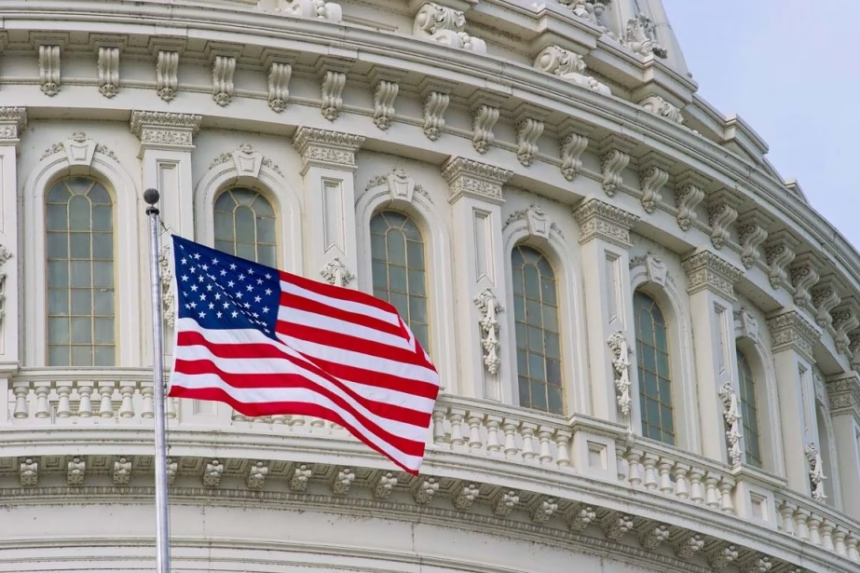
The US Congress has just taken a symbolically powerful step on the Haiti dossier. It has passed the “Haiti Criminal Collusion Transparency Act” as part of the massive National Defense Authorization Act.
The law explicitly targets the heart of the system that sustains violence in Haiti: the opaque links between armed gangs and the country’s political and economic elites.
The legislation, which now only awaits President Donald Trump’s signature to be enacted, could mark a turning point in the American approach, long criticized for its ineffectiveness. But its implementation is taking shape against a backdrop of extreme humanitarian chaos and raises formidable practical questions.
The Mechanism: Investigate, Identify, Sanction
Sponsored by Democratic Representative Gregory Meeks and Senator Jeanne Shaheen, with support from Florida Republican Senator Rick Scott, this law is the only major piece of Haiti-related legislation to emerge from Congress this year. Its principle is simple but ambitious: require the Secretary of State to submit to Congress, annually for five years, a comprehensive report on “the extent and nature of criminal collusion in Haiti.”

These reports must identify by name the principal gangs, their leaders, as well as government officials and businesspeople—current or former—who maintain “direct and significant ties” with them. They must also explain how these relationships are exploited for private purposes, detailing the mechanisms of financing, arming, and profiting. Beyond simple “naming and shaming,” the law provides for the imposition of targeted economic sanctions (asset freezes, visa bans) against individuals found guilty of supporting gang activities.
“There will be no progress in resolving the gang-fueled crisis in Haiti without dealing a hard blow to the accomplices of these violent gangs,” Gregory Meeks stated. His objective is clear: “to help Haitians fight against the gangs, as well as against the corrupt networks that finance, arm, and profit from the current instability.”
The law arrives in a country on the brink of collapse. Since the assassination of President Jovenel Moïse in July 2021, more than 16,000 people have perished in gang-related violence, with gangs controlling up to 90% of the capital, Port-au-Prince, and extending their grip to the provinces, choking the economy and paralyzing humanitarian aid.
The enthusiasm of the law’s promoters is tempered, however, by serious obstacles. The first is budgetary: to ensure bipartisan adoption, the legislation provides no new funding. Yet in recent years, the State Department has reduced staff at its Port-au-Prince embassy for security reasons, and the Drug Enforcement Administration (DEA), the lead agency for criminal investigations, has outright closed its Haiti office.
“All of this raises questions as to how US officials will fulfill their new mandate,” the report analyzes. Will the required reports be the result of “independent and rigorous investigations” or will they rely on “secondhand and unverified allegations”? These concerns are not theoretical. In recent months, several Haitian businesspeople have had their visas revoked without explanation, and two economic figures, Pierre Reginald Boulos and Dimitri Vorbe, are currently detained in Florida on immigration-related charges, with authorities accusing them of gang links without having yet produced public evidence.

Political Risk: A Door Left Open to Gangs
Another major pitfall is political. While the United States is pushing for a political transition, a new electoral law, drafted under American pressure, contains no morality clause and does not recognize bilateral sanctions. It therefore opens the door for individuals sanctioned by Washington for alleged gang ties to legally run for office and potentially join a future government, the Florida newspaper notes.
Moreover, the consistency of US policy is questioned. While this new law intends to fight the root causes of violence justifying exile, the Department of Homeland Security has announced the end of Temporary Protected Status (TPS) for Haitians in the United States starting February 3, 2026. A decision denounced by organizations like Faith in Action International, which believes that the “persistently high level of violence” makes any return dangerous and counterproductive.
The law is also the result of intense mobilization by the Haitian diaspora, led notably by Pastor Gregory Toussaint of North Miami. His petition launched in 2023, demanding that complicit elites “be held accountable,” garnered more than 110,000 signatures and organized rallies across the United States, Haiti, Canada, and France. Faith in Action International hailed the law’s passage, seeing it as an essential step to “establish the truth about the real causes of violence” and “offer a glimmer of hope.”
The passage of this law undeniably constitutes a strong political signal. For the first time, Congress explicitly mandates the executive to address not just the gangs themselves, but their financial and political ecosystem. It acknowledges a recognition: violence in Haiti is not a spontaneous social crisis, but the product of organized criminal collusion.
https://ctninfo.com/?p=38865&preview=true
https://www.facebook.com/CaribbeanNewsMedia
Based on information from the Miami Herald

