


International mobilization to restore security in Haiti is accelerating significantly.
According to reports from the Miami Herald, Latin Times, and Reuters, several countries from Africa and Asia have confirmed in recent days the deployment of soldiers, police officers, and technical teams to strengthen the international mission supported by the United States. These contributions bring the operation closer to the objective set by the UN Security Council: achieving a total contingent of 5,500 members.
For months, progress had been uneven, hampered by logistical difficulties, internal political uncertainties, and concerns about risks on the Haitian terrain. However, a recent meeting bringing together several contributing states shifted momentum, producing a series of new commitments.
Chad surprised observers by offering to deploy 1,500 soldiers—a notable commitment for a country facing its own security challenges, according to the Miami Herald. This announcement was followed by confirmations of participation from Sierra Leone, Burkina Faso, Gambia, and Burundi, which plan to join the mission.

Bangladesh, known for its historical role in UN peacekeeping operations, has proposed adding 1,500 police officers. These units could contribute to securing Haiti’s land and maritime borders, a crucial component as the country confronts intensifying weapons smuggling and clandestine movement.
Active presence already on the ground
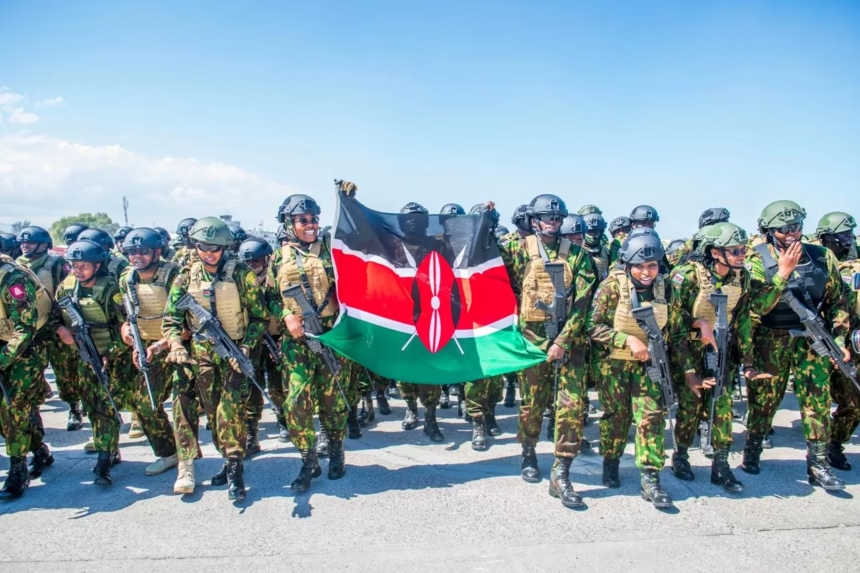
The most visible component remains Kenya, which leads the mission. Approximately 700 Kenyan police officers are already deployed in Haiti, with new reinforcements arriving this week, according to Latin Times. According to force spokesperson Jack Ombaka, the international presence now approaches 1,000 personnel—a figure still short of the final objective but showing continuous progress.
Countries from Central America and the Caribbean, including Jamaica, Belize, Guatemala, the Bahamas, and El Salvador, have also confirmed the deployment of additional personnel. For mission officials, these regional reinforcements are essential, as several of these states possess experience combating transnational criminal organizations.
To structure the overall effort, the mission appointed a new special representative this month: Jack Christofides, a UN expert with an extensive track record in peacebuilding and complex crisis management. Mission Commander Godfrey Otunge, quoted by Latin Times, assessed that Christofides “brings experience in political affairs, peacebuilding, and operational leadership, which will be essential to guide the efforts of the GSF in responding to Haiti’s security crisis and laying the foundations for lasting peace.”
This appointment responds to recurring criticism regarding lack of coherence and coordination among different national contingents.

A strong political signal
The joint contributions from Chad and Bangladesh represent not only one of the most significant commitments since the mission’s creation but also send a clear message: Haiti’s crisis is no longer perceived as a strictly regional problem but as a matter of international security requiring a global response.
This reinforced support comes as gangs continue controlling densely populated neighborhoods, strategic thoroughfares, and several ports. The country has more than one million internally displaced persons, while public institutions barely function.
According to experts consulted by various international media outlets, the arrival of new troops could enable expansion of secured zones, reopening of humanitarian corridors, and support for Haiti’s National Police, whose capacities are severely limited.
Despite diplomatic and military momentum, full deployment remains complex. Transportation, financing, troop accommodation, and operational coordination require heavy logistics and close cooperation among each contributing state. Several announced commitments have yet to be formalized.
However, the proliferation of offers of support marks a turning point. It reflects renewed international attention to a crisis long feared for its potential to become protracted and resistant to resolution.
The expanding international coalition signals recognition that Haiti’s stability affects regional and global security interests. As contributions materialize and coordination improves, officials hope the combined force can achieve meaningful progress in dismantling gang networks, restoring governmental authority, and creating conditions for genuine long-term recovery.