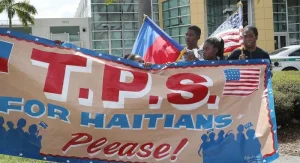



The federal court in Massachusetts will review one of the most significant immigration cases of 2025.
Haitian Americans United Inc. v. Trump (1:25-CV-10498) will be heard by the U.S. District Court for the District of Massachusetts, generating significant concern among Haitian and Venezuelan communities nationwide.
Filed on March 3, 2025, the lawsuit directly challenges President Donald J. Trump, the Department of Homeland Security (DHS), and Secretary Kristi Noem. A coalition of community organizations and immigrant rights advocates, including Haitian Americans United Inc., the Venezuelan Association of Massachusetts, the UndocuBlack Network, Inc., and several individuals, brought the case. The complaint was amended after the Trump administration ended Temporary Protected Status (TPS) for Haitians in November.
The litigation centers on the Trump administration’s decision to end TPS for thousands of Haitian and Venezuelan nationals, many of whom have legally resided in the United States for over a decade.
Plaintiffs argue that the decision was not based on an objective assessment of humanitarian conditions, but instead on discriminatory factors.
The complaint alleges that the TPS termination was motivated by racial and xenophobic bias, particularly influenced by President Trump’s public statements about immigrants from Haiti and Venezuela. Plaintiffs claim these views led to policy decisions that violate the equal protection principles of the Fifth Amendment.
Alleged violations of the Administrative Procedure Act
Plaintiff organizations also allege violations of the Administrative Procedure Act (APA), which requires government decisions to be based on factual and unbiased evidence. They assert the administration ignored critical data on insecurity, humanitarian crises, and socioeconomic conditions in Haiti and Venezuela.
The APA requires federal agencies to justify decisions with rational reasoning. Plaintiffs argue that the TPS termination is arbitrary, politically motivated, and lacks legal basis.
In their motion, the Haitian, Venezuelan, and Afro-descendant organizations request an injunction to prevent the federal government from ending TPS. They stress that ending TPS would put tens of thousands of families at risk of expulsion, job loss, and immediate hardship.
Plaintiffs’ attorneys argue that without court intervention, TPS recipients could be forced to return to countries facing severe economic, security, or political crises.
An ongoing legal process
Since March 2025, the case has moved through several procedural stages, including discovery and motions from both parties. The focus is on internal government communications that may clarify the reasons for the TPS termination.
The upcoming hearing may be pivotal, as the judge could choose to uphold or temporarily suspend the Trump administration’s decision pending a full trial.
For the organizations involved, this legal battle goes beyond administrative procedure. They view it as a fight for justice against what they call “arbitrary, discriminatory, and illegal” policies, and hope the federal judiciary will affirm that immigration decisions must respect constitutional principles and remain free from prejudice.
Community mobilization ahead of the hearing
In the days before the hearing, Massachusetts’s Haitian community, one of the largest in the country, is preparing for sustained mobilization. Immigrant rights advocates note that the outcome could have national implications and shape the legal framework for TPS protections going forward.
The decision could significantly impact the legal status of more than 500,000 Haitian and 560,000 Venezuelan nationals currently protected by TPS.
Beyond these immediate effects, the ruling may set a precedent for how courts review immigration policies based on discriminatory intent, influencing protections for future vulnerable groups.