



An Immigration and Customs Enforcement (ICE) operation in Vancouver, Washington, has sparked a wave of national outrage.
According to reporting by The New Republic, an immigrant with no criminal record, Wilmer Toledo-Martinez, was violently attacked by an assault dog while standing outside his home on November 14.
Democratic Senator Patty Murray has characterized the use of force as grossly excessive and demanded accountability. She is now calling for the immediate release of the father, who remains in custody despite his injuries.
A federal agent’s deception leads to brutal assault

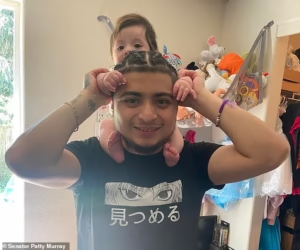
Toledo-Martinez has lived in the United States since adolescence. His wife and their three young children—ages 2, 3, and 7, all U.S. citizens—depend on him.
On the morning in question, a federal agent posing as a construction worker knocked on his door, claiming he had accidentally struck his vehicle. According to The New Republic, the man was actually an undercover ICE agent.
When Toledo-Martinez stepped outside to inspect his vehicle, he provided his name. As he turned to walk back toward his house to retrieve insurance documents, a second federal agent allegedly released an assault dog. The animal allegedly lunged at him and bit him repeatedly, causing significant injuries visible in photographs shared by Senator Murray. His two youngest children reportedly witnessed the attack helplessly.
Video shows man restrained with dog held upon him
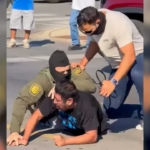
According to The New Republic’s reporting, video footage recorded minutes after the attack shows Toledo-Martinez lying on the ground, handcuffed, while an agent restrains the dog that had just attacked him.

Another officer, wearing a safety vest, asked for his name again before leading him to an official vehicle.
His attorney, Olia Catala, contends that agents refused to provide immediate medical care despite the apparent severity of his injuries. During an appearance on The Don Lemon Show, she reported that her client had to plead to be taken to the hospital. She also cited a statement allegedly made by one of the agents.
“This should trouble every American’s conscience”: Senator Murray condemns attack
In a strongly worded statement, Senator Murray has called for a thorough investigation. She maintains that the incident is incompatible with fundamental principles of the rule of law. “This should trouble the conscience of every single one of us,” Senator Murray stated, adding: “I refuse to live in a country where federal agents can unleash assault dogs on peaceful residents without accountability.”
The senator is also demanding an end to Toledo-Martinez’s detention. “I am calling for his immediate release from the NWIPC facility. He has no criminal record, poses no threat to the community, and requires urgent medical care—care that ICE continues to deny him.”
Detained despite injuries
Following the attack, Toledo-Martinez was transferred to the Northwest ICE Processing Center in Tacoma, where he remains incarcerated. According to his attorney, he suffers from injuries requiring specialized medical follow-up.
For human rights advocates, it is incomprehensible that an immigrant with no criminal record, unarmed, would be attacked by a dog and then placed in prolonged detention.
The incident raises urgent questions about federal intervention protocols, particularly the use of assault dogs in operations targeting non-violent individuals.
The incident reignites debate over ICE tactics
Under the Trump administration, ICE operations have intensified across multiple states, with increased deployment of K9 units. Civil rights organizations are condemning what they characterize as an escalation in the use of force, particularly during arrests in residential neighborhoods.
For Senator Murray, this case exemplifies a troubling trend. “We cannot tolerate an America where dehumanizing practices become the norm.”
When contacted by The New Republic, ICE did not provide detailed explanations regarding the justification for using an assault dog in an operation that resulted in the arrest of a father with no criminal history.