

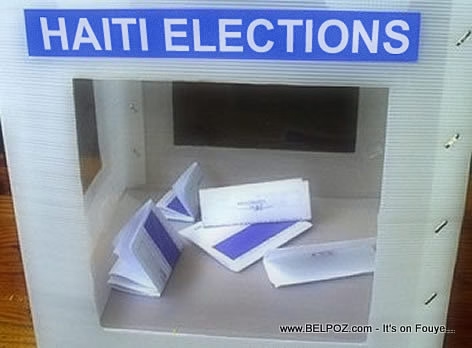
For the first time in nearly a decade, Haiti has an electoral calendar. The Provisional Electoral Council (CEP) has set August 30, 2026, as the date for the first round of presidential and legislative elections. However, this announcement, welcomed by the international community, comes with crucial preconditions, including territorial security—a major challenge in a country plagued by gang violence.
The CEP officially submitted the draft electoral decree and detailed calendar to the Presidential Transitional Council on Friday, November 14, 2025. This is the first time since the contested 2015 elections that concrete dates have been proposed for an electoral competition in Haiti.
According to this calendar, the first round of legislative and presidential elections is scheduled for August 30, 2026. The second round, which will also include local government elections, is set for December 6, 2026.
The campaign period for the first round will run from March 15 to August 29, 2026, while final results from the first round will be published on October 3, 2026. The country is expected to have newly elected leaders sworn in around January 20, 2027.
Essential Prerequisites: Security, Finances, and Timelines
In a statement released concurrently with the document submission, the CEP immediately tempered enthusiasm by conditioning implementation of this calendar on meeting “certain prerequisites.” The electoral institution emphasized four essential points: the prompt publication of the electoral decree, a secure environment, the availability of necessary financial resources, and the continuity of actions initiated by the CEP.
This last point underscores the operational challenge. The distribution of electoral materials, scheduled from August 12 to 28, 2026, presents a major logistical and security challenge. Indeed, most municipalities in the West and Artibonite departments, which account for over 60% of the electorate, are under total or partial control of criminal armed groups.
Despite these challenges, the announcement was welcomed by the international community, which has been pushing for months for a ballot-box solution to the crisis. The U.S. Embassy in Haiti issued an official statement to “commend recent progress.”
Ambassador Dennis Hankins emphasized that “Haiti’s future belongs to Haitians themselves,” while congratulating authorities on these initial steps. Washington expressed its expectation to see an “ambitious and realistic” timeline published quickly, calling it “essential to provide the necessary momentum” for organizing the vote. The United States reaffirmed its support for Haitian forces in restoring security and stable governance.
A Fragile Prospect
The publication of this calendar marks a symbolically significant step in Haiti’s ongoing political crisis. It offers prospects for a return to constitutional order. However, the road to the ballot box in 2026 promises to be long and obstacle-strewn. The state’s ability to restore minimum security, unlock necessary funds, and maintain political momentum will be scrutinized at every stage. For many Haitians, the date of August 30, 2026, remains a distant projection, contingent on the authorities’ capacity to create conditions that simply allow the people to vote.